Best Homebot Alternatives for Mortgage Pros in 2026

For mortgage professionals who need more than homeowner equity digests, Loan Officer AI is the strongest single pick: it combines predictive borrower scoring, real-time LOS integration, and automated follow-up in one CRM built specifically for loan officers. If your goal is pipeline growth rather than retention alone, a CRM-first platform will outperform a homeowner-dashboard tool every time.
Here is the shortlist at a glance:
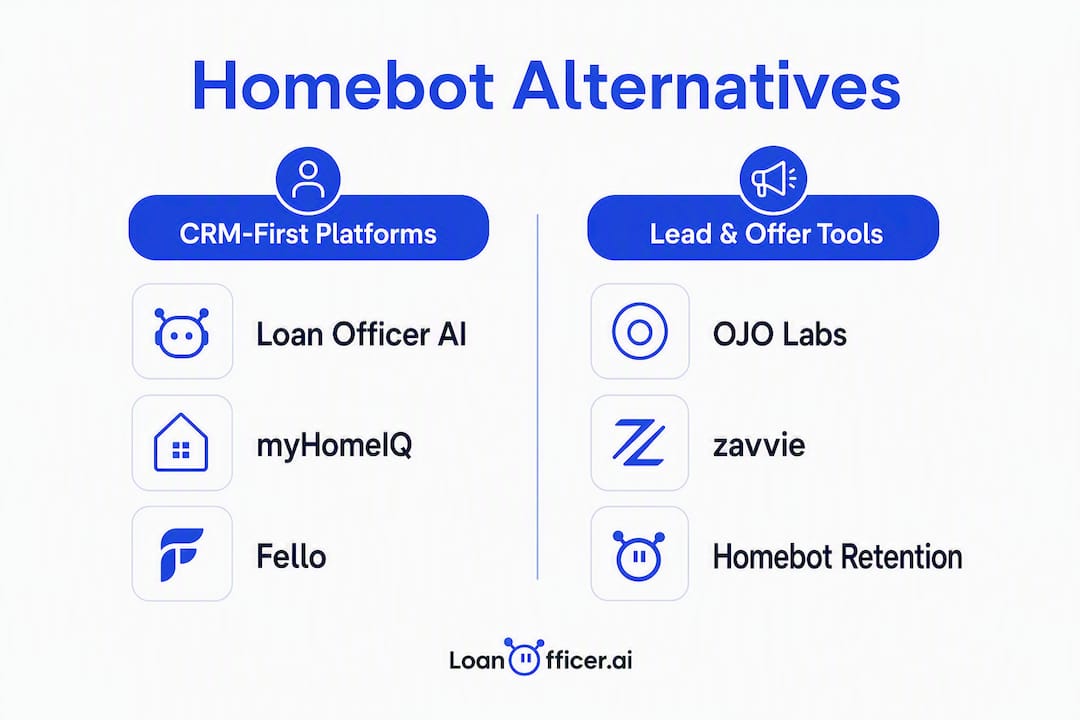
- Loan Officer AI — Best for loan officers and teams who want predictive equity signals, LOS sync, and automated multi-channel follow-up in one place
- Fello — Best for database reactivation and seller identification using proprietary intent data
- myHomeIQ — Best for agents and LOs who want a single platform to replace a fragmented tech stack
- OJO Labs — Best for AI-driven buyer and seller matching with referral network features
- zavvie — Best for agents focused on cash offer and iBuyer transaction facilitation
- Homebot (keep it if…) — Worth retaining as a retention supplement if you already have 100+ past clients and a separate CRM that handles pipeline actions
One practical note: Homebot’s Starter plan is designed for smaller client lists, priced at approximately $125 per month for up to 100 clients, while the Pro tier supports larger databases, at around $225 per month for up to 500 clients. Add-on pricing is available for higher contact caps. If you are under that contact threshold and purely focused on keeping past clients warm, a dashboard-only tool still has a place. Once you need pipeline tracking, task automation, or top-of-funnel lead capture, you need something else.
Table of Contents
- How the Top Homebot Alternatives Compare
- Detailed Profiles: What Each Platform Actually Does
- How to Choose the Right Alternative and Migrate Off Homebot
- Why Integrated CRM + Predictive Signals Outperform Dashboard-Only Tools
- Key Takeaways
- The Case for CRM-First: A Practical Perspective
- Loan Officer AI Fills the Gaps Homebot Leaves Open
- Sources and Further Reading
How the Top Homebot Alternatives Compare
| Platform | Best for | Core capabilities | Key integrations | Lead gen vs. retention | Pricing signal | Onboarding |
|---|---|---|---|---|---|---|
| Loan Officer AI | LOs, teams, brokerages | AI CRM + predictive scoring + LOS sync + automated campaigns | Encompass, Calyx, MLS data, Zapier, API | Both: lead capture + SOI retention | Paid subscription; trial available | Guided onboarding; data import support |
| Fello | Database reactivation | Seller intent scoring + automated marketing + CRM sync | Top CRMs; MLS-connected | Lead gen from existing database | Not publicly listed; demo required | CRM sync-based; relatively fast setup |
| myHomeIQ | Agents + LOs replacing fragmented stacks | Predictive intelligence + branded reports + agent referral tools | CRM integrations; MLS data | Both: pipeline + retention | Not publicly listed; demo required | Replaces multiple tools; migration support claimed |
| OJO Labs | Buyer/seller matching + referral networks | AI-matched leads + conversation AI + agent network | CRM sync; portal integrations | Lead gen primary | Not publicly listed | Managed onboarding |
| zavvie | Cash offer / iBuyer facilitation | Offer comparison tools + seller pipeline | MLS; brokerage integrations | Lead gen (seller-focused) | Not publicly listed | Brokerage-level setup |
| Homebot | Past-client retention only | Homeowner equity digests + Partner Intel signals | Limited CRM sync; Ylopo native integration | Retention only | moderate monthly cost | Fast; no pipeline migration needed |
A few things worth flagging immediately:
- Loan Officer AI is the only option on this list with a publicly signaled trial offer, which matters when you are evaluating time-to-value before committing.
- Fello uses proprietary data to identify who is ready to transact and automates personalized marketing against that signal, making it a strong complement to any existing CRM.
- myHomeIQ explicitly positions itself as a replacement for 8–12 disconnected apps, which is a meaningful claim for teams drowning in tool sprawl.
- Homebot’s AVM pulls from Altos Research market data. That is useful context during any migration: AVM values should be spot-checked against MLS actuals before you rely on them for client conversations.
Detailed Profiles: What Each Platform Actually Does
Loan Officer AI
Loan Officer AI is a mortgage-specific AI CRM that goes well beyond homeowner digests. The platform handles automated lead response, multi-channel follow-up campaigns, database mining for refinance and HELOC opportunities, real-time property and equity analytics, and pipeline management. It connects directly to major LOS platforms including Encompass and Calyx, which means contact records and loan status stay current without manual CSV exports.

Pros: Full CRM functionality plus predictive scoring in one platform; LOS sync eliminates data silos; smart dialer and mobile app included.
Cons: More platform than a solo LO with a tiny database needs on day one; the full feature set has a learning curve.
Best for: Independent loan officers scaling past 200 contacts, small-to-mid mortgage teams, and brokerages that need enterprise-level reporting alongside automated client engagement.
Pricing: Paid subscription with monthly and annual plans; a trial is available. Onboarding fee may apply for data migration.
Integrations: Encompass, Calyx, Zapier, API access, MLS/property data feeds, email and SMS automation.
Fello
Fello targets the database reactivation problem directly. Its proprietary scoring identifies which contacts in your existing book are most likely to transact soon, then automates personalized marketing to those contacts before they raise their hand elsewhere. CRM sync keeps data unified rather than creating a parallel silo.

Pros: Strong seller intent scoring; automated marketing runs without manual input; CRM-connected.
Cons: Pricing is not publicly listed, so budget planning requires a sales call; less suited to top-of-funnel cold lead capture.
Best for: Agents and LOs with a database of 500+ contacts who want to mine it for near-term transactions without adding manual outreach.
myHomeIQ
myHomeIQ pitches itself as the platform that replaces your fragmented stack. It combines predictive intelligence, branded homeowner reports, and agent referral tools in a single interface. The positioning is direct: stop juggling disconnected apps and let one system handle what your CRM misses.
Pros: Broad feature coverage; agent referral network built in; branded client-facing reports.
Cons: Pricing not publicly listed; replacing multiple tools at once means a longer evaluation period before you can validate ROI.
Best for: LOs who want to consolidate tools and strengthen agent partnerships simultaneously.
OJO Labs
OJO Labs leads with AI-driven buyer and seller matching, connecting consumers to agents and LOs through a conversation AI layer. Its referral network model means you can receive matched leads rather than generating them from scratch.
Pros: Qualified lead matching; AI conversation layer handles early-stage nurture.
Cons: Less control over lead quality than an owned database strategy; pricing and availability details require direct contact.
Best for: Agents and LOs who want an inbound lead channel alongside their existing retention tools.
zavvie
zavvie focuses specifically on cash offer and iBuyer facilitation, giving agents a way to present multiple offer options to sellers in one place. It is not a CRM and does not replace one. Think of it as a transaction-facilitation layer for seller-focused agents.
Pros: Unique positioning in the cash offer space; useful for agents in competitive seller markets.
Cons: Narrow use case; no borrower engagement or LOS integration; not relevant for mortgage-only teams.
Best for: Real estate agents in markets where cash offers and iBuyer options are a meaningful part of the conversation.
Homebot (when to keep it)
Homebot delivers personalized equity digests with open rates that consistently outperform generic drip campaigns, and its Partner Intel feature surfaces behavioral intent signals when homeowners start researching their options. That is genuinely valuable for retention. The honest limitation, confirmed across multiple independent reviews, is that Homebot is not a CRM and was never designed to be one. It has no pipeline tracking, no task automation, and no meaningful lead management layer.
Best for: LOs with an established book of 100+ past clients who already have a separate CRM and want to add a retention layer on top.
How to Choose the Right Alternative and Migrate Off Homebot
Matching the platform to your situation
Start with three questions before you book a single demo:
- What is your database size? Under 100 contacts, a homeowner-dashboard tool may still be your best retention spend. Over 200 contacts with active pipeline, you need CRM-first.
- Do you need LOS integration? If you are manually exporting CSVs to keep contact records current, real-time LOS sync is not optional at scale. It eliminates hours of weekly admin and keeps predictive signals accurate.
- Are you a solo LO, a team, or a brokerage? Solo operators need fast time-to-value and simple onboarding. Teams need shared pipeline visibility. Brokerages need reporting, compliance controls, and multi-user management.
Questions to ask vendors during demos
- What data sources power your AVM or equity estimates, and how often do they refresh?
- How does your predictive model validate seller or refinance intent? Can you show a confusion matrix or accuracy benchmark?
- What LOS platforms do you integrate with natively, and is the sync bi-directional?
- What are your API rate limits, and do you support Zapier for custom workflow triggers?
- What does onboarding include: dedicated support, data import service, or self-serve only?
- What is your SLA for support tickets?
Migration checklist
- Audit your current data. Pull a full contact export from Homebot and identify duplicates, missing fields, and stale records before you touch a new platform.
- Map your fields. Match Homebot contact fields (name, address, loan date, equity estimate) to the destination CRM’s schema. Note any custom fields that need manual mapping.
- Export from Homebot. Download your contact list as a CSV. Note that Homebot’s AVM values use Altos Research data; validate any outlier valuations against MLS actuals before importing them as ground truth.
- Run a test import. Import a sample of 50–100 records into the new platform and verify field mapping, AVM values, and contact deduplication before the full load.
- QA predictive signals. After full import, spot-check that equity and intent scores are populating correctly for a known set of contacts.
- Stage your rollout. Activate automated campaigns for a pilot segment first. Measure open rates, response rates, and lead-to-contact conversion over 30 days before expanding.
Red flags to watch for:
- No native LOS integration (CSV-only sync is a scaling dead end)
- One-way data sync that does not write back to your LOS
- Predictive models with no documented data sources or accuracy validation
- Onboarding that is entirely self-serve with no human support option
Pro Tip:Before migrating, build a simple playbook that maps each intent signal to a specific CRM task. An alert without a next action assigned to a human or automation is a lead that will go cold.
Why Integrated CRM + Predictive Signals Outperform Dashboard-Only Tools
The gap between a homeowner-dashboard tool and a CRM-first platform is not a feature gap. It is an operational gap.
Behavioral intent alerts only create revenue when they trigger an immediate action. A homeowner opening their equity digest for the third time in a week is a signal. But if that signal lands in an inbox with no CRM task, no automated SMS, and no call assignment, the moment passes. This is what practitioners call the “automation paradox”: the alert exists, but the infrastructure to act on it does not. The lead goes to whoever calls first, and that is often a competitor.
Real-time, bi-directional LOS integration addresses the data side of this problem. Moving away from manual CSV uploads to live LOS sync eliminates hours of weekly admin and standardizes contact data across every system that touches the loan. Standardized data is what makes predictive scoring reliable. When equity estimates, loan dates, and contact activity are all current, the model can actually identify who is likely to refinance or sell in the next 90 days. When the data is stale, the model is guessing.
A sourced insight worth internalizing: industry guidance consistently frames data integrity as the quiet engine of high-producing teams. Switching from manual CSV workflows to real-time LOS sync is the single infrastructure change that makes predictive performance consistent at scale.
Homebot is genuinely good at what it does. Its personalized homeowner digests produce open rates that outperform standard drip campaigns, and the Partner Intel signals are real. The limitation is that Homebot was built to surface intent, not to act on it. Acting on it requires a CRM with triggers, tasks, and automation. That is the gap the alternatives on this list are designed to fill.
Pro Tip:After migrating to a CRM-first platform, track three KPIs for the first 60 days: contact activation rate (what percentage of your database received at least one automated touchpoint), time-to-first-contact after an intent signal fires, and lead-to-funded-loan conversion rate. These three numbers will tell you whether the migration is producing ROI faster than any dashboard metric will.
Key Takeaways
For mortgage professionals evaluating Homebot alternatives, the clearest finding is this: CRM-first platforms with real-time LOS sync and predictive scoring consistently outperform homeowner-dashboard-only tools for teams focused on pipeline growth, not just retention.
| Point | Details |
|---|---|
| Homebot is a retention tool, not a CRM | It surfaces intent signals but lacks pipeline tracking, task automation, and lead management. |
| LOS integration is a gating criterion | Real-time bi-directional sync eliminates manual admin and keeps predictive models accurate at scale. |
| Intent signals require operational infrastructure | An alert without a CRM task or automated follow-up assigned loses the lead at peak conversion likelihood. |
| Match platform to database size and team structure | Under 100 contacts, a dashboard tool may still fit; over 200 with active pipeline, switch to CRM-first. |
| Loan Officer AI covers the full stack | It combines predictive equity scoring, LOS integrations, automated campaigns, and pipeline management in one platform built for mortgage pros. |
The Case for CRM-First: A Practical Perspective
The conventional wisdom in mortgage tech is that you layer tools: a CRM for pipeline, a homeowner dashboard for retention, a dialer for outreach, a separate email platform for campaigns. That stack made sense when no single platform did all of it well. It makes less sense now.
What I keep seeing in teams that actually convert intent signals into funded loans is not a better dashboard. It is a tighter feedback loop between the signal and the action. The moment a contact’s equity crosses a threshold or their browsing behavior flags seller intent, a task fires, a text goes out, and a call gets scheduled. That sequence happens in seconds, not days. The teams doing this are not running four tools. They are running one platform that handles all of it.
The argument for keeping Homebot alongside a CRM is real for a specific profile: a high-volume LO with 500+ past clients, a dedicated assistant to manage follow-up, and a CRM already handling pipeline. In that setup, Homebot’s open rates and equity digests add genuine retention value. For everyone else, the overhead of managing two systems and manually bridging the gap between a signal and a CRM task is where leads die.
The migration is not as painful as it sounds. A clean data audit, a mapped field schema, and a 30-day pilot segment will tell you within a month whether the new platform is producing. The teams that stall are the ones that try to migrate everything at once and measure nothing. Start small, measure the three KPIs that matter (contact activation, time-to-first-contact, lead-to-funded conversion), and expand from there.
Loan Officer AI Fills the Gaps Homebot Leaves Open
Most Homebot alternatives solve one piece of the puzzle. Loan Officer AI solves the whole thing. Where Homebot surfaces equity signals and stops, Loan Officer AI picks up with automated SMS and email follow-up, a smart dialer, pipeline tracking, and direct LOS integration that keeps every contact record current without manual work.
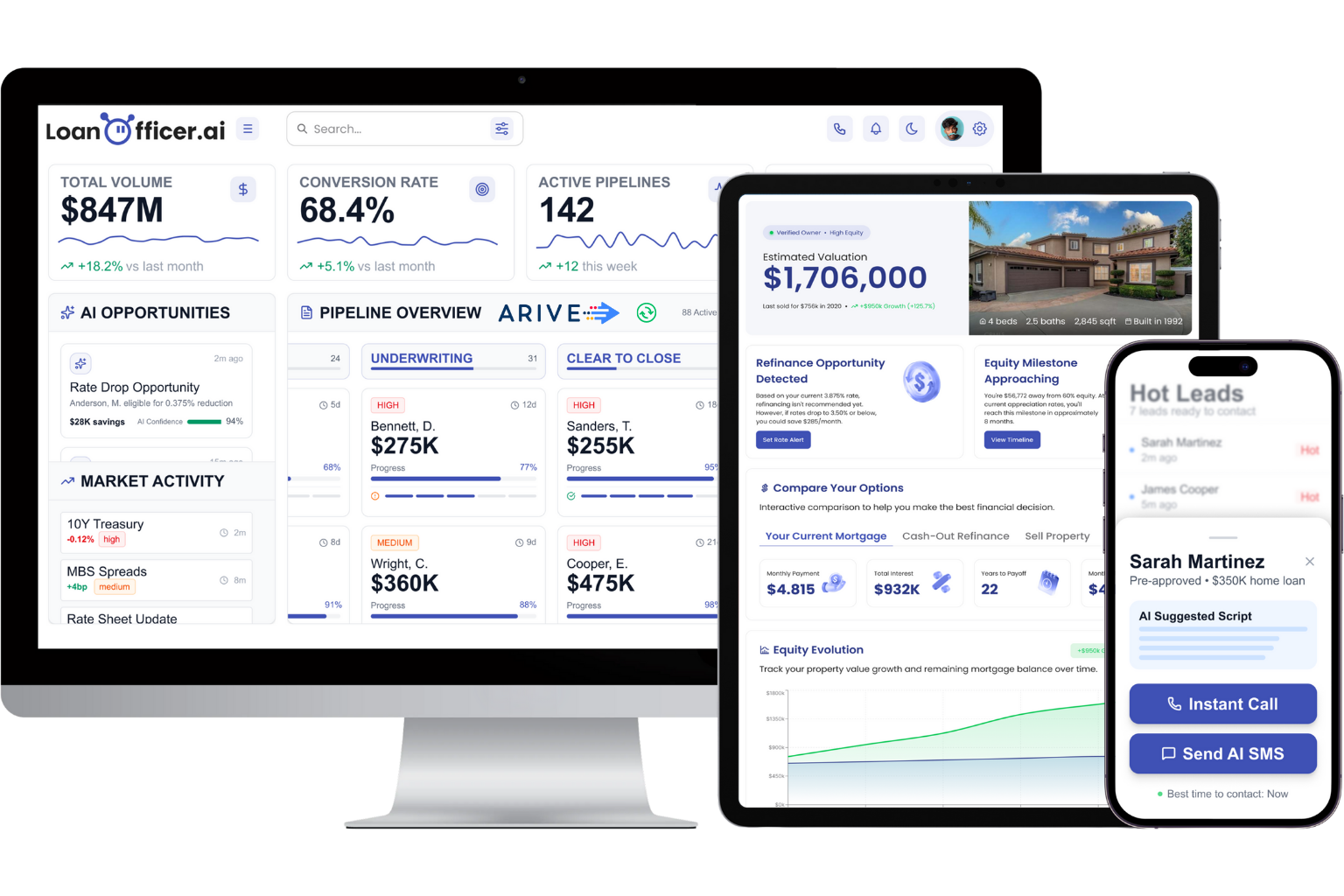
For independent loan officers who want to stop stitching together tools, and for brokerages that need enterprise reporting alongside automated client engagement, the platform covers retention and lead capture in one place. The reported 93% partner retention rate reflects what happens when follow-up is automated and no intent signal falls through the cracks.
Loan Officer AI includes guided onboarding with data import support from Friendly Financial Group, so the migration from a homeowner-dashboard tool does not require a technical team. You can start a trial to test the platform against your actual database before committing to a full migration.
Sources and Further Reading
- Homebot Review 2026: Honest Analysis for Mortgage Loan Officers — LeadPops; covers retention positioning, intent signals, and platform limits
- Homebot Review 2026: Should Your Team Use It? — The Key Report; open rate data and retention value analysis
- Homebot Review 2026: $25/mo Sales, Pros, Cons & Verdict — AI Productivity; CRM comparison and category positioning
- Homebot Review 2026: New Pricing, AI Features, Verdict — AI Tools Bakery; pricing tiers and AVM data sourcing
- HubSpot Mortgage Data Solution: Connecting Encompass, CRM, and Marketing — Proven ROI; LOS integration and data integrity guidance
- Fello Mortgage: Grow Your Mortgage Business on Autopilot — Fello product overview
- myHomeIQ: Generate Mortgage Leads & Close More Loans — myHomeIQ product overview
- Loan Officer AI: AI-Powered CRM for Mortgage Pros — platform overview and feature detail
- Best Mortgage CRM 2026: 7 Top Platforms Ranked — broader CRM comparison for context
