No New Leads: AI Realtor Database Mining for Loan Officers
Realtor database mining turns your existing CRM records, AVM valuations, and engagement signals into a ranked call list of refinance and HELOC ready homeowners. The output is a prioritized queue, not a guess. Run a rate gap and equity filter against your current book today, then push the top segment into a rate watch campaign so you’re calling the borrowers most likely to say yes first.
TL;DR:
- Prioritize homeowners with a significant rate gap and high equity, especially those with recent engagement signals like email opens or scenario runs.
- Regularly verify and clean contact data every 90 days to avoid wasting call time on disconnected numbers or outdated information.
- Use a scoring model that considers rate gap, equity percentage, loan age, and engagement to sort prospects into immediate, nurture, or long-term categories.
- Automate ongoing campaigns triggered by precise scoring thresholds, focusing on personalized messages that highlight specific savings or equity opportunities.
- Implement daily scheduled outreach blocks and weekly list refreshes, ensuring automated systems connect seamlessly with CRM, AVM feeds, and LOS data for maximum efficiency.
Table of Contents
- What to Mine From Your CRM and Property Records
- How to Score and Prioritize Your Opportunity List
- Campaigns and Outreach Playbooks That Convert
- Your Daily and Weekly Cadence for Working the List
- Which Tools and Integrations Actually Matter Here?
- Where the Data Actually Comes From
- Staying Compliant While You Mine Your Database
- Keeping Mined Data Clean and Reliable
- Predictive Scoring and Machine Learning in Practice
- A Loan Officer’s Take on Working the Database Daily
- How Loan Officer AI Runs This Playbook Automatically
- Sources
What to Mine From Your CRM and Property Records
Database mining only works if the underlying fields are complete and clean. Most loan officers already have this information scattered across a CRM, a loan origination system, and old email threads. The job is pulling it into one place and making it queryable.
Start with the CRM fields that actually predict opportunity: current loan rate, loan origination date, remaining balance, primary and secondary contact info, and notes from the last conversation. Without loan age and rate, you can’t calculate a rate gap, and without a working phone number, none of it matters.
Layer property data on top. An automated valuation model feed gives you estimated market value, which combines with the loan balance to produce estimated equity. Homeowners have been sitting on record levels of home equity for the past several years, and most of them have no idea how much they could tap through a HELOC.
Behavioral signals separate a warm lead from a cold one. Track portal logins, email opens on rate updates, and any time a borrower runs a refinance scenario on their own. Repeated scenario engagement and frequent home value checks are some of the clearest signals that a borrower is close to acting.
Before any of this feeds a scoring model, clean it up:
- Dedupe records so the same household doesn’t appear three times with three different phone numbers.
- Normalize addresses (USPS format, consistent abbreviations) so property lookups don’t fail silently.
- Verify contact methods quarterly; a 2-year-old cell number is dead weight in a call queue.
- Tag referral sources on every record so you know which realtor partner to loop back in when a deal closes.
Pro Tip:Set a recurring calendar reminder to re-verify your top 100 contacts’ phone numbers every 90 days. A perfectly scored lead with a disconnected number is worse than no lead at all, because it eats call-block time you can’t get back.
How to Score and Prioritize Your Opportunity List
A scoring model turns a flat spreadsheet into a queue you can work in order of urgency. You don’t need a data science team to build one. Five inputs, weighted sensibly, get you most of the way there.
- Rate gap — the difference between the borrower’s current rate and today’s market rate. A wider gap means more urgency and a stronger message.
- Equity percentage — current market value minus loan balance, divided by market value. Higher equity opens the door to HELOC conversations even when a rate gap doesn’t exist.
- Loan age — how long they’ve held the current mortgage. Older loans have built more equity and are more likely to be candidates for a cash-out move.
- Estimated monthly savings — the dollar number that actually gets a borrower to call you back.
- Engagement weight — a bump in score for anyone who’s recently opened a rate email or run a scenario calculator.
For thresholds, a rate gap within a reasonable baseline range is used for flagging refinance candidates once closing costs and a realistic payback window are factored in, with higher thresholds safer for retail borrowers who won’t hold the loan long enough to recoup costs at a thin margin. Flag borrowers near typical loan-to-value thresholds for MI or PMI removal outreach, and separately tag adjustable-rate borrowers whose reset date falls within a near-term period — those two groups need a different message than a standard refinance pitch.
Behavioral signals should push a borderline record up a tier. Someone with a modest rate gap who has opened three rate-drop emails this month deserves a call before someone with a bigger gap and zero engagement.
Sort the output into three buckets:
- Immediate call list — meets rate gap or equity threshold and shows recent engagement.
- Nurture list — meets the numeric threshold but shows no recent activity; goes into an automated drip.
- Long-term watch — doesn’t qualify yet, but a small rate move or a few more months of equity growth would change that.
Campaigns and Outreach Playbooks That Convert
A scored list is only valuable if it feeds a campaign with a clear trigger and a specific message. Generic “thinking about refinancing?” blasts get ignored. Campaigns built around a borrower’s actual numbers get answered.
The rate-watch campaign is the workhorse. Set an automated trigger for whenever a borrower’s calculated rate gap crosses your threshold, then send a message with their specific numbers: “Rates just moved enough that your loan could save an estimated $210 a month. Want me to run the exact math?” That specificity outperforms a form letter every time.
An annual equity checkup works as a standing campaign rather than a one-off blast. Once a year, every past client on your books gets a personalized update on what their home is worth now versus what they owed at closing. This is exactly the kind of automated, no-new-leads-required approach that generates HELOC and refinance conversations without buying a single new lead.
Seasonal plays matter too. Spring and early summer line up with home improvement season, so a HELOC message tied to renovation financing lands well. Late in the year, a credit-card consolidation angle resonates as holiday balances climb. HELOC marketing that draws on known customer data and behavioral triggers consistently show stronger response than cold outreach.
- Sequence channels instead of picking one: an email first, a text two days later, a call by day five, and direct mail as a slower-moving backstop.
- Keep messaging concrete: dollar amounts, specific rate numbers, and named next steps beat vague invitations to “reach out anytime.”
Pro Tip:Never lead a HELOC message with the interest rate. Lead with what the money could actually do, then let the numbers back it up in the second line.
For a deeper walkthrough of these sequences, see the full mortgage database mining playbook.
Your Daily and Weekly Cadence for Working the List
A scored database is useless if it sits in a dashboard. The lenders who consistently close deals from their own book treat outreach as a scheduled, non-negotiable block, not something squeezed in between other tasks.
- Block 60 minutes every day for calls, working straight down the immediate call list with a short script: confirm the number, state the specific savings figure, ask for 10 minutes to run the math.
- Refresh and re-score the full list weekly. Rates move, home values shift, and engagement data changes daily, so a list scored once a month is already stale.
- Promote or demote prospects based on new activity. A nurture-list contact who just opened three emails moves up. An immediate-list contact who’s gone silent for three weeks drops back.
- Track four numbers weekly: calls made, conversion rate from call to application, funded loans traced back to database mining, and average time-to-contact after a rate-watch alert fires.
- Hand off cleanly. Once a borrower commits, log the referral source, notify the processing team with complete notes, and flag the realtor partner if one was involved in the original transaction.
This is the same discipline that shows up in lender sales-training material: a strict daily outreach block paired with a weekly list refresh is what separates consistent pipeline growth from sporadic bursts.
Which Tools and Integrations Actually Matter Here?
The scoring logic above only runs at scale if your systems talk to each other. Four pieces need to connect: your CRM, an AVM feed, your loan origination system, and your communication channels (email, SMS, and a dialer). When those are siloed, someone is manually exporting spreadsheets every week, and that person eventually stops doing it.
Automation earns its keep at the portfolio level. Instead of checking one borrower’s numbers at a time, portfolio-level AVM tools can scan an entire book and flag homeowners with high equity and above-market rates in a single pass, which is the mechanism behind most modern proactive refinance and HELOC targeting. Rate-watch alerts and automatic rescoring turn a quarterly manual project into a daily background process.
This is where Loan Officer AI fits directly into the playbook: automated opportunity detection, AVM-driven equity tracking, and campaign automation built specifically for mortgage professionals working their own book. Loan Officer AI reports 93% partner retention, along with automated realtor partnership tools that keep referral relationships active without manual follow-up.
When evaluating any platform for this work, check for:
- Data refresh cadence (daily beats weekly beats monthly)
- Native LOS connectors instead of manual CSV exports
- Built-in campaign automation, not just a contact database
- Reporting that ties activity back to funded loans, not just email opens
Where the Data Actually Comes From
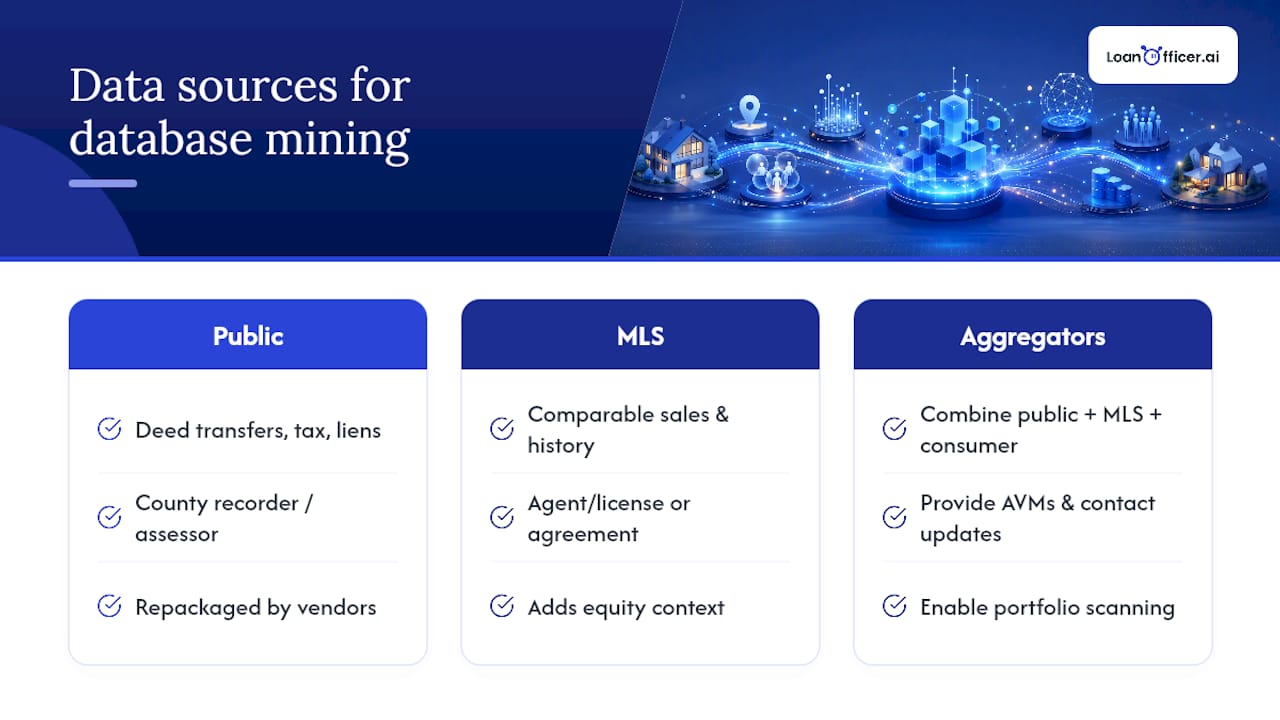
Database mining draws on three distinct sources, and each one fills a different gap. Public records provide the baseline: deed transfers, tax assessments, and recorded mortgage liens that establish who owns what and roughly what they owe. County recorder offices and tax assessor databases are the backbone here, and most third-party data providers repackage this same public information with added cleaning and standardization.
MLS data adds context that public records can’t, particularly comparable sales and listing history, which feeds directly into equity estimates when a formal AVM isn’t available for a specific property type. Access to MLS feeds typically requires a licensed agent relationship or a data-sharing agreement, which is one reason realtor partnerships matter beyond referrals. A shared data pipeline with a partner agent can fill gaps your own CRM doesn’t cover.
Third-party data providers sit on top of both. They aggregate public records, MLS feeds, and consumer data into a single queryable product, then layer in valuation models and, in some cases, contact information updates. This is where most AVM feeds originate, and it’s the layer that makes portfolio-level scanning possible instead of manual, one-property-at-a-time lookups.
The integration question matters as much as the source. A data feed that updates weekly but requires manual import into your CRM defeats the purpose of automation. Look for providers whose data pushes directly into your CRM or LOS through an API, so equity and rate-gap figures update without anyone touching a spreadsheet.
Staying Compliant While You Mine Your Database
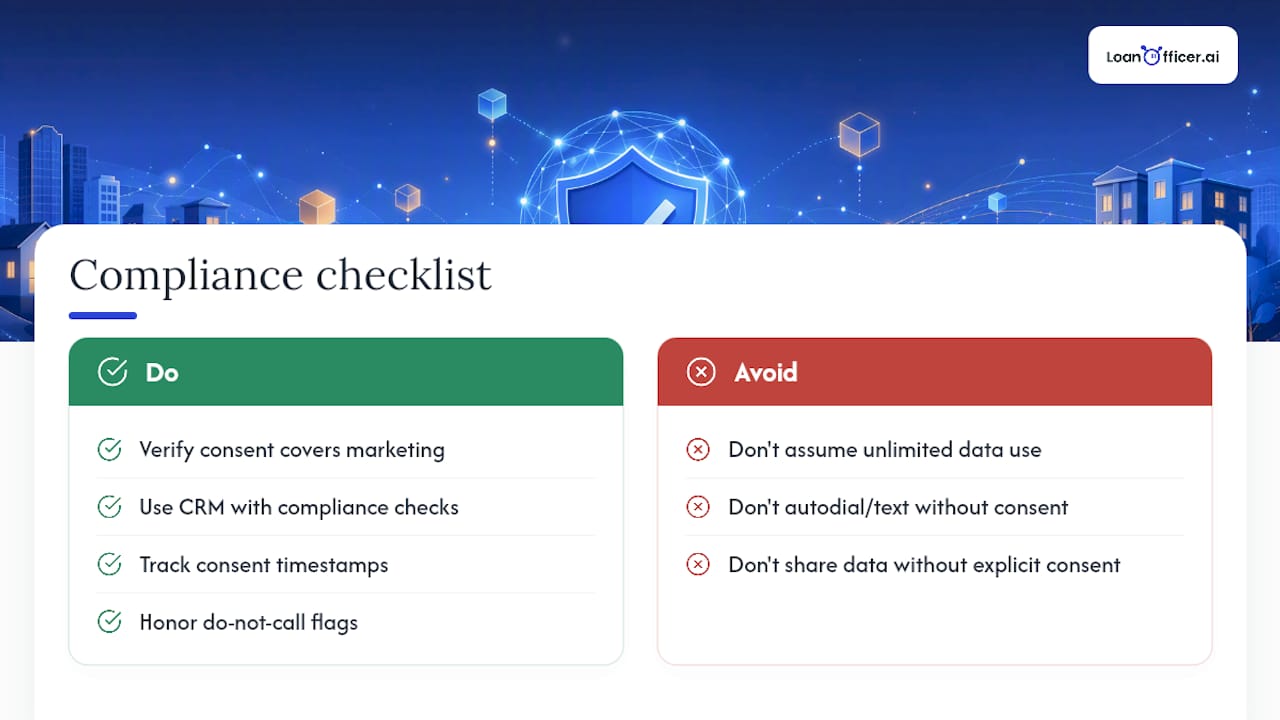
Database mining works with information you already have a legitimate relationship to, which is different from buying a cold list. Past and current clients gave you their information in the course of an application, and that existing relationship generally supports ongoing communication about their loan. It does not give you unlimited license to do whatever you want with the data.
The Telephone Consumer Protection Act governs how you can call or text, particularly around autodialed calls and prewritten text messages. If you’re using an automated dialer or bulk SMS platform, confirm the borrower’s original consent covers marketing communications, not just servicing notices about their existing loan. The Fair Credit Reporting Act adds another layer if you’re pulling credit-related data to prequalify prospects before contact; a soft pull for marketing purposes carries different disclosure requirements than a hard pull tied to an application.
Some states add their own privacy layers on top of federal rules, particularly around how consumer data can be shared with third parties like referral partners. If you’re passing borrower data to a realtor partner as part of a nurture sequence, get explicit consent for that specific use, not a blanket opt-in buried in old paperwork.
None of this should stop you from mining your own book. It should push you toward CRM and campaign tools that build compliance checks into the workflow (do-not-call flags, consent timestamps, opt-out tracking) rather than leaving it to memory. A platform that automates outreach without automating compliance just moves the risk faster.
Keeping Mined Data Clean and Reliable
A scoring model is only as good as the data feeding it, and stale or duplicate records quietly wreck accuracy long before anyone notices. The fix isn’t a one-time cleanup project. It’s a standing routine.
Start with deduplication logic that catches near-matches, not just exact ones. “123 Main St” and “123 Main Street Apt 2” often represent the same household with an address parsing error, and if your CRM treats them as separate records, your equity calculations split across two incomplete profiles instead of one accurate one.
Cross-check AVM-generated valuations against recent comparable sales periodically, especially in markets where prices have moved quickly. An automated valuation is an estimate, not an appraisal, and treating it as gospel for every property type (particularly unique or rural homes) introduces error into your rate-gap math.
Validate contact data on a schedule rather than reactively. Bounced emails and disconnected numbers should automatically flag a record for manual review, not just silently fail. Set a rule: any contact method that bounces twice gets pulled from active campaigns until someone verifies it.
Finally, audit your scoring outputs against actual outcomes every quarter. If your immediate call list is converting at half the rate you’d expect, the problem usually isn’t your sales pitch. It’s a threshold that’s too loose, a stale valuation feed, or a data source that’s drifted out of sync with reality.
Predictive Scoring and Machine Learning in Practice
The scoring rules covered earlier (rate gap, equity percentage, loan age, engagement weight) work as a static model. Machine learning approaches take the same inputs and let the weighting adjust based on which combinations actually converted historically, rather than fixed thresholds you set once and never revisit.
In practice, this means a model can learn that, for your specific book, a borrower with moderate equity and high engagement converts more often than one with high equity and no engagement, even if a static rule had scored them the same. Over time, the model refines itself against your actual funded-loan outcomes instead of a generic industry assumption.
This matters most at volume. A team working a few hundred contacts can score manually and get reasonable results. A team or brokerage working tens of thousands of records benefits from a model that continuously reprioritizes as new AVM data, rate movements, and engagement signals arrive, catching combinations a fixed rule set would miss entirely.
The practical takeaway isn’t that you need to build a machine learning model yourself. It’s that when evaluating a CRM or database mining tool, ask whether the scoring logic is static or whether it improves based on your own conversion history. That difference compounds over a year of use.
A Loan Officer’s Take on Working the Database Daily
The loan officers who consistently close deals from their own book aren’t smarter than everyone else. They’re just more consistent about the daily call block and about logging every conversation, even the short ones. A rate-watch alert fires, they call within the hour, and they take notes specific enough to reference six months later when equity or rates shift again.
One pattern shows up repeatedly in strong producers: they treat every past client conversation as a referral opportunity, not just a transaction. Asking a satisfied refinance client for a realtor introduction costs nothing and compounds over years.
— Jared Hart
How Loan Officer AI Runs This Playbook Automatically
Everything in this playbook, the rate-gap scoring, the AVM-driven equity tracking, the opportunity queues, the multi-channel campaigns, is exactly what Loan Officer AI was built to automate. Instead of exporting spreadsheets and manually recalculating thresholds every week, the platform runs refi and HELOC detection continuously against your live database and surfaces a ranked call list automatically.
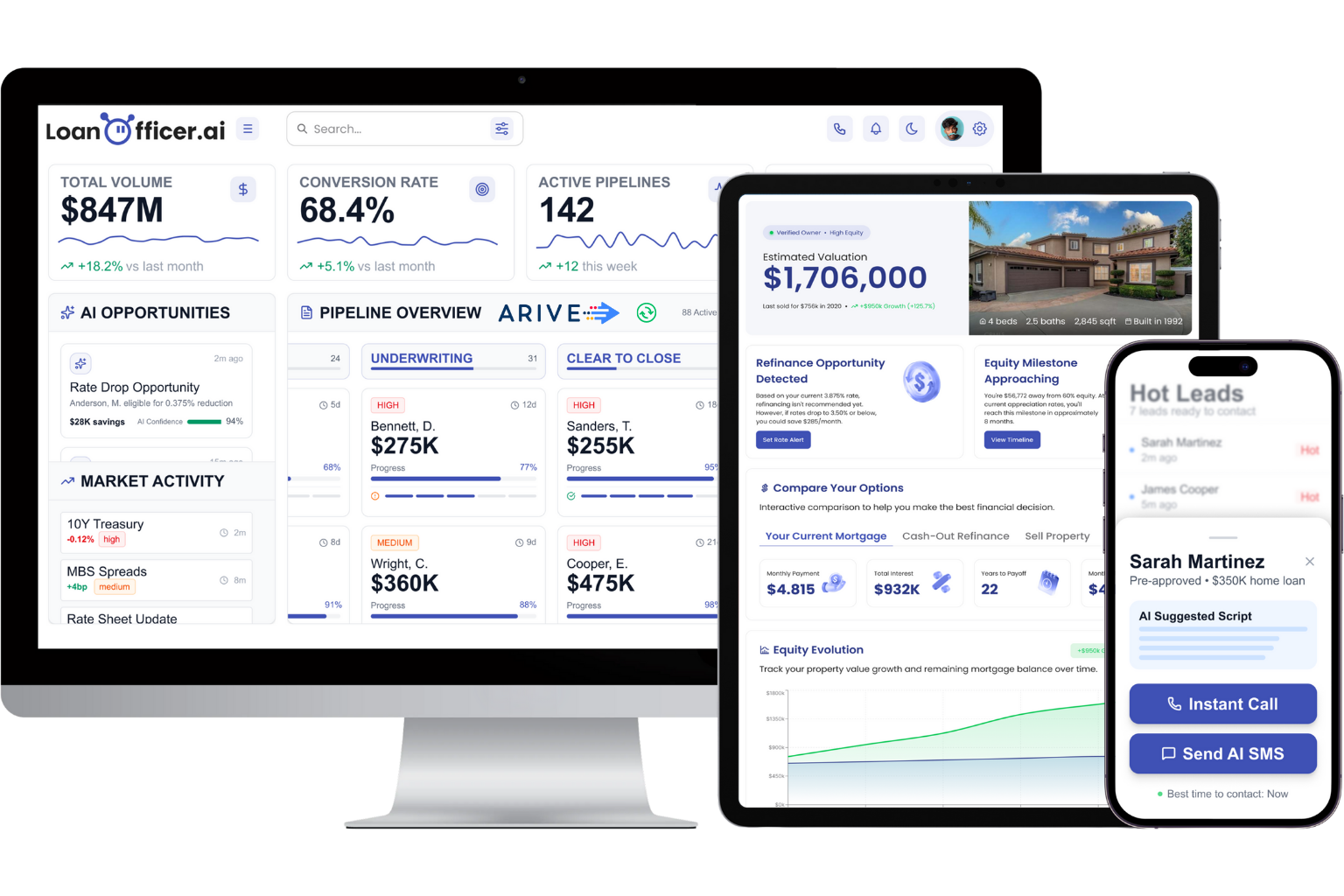
The AI-powered CRM connects your existing contact data with AVM feeds and LOS records, then triggers rate-watch alerts and campaign sequences the moment a borrower crosses your scoring threshold, no manual list-pulling required. Realtor partnership outreach runs on the same automated cadence, which is part of why partners report 93% retention using the platform.
If you’re a small team splitting outreach across a few loan officers, the team-focused workflows handle handoffs and shared pipeline visibility without extra spreadsheets. Onboarding is guided, and a trial period lets you connect your existing database and see your own opportunity queue before committing to a plan. Start a trial and watch your first ranked call list generate itself.