Mortgage Database Mining: A Loan Officer’s Playbook
Mortgage database mining is the practice of pulling prioritized refinance, HELOC, and purchase-opportunity leads directly from your CRM, then automating the outreach that turns them into applications. It works because your funded loans and past clients already trust you, which makes them cheaper to convert than any purchased lead list.
Your first move should take less than an hour. Pull one high-priority trigger list, such as borrowers sitting at or below 80% loan-to-value (LTV) who could drop mortgage insurance, or adjustable-rate mortgage (ARM) holders facing a reset within 12 months. Then queue an automated Rate Drop, MI Removal, or Pre-Approval Refresh sequence against that list before the day ends.
- Definition: Mining your existing mortgage CRM for refinance, HELOC, and cross-sell opportunities, then automating the follow-up.
- First action: Pull one trigger list today (LTV, ARM reset, or seasoning) and launch one automated campaign within 24 hours.
- Why it works: Platforms built for this, including LoanOfficer.ai’s database reactivation study, show dormant borrowers respond well to AI-driven re-engagement, and industry data from Experian backs the shift toward smarter, consent-aware targeting.
Table of Contents
- Why Mining Your Existing Database Beats Buying New Leads
- What Are the Priority Borrower Triggers to Mine For?
- How Do You Structure Your CRM for Reliable Mining?
- Automation Workflows: Building the Three Core Campaigns
- What Changed for Trigger Leads, and What Replaces Them?
- What Should Your Daily and Weekly Routine Look Like?
- How Do You Measure Whether Database Mining Is Working?
- Your 30/60/90-Day Rollout Plan
- How LoanOfficer.ai Fits Into This Playbook
- Why Small Teams Overthink This
- LoanOfficer.ai’s Role in the Playbook
- Frequently Asked Questions
- Sources
Why Mining Your Existing Database Beats Buying New Leads
A funded loan isn’t a closed file. It’s a future refinance, a future HELOC, or a future referral sitting in your CRM waiting for the right trigger. Every closing you already booked seeds two or three more opportunities over the following 12 to 24 months, provided you have a system watching for them.
Purchased leads cost money before you know if they’ll close. Database mining costs almost nothing beyond the software and the discipline to run it, because you’re working contacts who already passed underwriting, already trust your name, and already know how you communicate. The Churchill Mortgage database-mining playbook treats mining funded loans and past leads as the backbone of a repeatable pipeline, not a side project.
There’s also an early payoff clause: EPO risk. Early payoff penalties from investors hit hardest when a loan refinances within the first six months. Mining your own database with seasoning rules built in means you’re targeting borrowers after that window closes, not accidentally cannibalizing your own recent fundings.
By the Numbers: Leads contacted quickly after inquiry convert at meaningfully higher rates than delayed follow-up, and a substantial re-engagement period on past clients recaptures refinance business that would otherwise walk to a competitor, according to Aplos AI’s mortgage automation analysis.
- Cost-per-opportunity in your own database is a fraction of a purchased lead once you factor in underwriting familiarity and trust.
- A 6 to 12 month seasoning window on funded loans keeps you clear of most EPO clawback periods.
- Past clients who refinance with someone else usually do it because nobody reached out first.
What Are the Priority Borrower Triggers to Mine For?
Not every borrower in your database is worth calling this week. The ones worth calling have a specific, measurable trigger, and the Churchill Mortgage playbook lays out the thresholds that separate a real opportunity from a wasted dial.
| Trigger | Threshold | How to calculate it |
|---|---|---|
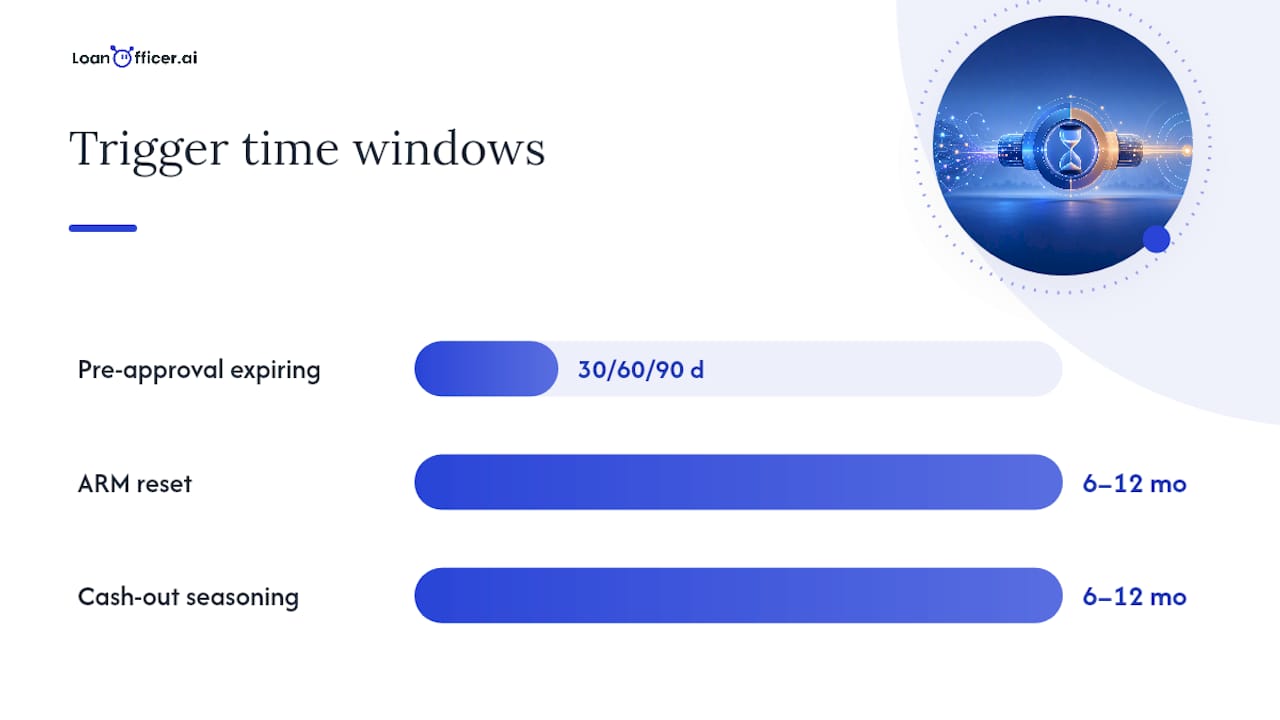
| Rate drop | 0.50%+ savings vs. current note rate | Compare current market rate to loan’s original rate on file |
| ARM reset | Adjusting in 6–12 months | Pull ARM reset date from loan terms, filter by upcoming window |
| PMI removal | 80% LTV or below | Current estimated value (AVM or tax-assessed) divided into remaining balance |
| Cash-out seasoning | 6–12 months since funding | Close date plus seasoning period, filtered against today’s date |
| Term reduction | Strong payment history, shorter remaining term desired | Cross-reference loan age with client engagement notes |
| Pre-approval expiring | 30/60/90 days out | Pre-approval issue date plus validity window |
Beyond these six, segment further. HELOC candidates need combined loan-to-value (CLTV) filtering to find second-lien room, a tactic LeadPlanet’s 2026 home equity analysis flags as the difference between a wasted call and a warm second-mortgage conversation. Layer in referral source, recent engagement (opened your last three emails vs. ignored them), and property value changes from your last AVM refresh.
- Score leads by estimated dollar savings first, engagement history second.
- Push HELOC candidates with CLTV under 80% to the top of that list.
- Deprioritize contacts with no engagement in over 18 months until you’ve cleared warmer names.
Pro Tip:When a trigger list runs into the hundreds, don’t call top to bottom. Rank by estimated monthly savings multiplied by a simple engagement score. A borrower saving $180 a month who opened your last email beats one saving $220 who hasn’t responded in a year.
How Do You Structure Your CRM for Reliable Mining?
Database mining only works if your CRM has the right fields populated and refreshed on a schedule, not updated whenever someone remembers. Start with the non-negotiable fields: close date, original loan amount, original rate, current estimated property value, current lien position or CLTV, ARM reset date, private mortgage insurance (PMI) flag, last contact date, and last campaign touched.

Tagging matters as much as the fields themselves. A clean taxonomy, RateDrop, MIRemoval, HELOCCandidate, and PreApprovalRefresh, lets you filter instantly instead of rebuilding a query every time you want to run a campaign. Sync these tags to your loan origination system (LOS) so a status change updates the tag automatically rather than waiting for manual entry.
Configuration checklist:
- Map every relevant LOS field to its CRM counterpart so data flows one direction without duplicate entry.
- Schedule automated valuation model (AVM) and property-value refreshes on a nightly cycle, since Mortgageleads points to stale equity data as the top reason mined lists misfire.
- Import propensity or alternative-data flags where your data provider supports them, so scoring reflects more than trigger alone.
Pro Tip:If a property’s last valuation is more than six months old, treat any LTV calculated from it as an estimate, not a fact. Flag those records for a manual check before they trigger an automated MI-removal campaign.
Automation Workflows: Building the Three Core Campaigns
Three campaigns cover most of the volume in a well-mined database: Rate Drop, MI Removal, and Pre-Approval Refresh. Multiple industry playbooks converge on these three as the highest-impact automations for an existing database, and each follows a similar sequencing logic.
- Rate Drop: Trigger fires when market rate beats a borrower’s note rate by 0.50% or more. Send an instant SMS or email acknowledgment, then open a 15-minute call window before the lead cools.
- MI Removal: Trigger fires at 80% LTV. Lead with a savings figure, not a generic “check your equity” message since specificity gets replies.
- Pre-Approval Refresh: Trigger fires 30, 60, and 90 days before expiration, with escalating urgency and a direct call-to-schedule at the 30-day mark.
Contact speed decides most of the outcome. Leads reached within five minutes convert far better than ones that sit, according to Aplos AI’s automation research, so the sequence order matters: instant acknowledgment, a call attempt inside 15 minutes, then a follow-up cadence across SMS, voice, and email over 7 to 30 days if the first attempt doesn’t land.
- Longer-lead HELOC and purchase prospects need a slower “heat-up” sequence, not a hard sell, since these buyers often need months, not days.
- Escalate unresponsive high-value contacts to a smart dialer or a team member for a live attempt rather than letting them cycle through email alone.
- Cap touches at two to three per week per contact. More than that reads as spam and burns trust you’ll need later.
What Changed for Trigger Leads, and What Replaces Them?
The Homebuyers Privacy Protection Act (HPPA) restricted the credit-based trigger leads that used to flood loan officers with names the moment someone pulled credit. That playbook is fading, and Experian’s analysis of the shift is blunt about it: lenders who relied on passive trigger leads need a new source of signal, and it has to be consent-aware.
Propensity modeling is the replacement. Instead of waiting for a credit pull to flag a shopper, propensity models score your existing database using behavior, alternative data, and property signals to predict who’s likely to refinance or borrow next, without touching a third-party credit trigger at all. Experian notes that alternative and cash-flow data can add real lift over bureau-only signals in segmentation.
For a small team, this doesn’t mean building a data science department. It means:
- Capture consent upfront for rate alerts and SMS, framed as a service the borrower opted into, not a cold approach.
- Use off-the-shelf propensity scoring where your CRM or data provider offers it, rather than building your own model.
- Weight property-value changes, engagement history, and payment behavior heavier than any single external trigger.
Pro Tip:A permissioned rate-alert opt-in at closing does double duty. It’s compliant, and it gives you a legitimate reason to message that borrower again the moment rates move, without needing a third-party trigger at all.
What Should Your Daily and Weekly Routine Look Like?
Mining a database only produces revenue if someone actually works the list every day. Build the routine around a short daily loop and a slightly heavier weekly maintenance pass.
Daily:
- Review overnight rate-watch alerts and refresh your top-20 scored contact list.
- Call the top 20 before touching email, since a live conversation beats an automated touch every time.
- Send instant acknowledgment messages to anyone who engaged with a campaign overnight.
- Log notes and set the next follow-up date in the CRM before moving to the next contact.
Weekly:
- Refresh AVM and property values across the active trigger lists.
- Pull the 6 to 12 month seasoning list for cash-out candidates.
- Run the HELOC prospect list filtered by CLTV.
- Refresh expiring pre-approvals at the 30, 60, and 90-day marks.
Quick-win checklist for this week, each doable in under an hour: pull one 80% LTV list, launch one Rate Drop sequence, ask three recent closers for a referral, and check that your ARM reset field is actually populated for loans older than a year.
Pro Tip:Ask for the appointment on the first call, not the third. “Want me to run your numbers this week?” converts better than a soft “let me know if you’re interested” close.
How Do You Measure Whether Database Mining Is Working?
Track a small set of numbers weekly and a slightly broader set monthly. Contact rate and appointment rate tell you if your outreach is landing; application rate and funded conversion tell you if it’s producing revenue.
| Metric | Frequency | How to calculate |
|---|---|---|
| Contact rate | Weekly | Contacts reached divided by total dialed |
| Appointment rate | Weekly | Appointments set divided by contacts reached |
| Application rate | Weekly | Applications taken divided by appointments held |
| Funded conversion | Monthly | Funded loans divided by applications taken |
| Pipeline lift | Monthly | Dollar volume from mined leads vs. prior baseline period |
| EPO reduction | Monthly | Early payoffs this period vs. same period last year |
Once you have a baseline, run small experiments rather than overhauling everything at once. Test one variable at a time: SMS-first versus call-first sequencing, a savings-figure subject line versus a generic one, or a three-touch cadence versus a five-touch one. Prioritize whichever test touches your highest-volume trigger list first, since a small lift there moves more revenue than a big lift on a niche segment.
Your 30/60/90-Day Rollout Plan
You don’t need every piece running on day one. A phased rollout gets you a live campaign fast while you build toward full automation.
- Days 1 to 30: Audit your CRM data quality, populate the core fields (LTV, ARM reset, PMI flag), and launch one Rate Drop sequence against your cleanest list.
- Days 31 to 60: Connect AVM and LOS syncs for nightly refreshes, add propensity or alternative-data flags if your provider supports them, and launch MI Removal and Pre-Approval Refresh alongside Rate Drop.
- Days 61 to 90: Measure lift against your 30-day baseline, run your first A/B test on cadence or messaging, and scale smart-dialer escalation and referral-ask workflows across your full mined list.
- Milestone check at day 30: at least one automated sequence live, core fields populated for 80% of active records.
- Milestone check at day 60: three campaigns running, nightly data refresh confirmed working.
- Milestone check at day 90: documented pipeline lift number, one completed A/B test, referral-ask built into every closing.
For cadence structure and compliance-friendly campaign timing as you build this out, the mortgage drip campaign guide from 1SMTG is worth reviewing alongside your own sequence design.
How LoanOfficer.ai Fits Into This Playbook
Everything above works with a spreadsheet and enough discipline, but it works faster with a system built for exactly this job. LoanOfficer.ai’s mortgage CRM maps directly onto the playbook: RateWatch alerts fire the Rate Drop and MI Removal triggers automatically, AVM integration keeps LTV and CLTV current without a manual refresh, and the smart dialer escalates unresponsive high-value contacts to a live call instead of letting them go cold in an email queue.
LoanOfficer.ai’s own database reactivation study documents that AI-driven re-engagement brings dormant borrowers back into active conversations faster than manual outreach, and the company reports 93% partner retention among the loan officers and brokerages already running it. If you’re managing this across a team rather than solo, the platform’s team workflows handle assignment rules and shared pipeline visibility without extra spreadsheets.
The lowest-friction way to test this is a small pilot: share one trigger list, run one automated campaign, and measure the appointment rate against your current manual process. If you’re ready to see how it runs against your own database, start a trial and load your first list this week.
Why Small Teams Overthink This
Most loan officers delay database mining because they’re waiting for perfect data. Every field populated, every valuation current, every tag consistent. That’s backward. The Churchill Mortgage playbook and the automation research from Aplos AI both point the same direction: speed of first contact and consistency of follow-up matter more than data perfection.
Start with the trigger list that has the most obvious, calculable savings, even if it’s a fraction of your total database. Run it. See what the appointment rate actually is, not what you assume it will be.
The other mistake is treating every borrower the same. A rate-drop candidate wants a number and a call. A HELOC prospect six months out wants a slower, educational nurture. Collapsing both into one generic monthly newsletter is how databases go stale and unsubscribe rates climb. Match the cadence to the borrower’s actual timeline, not your convenience.
LoanOfficer.ai’s Role in the Playbook
Database mining works because it turns dollars you already spent acquiring a client into dollars you earn again without spending on acquisition twice. The fastest path to results is one clean trigger list, one automated campaign, and a daily habit of working the calls it generates.
| Point | Details |
|---|---|
| Pull one trigger list now | Start with 80% LTV or ARM resets within 12 months, since both have clear, calculable savings. |
| Launch one automated campaign | Rate Drop, MI Removal, or Pre-Approval Refresh, whichever matches your cleanest list. |
| Build the daily call habit | Review alerts, call your top 20 scored contacts, log notes before moving on. |
| Measure before scaling | Track contact rate and appointment rate weekly before adding more campaigns. |
| Automate with LoanOfficer.ai | RateWatch alerts, AVM syncs, and smart-dialer escalation run the playbook without manual list-pulling. |
Frequently Asked Questions
What is mortgage database mining, exactly? It’s the process of analyzing your existing CRM records to find refinance, HELOC, and purchase-opportunity leads among borrowers you already closed, then automating follow-up to convert them.
How often should I refresh property values for accurate LTV calculations? A nightly AVM sync is ideal for active trigger lists; anything older than six months should be flagged as an estimate rather than treated as current.
What’s the difference between a Rate Drop and an MI Removal campaign? Rate Drop targets borrowers whose current note rate sits 0.50% or more above market. MI Removal targets borrowers who’ve likely crossed the 80% LTV threshold and can drop mortgage insurance.
Can I still use trigger leads after HPPA? Credit-based trigger leads are more restricted now, which is why propensity modeling and consent-based rate alerts have become the compliant alternative for most lenders.
How long should I wait before mining a funded loan for cash-out refinance opportunities? Most playbooks recommend a 6 to 12 month seasoning period to avoid early payoff penalties and align with typical equity buildup timelines.
Sources
- Staying Competitive After Trigger Leads Evolve: A Roadmap For Lenders - Experian Insights
- Database Mining - Briggs 2026 Summit (Churchill Mortgage slides)
- Mortgageleads
- Mortgage Broker Automation Guide (2026)
- How Companies Succeed with Home Equity Leads in 2026 - LeadPlanet
