Protect Compliance: 4 AI Email Prompts for Mortgage Teams
AI can draft and automate routine mortgage emails, but licensed review stays mandatory for pricing, product recommendations, and adverse actions. The right first move isn’t buying a platform. It’s picking one low-risk use case, such as document requests, and running it through a human-review gate with a logged audit trail before you scale anything further.
TL;DR:
- Using CRM-integrated automation provides the strongest compliance safeguards by automatically logging drafts to borrower records and requiring licensed review before sending.
- AI email drafts must be reviewed and approved by a licensed loan officer, especially when referencing rates, product recommendations, or credit decisions, within a 120-day governance window.
- Connecting AI-generated emails to your CRM with staged drafts and escalation rules minimizes the risk of sending unreviewed or non-compliant messages.
- The primary compliance challenge is ensuring an audit trail links each email, prompt, review, and approval for 5 to 7 years to meet regulatory standards.
- Pilot programs should focus on a single, low-risk use case with a strict review process to demonstrate value before scaling AI within mortgage workflows.
Table of Contents
- What Tools Handle AI Email Writing for Mortgage Teams?
- How Do You Write Mortgage Emails With AI Step by Step?
- What Compliance Controls Do AI Mortgage Emails Need?
- How Do You Connect AI Drafts to Your CRM Safely?
- How Do You Measure AI Email Writing Results?
- Author Perspective: Lessons From Deploying AI Email in Mortgage Workflows
- Where LoanOfficer.ai Fits Into This Playbook
- Sources
What Tools Handle AI Email Writing for Mortgage Teams?
Most mortgage teams choosing an AI email writing setup land in one of four categories, and the right one depends less on budget than on how much of your compliance process you’re willing to rebuild.
Generic inbox assistants (built into Gmail or Outlook) draft replies fast but store nothing specific to your loan files. They work for a solo loan officer answering simple borrower questions, but they leave you assembling audit trails by hand.
CRM-integrated automation ties AI drafting directly to loan status, borrower data, and reviewer queues. This is the category built for teams that need every draft logged against a specific file automatically, which matters once regulators start asking for records.
Prompt libraries and editable templates give you full control with zero platform lock-in. They’re the cheapest entry point, but every send depends entirely on the person copying, pasting, and checking the output.
API-based integrations let developers wire AI drafting into a proprietary loan origination system (LOS). Powerful, but only worth the engineering cost for larger shops with in-house technical staff.
- Solo brokers: inbox assistants or templates, minimal setup, weak audit trail
- Small teams (2-10 LOs): CRM-integrated automation, moderate setup, strong audit trail
- Brokerages and branches: CRM-integrated automation or APIs, higher setup, strongest governance fit
- Enterprise/IMBs: custom API integration, heaviest lift, full control over data handling
A CRM-integrated approach like Loan Officer AI aligns naturally with the governance patterns regulators expect: drafts tied to a borrower record, a reviewer step before anything sends, and a permanent log of who approved what.
How Do You Write Mortgage Emails With AI Step by Step?
Building a working AI email writing for mortgage workflow starts with prompt structure, not software. A good prompt gives the model a role, the specific facts of the file, the tone you want, and a hard boundary on what it cannot decide.
Here are four prompt skeletons you can copy into any AI writing tool today:
- Lead acknowledgement: “Write a warm, brief email acknowledging that [borrower name] just submitted an inquiry about [loan purpose]. Confirm we received it, state that a licensed loan officer will follow up within [X hours], and ask for [one specific missing document]. Do not mention rates, terms, or approval likelihood.”
- Document request: “Draft a follow-up email requesting [document name] from [borrower name] for their file. Reference that we’re missing this item to move the file to [processing stage]. Keep it under 120 words and include a deadline of [date].”
- Rate-movement notice: “Write a factual, neutral email informing [borrower name] that market rates have moved. Do not state a specific rate or imply a guaranteed number. Direct them to schedule a call with [loan officer name] to discuss current options.”
- Post-consultation recap: “Summarize the call with [borrower name] covering [topics discussed]. List next steps and required documents only. Flag any dollar figures or program names for manual review before sending.”
Personalize each one with placeholders ([borrower name], [loan amount], [document name]) and pull the actual numbers from your LOS or CRM record, never from memory or estimation. This is where most AI email writing mistakes happen: a model asked to “explain the rate” without a verified source will sometimes generate a plausible-sounding number that’s simply wrong.
The safest automation flow looks like this:
Trigger (new lead, missing document, status change) → AI draft (generated from the prompt skeleton with real file data) → Reviewer (licensed loan officer checks figures and tone) → Send (only after sign-off) → Archive (prompt, output, and reviewer approval logged together).
Pro Tip:Never let an AI-drafted email include a number the model calculated itself. Pull every rate, payment, and fee directly from your LOS or CRM, paste it into the prompt as a fixed value, and have your reviewer confirm it matches the file before anything goes out.
What Compliance Controls Do AI Mortgage Emails Need?
Fannie Mae’s LL-2026-04 governance framework gives seller/servicers a 120-day window to put AI/ML policies, vendor controls, and monitoring in place. That timeline should shape how fast you formalize your own email review process, not just how fast you adopt a tool.
Certain content must always pass through a licensed reviewer before it reaches a borrower’s inbox:
- Any specific interest rate, APR, or payment figure
- Product recommendations or loan program comparisons
- Statements that could be read as approval, denial, or a counteroffer
- Language referencing underwriting conditions or credit decisions
- Testimonials, endorsements, or performance claims used in outreach
Your audit log needs to capture more than just the final email. A defensible record includes the exact prompt text, the model version used, the output as actually sent, the reviewer’s identity and comments, and a timestamp for each step. Industry guidance on AI audit trail requirements points to a conservative 5 to 7 year retention baseline for these artifacts, aligned with standard loan-file retention practice.
Before signing with any AI vendor, demand documentation on model training data, data residency, fair-lending testing, and how they handle model updates that could shift output behavior. Practical guidance on inbox AI compliance recommends keeping every key financial term spelled out in the email body itself, rather than buried in an attachment or link, so both the borrower and any later audit can see exactly what was disclosed.
How Do You Connect AI Drafts to Your CRM Safely?
Integration is where most of the real risk hides. Three patterns work well without breaking your compliance chain:
- Draft staging in CRM: AI writes into a queue tied to the borrower record; nothing sends until a reviewer clicks approve.
- Reviewer queues with SLAs: every draft gets a time limit (say, two business hours) before it escalates to a supervisor, so nothing sits unreviewed indefinitely.
- Inbox plugin suggestions: AI proposes text inside Gmail or Outlook, but the loan officer types the send command manually.
- API-based staging endpoints: custom builds that hold AI output in a pending state until a reviewer’s approval token is logged.
Set escalation rules so anything touching rate, pricing, or adverse-action language routes automatically to a licensed reviewer, never a junior team member. Commentary on keeping humans in the loop stresses that this alignment with NMLS obligations isn’t optional once AI touches borrower-facing communication.
One more thing worth checking before you pick a vendor: where does borrower data actually go? Feeding Social Security numbers or income details into a public LLM is a bad habit. Favor private or enterprise-tier models with contractual data protections whenever real borrower information is involved.
How Do You Measure AI Email Writing Results?
Four numbers tell you whether your AI email writing for mortgage workflow is actually working: time-to-first-reply, document-completion rate, conversion to completed application, and reviewer override rate (how often a human rejects or heavily edits the AI draft).
A rising override rate isn’t a failure. It’s a signal your prompts need retraining, not that AI email drafting doesn’t work.
- Run subject-line A/B tests with compliance-safe variants only (no rate promises, no urgency claims)
- Test two prompt tones for the same email type and compare reply rates
- Review override patterns weekly and update prompt skeletons based on what reviewers keep correcting
Author Perspective: Lessons From Deploying AI Email in Mortgage Workflows
A narrow pilot wins internal buy-in faster than a full rollout ever will. One use case, one reviewer, one short retention window to test. That’s the fastest route to proof it works, and to catching where it doesn’t.
The honest tradeoff is time-saved versus compliance workload added. AI cuts drafting time substantially, but reviewer sign-off, logging, and prompt maintenance eat into that gain. Teams that treat the review step as overhead lose the argument for AI internally. Teams that treat it as the actual product tend to keep it running past the pilot.
— Jared Hart
Where LoanOfficer.ai Fits Into This Playbook
There are tools that integrate follow-up, opportunity detection, and pipeline triggers into the same system that holds borrower records, so drafts, reviewer sign-off, and logs stay attached to the file instead of scattered across separate tools.
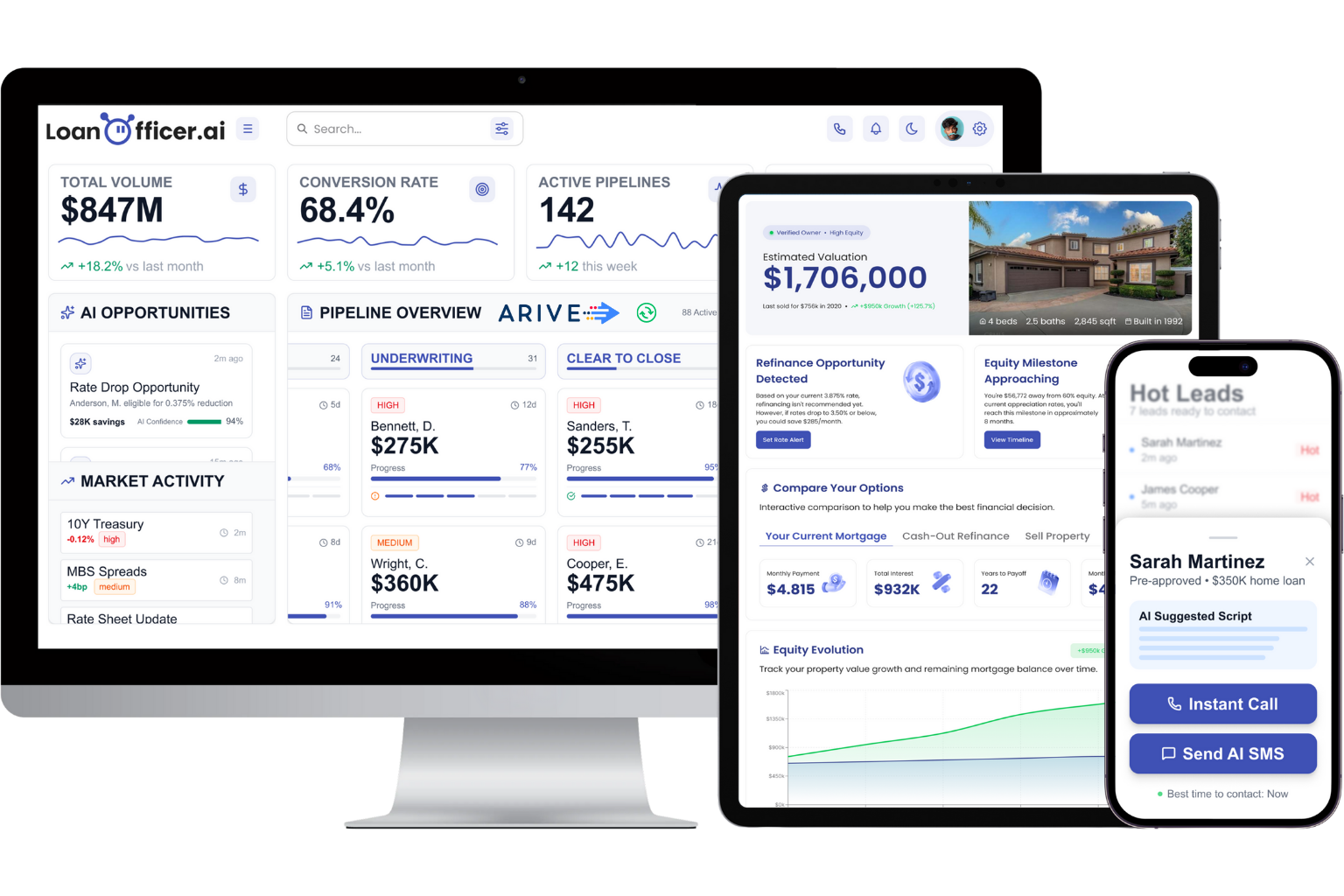
That matters because the biggest compliance gap in ad-hoc AI email setups isn’t the drafting itself. It’s the missing link between what got sent and who approved it. An integrated mortgage CRM closes that gap by design rather than by discipline, which is a lot more reliable when your team is busy and the reviewer step is easy to skip under deadline pressure.
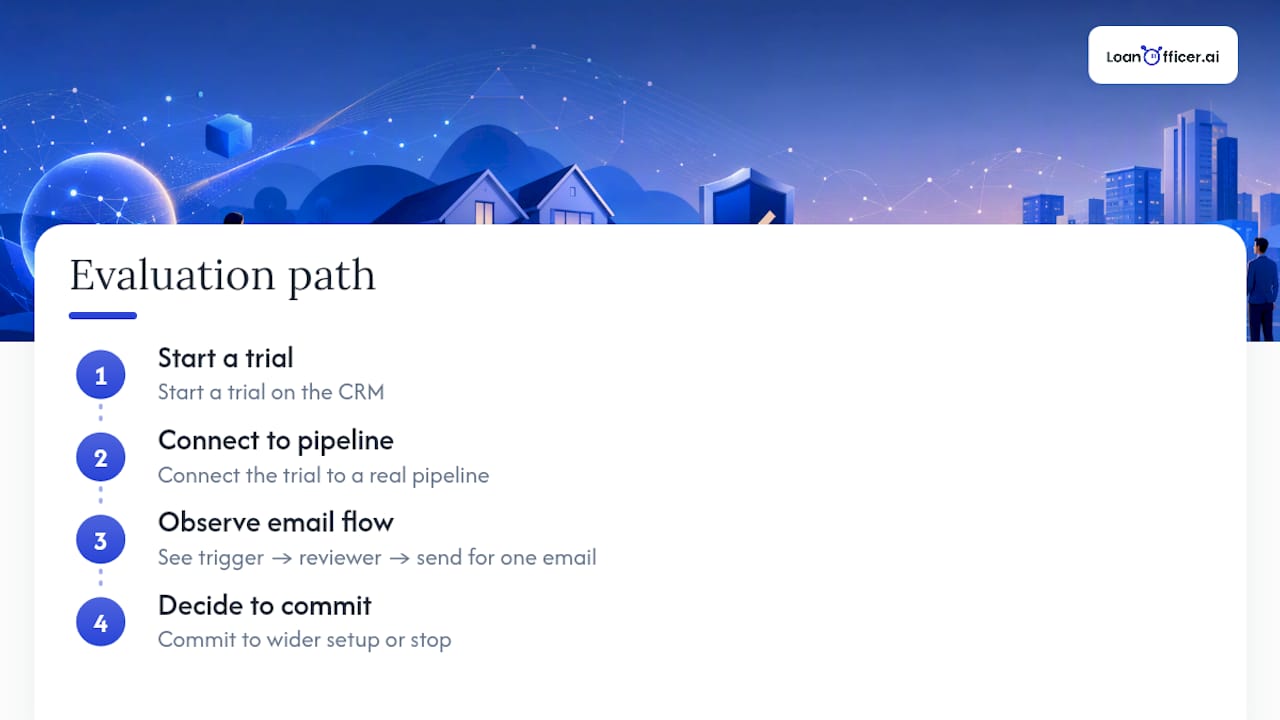
If you’re running a brokerage, the CRM for mortgage brokerages setup centralizes reviewer workflows across multiple loan officers instead of leaving each one to build their own process. Independent loan officers can start smaller with a focused independent LO setup and add automation as volume grows. Either way, the evaluation path is the same: start a trial, connect it to a real pipeline, and watch how a single acknowledgement or document-request email moves from trigger to reviewer to send before you commit to anything larger.
Sources
For deeper compliance detail beyond this playbook, review Fannie Mae’s AI/ML governance framework, industry analysis on AI marketing content risk, and practical guidance on inbox AI rules for lenders. For subject-line testing and prompt tone ideas outside the mortgage space, Tatem Web Design’s guide to AI email automation offers useful comparison points on open-rate testing.
This article is general information, not a substitute for advice from a qualified financial advisor. Consult a qualified financial professional about your own circumstances before acting on anything here.
- AI Governance in Mortgage Banking: Moving From Policy Discussion To Regulatory Reality – NMP
- Email, AI & Compliance: Inbox AI Rules for Lenders
- AI in mortgage compliance: moving fast while keeping humans in the loop
- AI audit trail requirements — 2026 checklist
