Facebook Leads for Mortgage CRM: A Compliance-First Playbook
Yes, Facebook can generate fundable mortgage leads, but only when campaigns run under Meta’s Special Ad Category, get tracked with the Conversions API, and feed straight into a CRM built for fast follow-up. Skip any of those three pieces and you’re paying for form-fills that die in a spreadsheet. Here’s what to do before you spend a dollar:
- Turn on Special Ad Category for Credit, and rebuild any old campaign that isn’t using it.
- Pick your capture method now: native Facebook lead forms for volume, or a hosted pre-qual page for higher intent.
- Route every lead automatically into a mortgage CRM like Loan Officer AI so the first call happens in minutes, not hours.
Key Takeaways
Facebook works as a mortgage lead source only when Special Ad Category compliance, Conversions API tracking, and automatic CRM handoff all operate together as one system.
| Point | Details |
|---|---|
| Declare Special Ad Category | Every credit or housing ad must run under this category, and boosting posts bypasses the setting entirely. |
| Structure a three-campaign funnel | Split budget roughly 50/30/20 across prospecting, retargeting, and conversion campaigns. |
| Implement CAPI early | Server-side tracking recovers an estimated 10 to 20 percent of conversion signal lost since Apple’s ATT changes. |
| Migrate optimization events over time | Start on SubmitApplication, then shift to CreditAuthorized once you can fire roughly 50 events per week. |
| Automate the CRM handoff | Loan Officer AI syncs Facebook leads instantly, tags the source, and triggers follow-up within minutes to protect speed-to-lead. |
Table of Contents
- What Compliance Rules Apply to Facebook Leads for a Mortgage CRM?
- How Should You Structure a Mortgage Facebook Ad Campaign?
- Facebook Lead Forms vs. Hosted Landing Pages: Which Should You Use?
- Why Does the Conversions API Matter for Mortgage Ad Tracking?
- What Ad Creative Works Under Special Ad Category Restrictions?
- What Metrics Actually Predict a Profitable Mortgage Facebook Campaign?
- What Follow-Up Workflow Converts Facebook Leads Into Closed Loans?
- How Loan Officer AI Turns Facebook Leads Into Funded Pipeline
- Why Facebook Ads Fail for Most Mortgage Teams (And It’s Not the Platform)
- Turn Facebook Leads Into a Working Pipeline With Loan Officer AI
- Sources
What Compliance Rules Apply to Facebook Leads for a Mortgage CRM?
Any ad promoting a mortgage, HELOC, or refinance offer has to run under Meta’s Special Ad Category for Credit. This isn’t optional. It strips out age, gender, and zip code targeting tools that could trigger fair lending exposure, which means your audience strategy has to lean on lookalikes and retargeting instead of demographic slicing. Meta’s own enforcement history and agency reporting confirm that skipping this declaration gets ads pulled and invites regulatory scrutiny you don’t want.
Boosting a post from your Facebook page feels convenient, but it’s a compliance trap. The boost workflow buries the Special Ad Category toggle and strips away delivery controls, which compliance advisories flag as a disparate delivery risk. Build every campaign in Ads Manager instead.
- Declare Special Ad Category on every credit or housing offer, no exceptions.
- Build campaigns in Ads Manager, never through the Boost button.
- Keep an approval log: who wrote the ad, who approved it, and when it went live.
- Upload a suppression list of current borrowers monthly so you’re not re-marketing to people who already closed.
- Document your targeting logic in case a fair-lending audit ever asks why an ad showed to whom.
Pro Tip:Keep a dated screenshot of every ad’s targeting settings and creative before it goes live. The FTC’s guidance on substantiating advertising claims makes clear that recordkeeping is your best defense if a regulator or a complaint ever comes knocking.
How Should You Structure a Mortgage Facebook Ad Campaign?
Run three campaigns, not one. A prospecting campaign introduces cold audiences to your brand and offer. A retargeting campaign catches people who visited your site or engaged with prior ads. A conversion campaign pushes warm leads toward an application. Agencies that specialize in mortgage Meta ads typically recommend seeding this funnel with Special Ad Audiences built from your funded-borrower list, since standard lookalikes aren’t available under the Credit category.
Budget allocation matters more than most brokers assume. A rough 50/30/20 split across prospecting, retargeting, and conversion keeps the top of funnel full while still capturing intent from people already warm.
| Campaign stage | Budget share | What it’s optimizing for |
|---|---|---|
| Prospecting | 50% | Reach and initial engagement with cold audiences |
| Retargeting | 30% | Re-engaging site visitors and past lead form viewers |
| Conversion | 20% | Application starts from warm, high-intent traffic |
Meta typically needs a sufficient number of conversion events per ad set within a week to exit the learning phase and stabilize delivery. Below that, expect volatile costs. Test budgets in the $20 to $50 per day range per ad set while you’re validating creative, then plan for a budget at a level sufficient to produce consistent, fundable leads.
Facebook Lead Forms vs. Hosted Landing Pages: Which Should You Use?

Native Facebook lead forms remove almost all friction. A borrower taps a few pre-filled fields and submits, which drives volume but also invites low-intent tire-kickers who forgot they clicked. Hosted pre-qual pages ask for more effort up front, so the leads that come through tend to be further along, and you get far more control over the page for split testing and disclosure placement.
Whichever you choose, the wiring into your CRM has to be automatic. Manual CSV exports from Facebook are how leads die.
- Native connector: Many mortgage CRMs, including Loan Officer AI, offer a direct Facebook lead ad integration that syncs new submissions in real time.
- Webhook through middleware: Zapier or Make can catch a new lead event and push it into your CRM within seconds, useful if your CRM lacks a native connector.
- LOS webhook back to Meta: Once a lead becomes an application, a webhook from your loan origination system can fire a server-side event back to Meta through CAPI, closing the loop on true funded-loan data.
- Preserve the UTM parameters and lead source field on the way in. If a lead lands in the CRM tagged simply “web inquiry,” you’ve lost the ability to measure Facebook’s real return.
Pro Tip:Tag every Facebook lead with “Meta” as the source field in your CRM the moment it lands, and upload your closed-loan list back to Facebook monthly as a suppression audience. This keeps you from spending ad dollars re-marketing to someone who already closed with you three weeks ago.
Why Does the Conversions API Matter for Mortgage Ad Tracking?
Apple’s App Tracking Transparency changes degraded browser-based pixel tracking across the board, and mortgage advertisers felt it as inflated costs and murky attribution. The Conversions API sends conversion events server to server instead of relying on a browser pixel alone. Industry estimates put its recovery of lost conversion signal at roughly 10 to 20 percent.
- Start by optimizing toward the SubmitApplication event if your ad account is new or your volume is thin. This gives Meta’s algorithm a shallow, frequent signal to learn from.
- Once an ad set can reliably fire around 50 CreditAuthorized events per week, migrate optimization to that deeper LOS event. It trains the algorithm on people who actually qualify, not just people who filled out a form.
- Implement CAPI through no-code middleware if you lack developer resources, or connect it directly through your LOS webhook if you have technical support in house.
A wide gap between your Lead event count and your CreditAuthorized event count, sometimes called the event divergence ratio, is a signal your targeting is pulling in volume without quality.
What Ad Creative Works Under Special Ad Category Restrictions?
Short educational video outperforms static images for mortgage offers, mainly because it builds trust before someone ever fills out a form. Testimonial-style creative and equity-focused HELOC messaging also tend to perform well, since younger buyers in particular are facing steeper barriers to homeownership and respond to content that speaks to that friction directly rather than generic rate promotions.
- Keep lead forms to a small number of fields to balance completion and qualification. Every extra field costs you completions.
- Build landing pages mobile-first, since most Facebook traffic arrives on a phone.
- Include clear disclosure and consent language above the fold, not buried in a footer.
- Rotate creative regularly to avoid ad fatigue, and swap messaging entirely when you shift from purchase to refinance offers.
What Metrics Actually Predict a Profitable Mortgage Facebook Campaign?
Cost per lead tells you almost nothing on its own. A campaign with a rock-bottom CPL and no applications behind it is often a warning sign that your targeting or creative is pulling in curiosity clicks, not borrowers. Track cost-per-credit-authorized alongside lead-to-application and lead-to-funded-loan rates to see the real economics.
- Typical CPL for a straightforward form-fill campaign runs roughly $35 to $120, while qualified leads with stronger intent signals land closer to $80 to $250.
- Watch the learning phase duration on each ad set. Constant edits reset it and keep costs unstable.
- When CPL drops sharply but application rate doesn’t follow, treat that as a targeting or creative quality problem, not a win.
- Move underperforming traffic into a long-term nurture track in your CRM instead of writing it off. A purchase lead six months out today is still a funded loan later.
What Follow-Up Workflow Converts Facebook Leads Into Closed Loans?
Speed decides more than almost any other variable in this channel. Aim to make first contact promptly after a lead arrives in your CRM, and build an automated fallback for the moments you can’t get a human on the phone that fast.
- Fire an immediate SMS and email the moment a lead lands, before a human ever picks up the phone.
- Trigger a call task for your team with the lead’s source and campaign details already attached.
- If no human contact happens within the five-minute window, let an automated nurture sequence keep the lead warm with rate information and next steps.
- For purchase-intent leads on a longer six to twelve month timeline, schedule rate-watch emails and periodic value content instead of aggressive weekly calls.
- Route every touch back through the CRM so the next person who talks to that lead sees the full history, not a blank slate.
Loan Officer AI’s automated follow-up tools are built around exactly this kind of sequencing, pairing AI-driven opportunity alerts with pipeline tracking so a Facebook lead never sits untouched while its context evaporates.
Pro Tip:If your team can’t hit the five-minute mark consistently, don’t just accept slower response times. Automate the gap instead. A well-timed text that says “got your info, calling you in the next 10 minutes” keeps a lead warm even when a human isn’t available yet.
How Loan Officer AI Turns Facebook Leads Into Funded Pipeline
Wiring a Facebook lead form into a CRM is one thing. Turning that lead into a CreditAuthorized event, then a funded loan, is the harder problem, and it’s the one Loan Officer AI was built around. The platform connects directly to Facebook lead ads, tags each submission with its source and campaign, and triggers an automated outreach sequence within minutes of arrival, no manual export required.
- Automated follow-up: SMS and email sequences fire the moment a lead lands, closing the speed-to-lead gap most teams struggle with manually.
- AI opportunity detection: The system flags refinance and HELOC candidates already in your database, so Facebook spend isn’t your only source of qualified conversations.
- LOS integrations: Application and credit-authorization events sync back, giving you the CreditAuthorized signal Meta’s algorithm needs to optimize for quality.
- Pipeline management: Every lead, regardless of source, moves through one visible pipeline instead of living in a separate spreadsheet.
Consider a lead form for a HELOC offer. Facebook pushes the submission to Loan Officer AI instantly, an SMS goes out inside minutes, and once that borrower authorizes credit inside your LOS, a webhook fires the CreditAuthorized event back to the ad platform. That closes the loop Meta’s algorithm needs to stop optimizing for cheap form-fills and start optimizing for people who actually qualify.
Mortgage teams using Loan Officer AI report 93% partner retention, a reflection of how much time automated follow-up and pipeline visibility save once the manual busywork disappears.
Why Facebook Ads Fail for Most Mortgage Teams (And It’s Not the Platform)
Most brokers blame Facebook when their lead volume looks good but their pipeline stays empty. That diagnosis is almost always wrong. The problem sits in the handoff, not the ad. A lead form that dumps submissions into an inbox nobody checks for three hours has already lost the deal before a loan officer even sees the name.
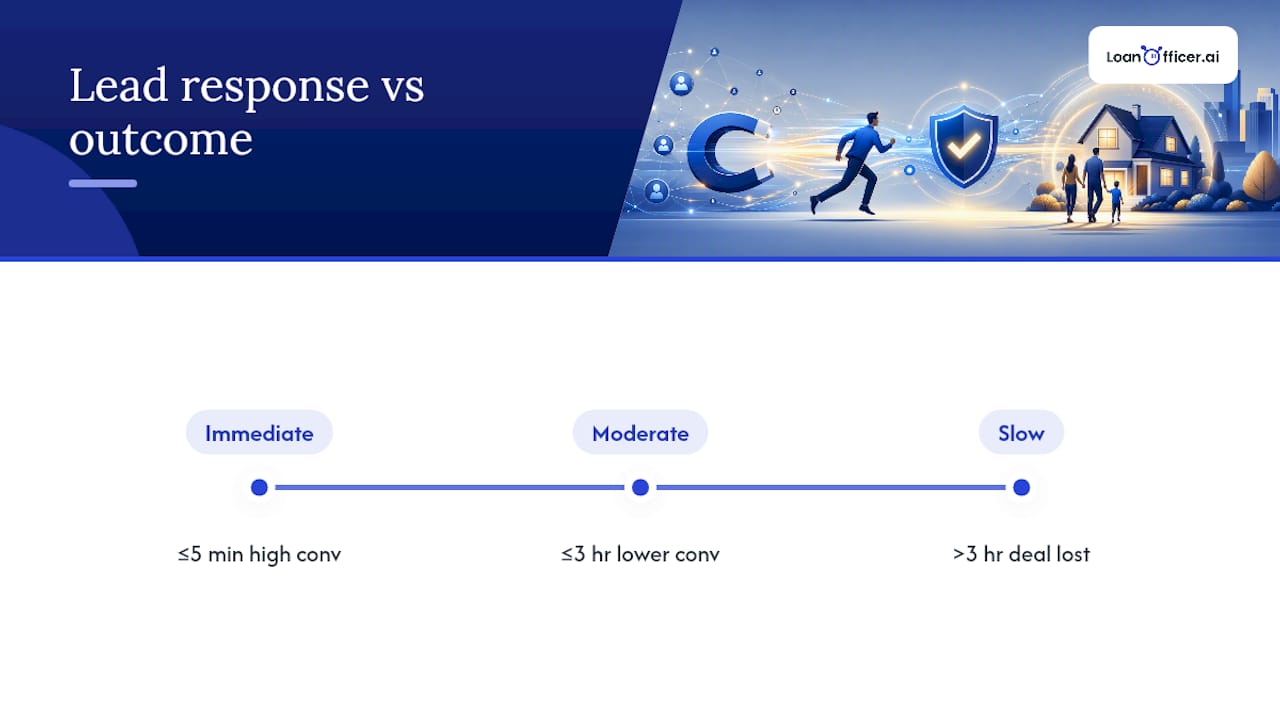
Conventional advice tells brokers to fix this by tweaking targeting or lowering CPL. That’s backward. A campaign with a higher CPL but a CRM that responds in under five minutes will out-convert a cheaper campaign every time, because mortgage shoppers fill out three or four forms in one sitting and go with whoever calls first. The economics of speed dwarf the economics of ad spend.
The other overlooked piece is optimization events. Teams that never migrate past the basic Lead event are training Meta’s algorithm to find more people who fill out forms, not more people who qualify for credit. That’s a slow leak on ad spend that never shows up on a CPL report, only on a loan officer’s closing ratio months later.
Get the CRM wiring and the event strategy right first. Everything else is optimization on top of a foundation that already works.
— Jared Hart
Turn Facebook Leads Into a Working Pipeline With Loan Officer AI
Loan Officer AI gives you the piece most Facebook campaigns are missing: a CRM built specifically to catch a mortgage lead the second it arrives and keep working it until it either closes or ages into a long-term nurture track.
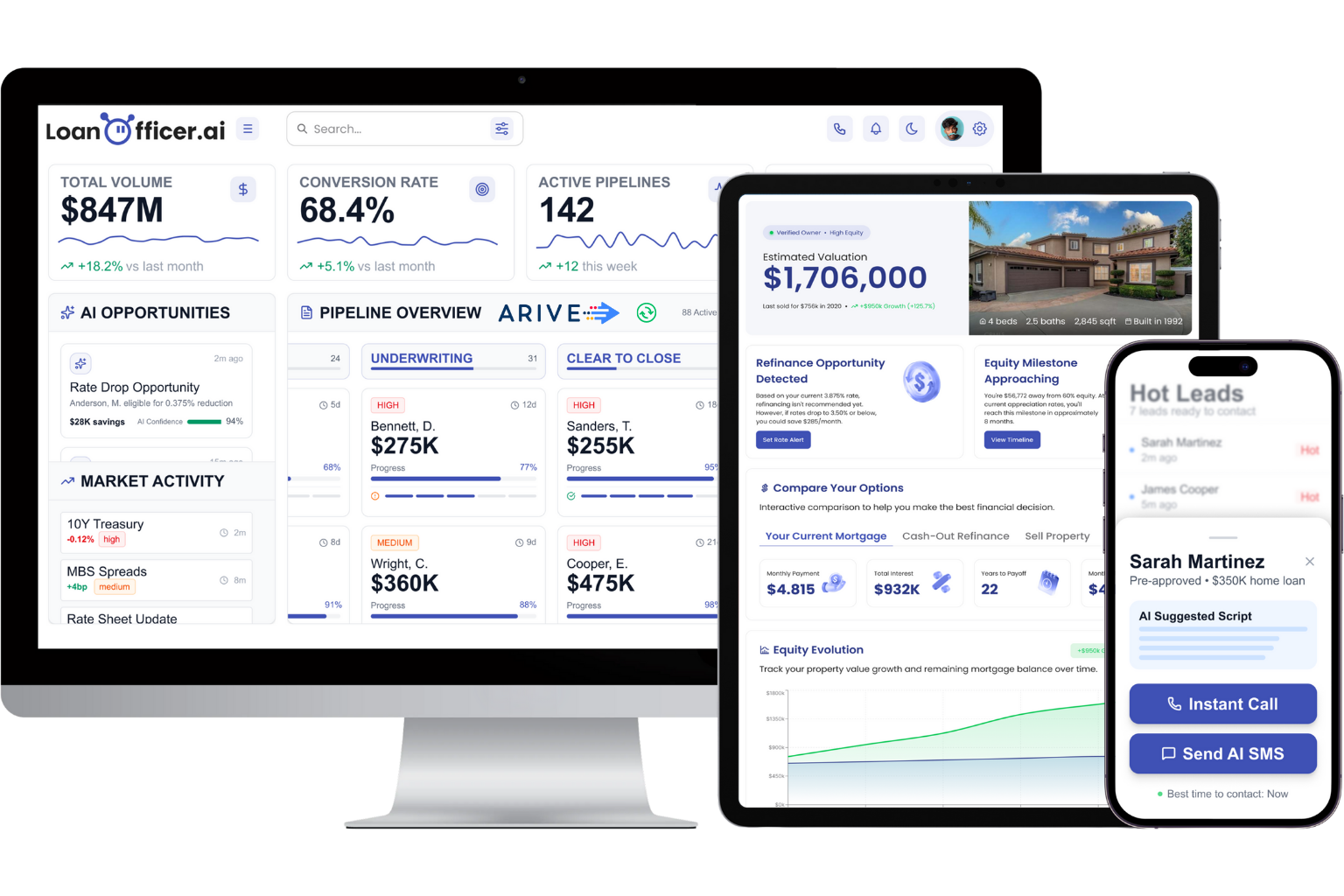
Instead of stitching together a lead form, a spreadsheet, and a reminder to call someone back, the platform connects directly to your ad account, tags every lead by source, and fires automated follow-up sequences without a manual trigger. Loan officers running independent shops get the same automation that larger teams use, and brokerages get pipeline visibility across every loan officer at once. If you’re already running Facebook campaigns and losing track of who followed up on what, this is the fix built for exactly that gap.
Start a free trial of the mortgage CRM and connect your first Facebook lead form today to see how fast automated follow-up actually moves a pipeline.
Sources
- Advertising and Marketing on the Internet: Rules of the Road (FTC guidance)
- Facebook Ads for Mortgage Lenders: Compliance, Targeting, and What Actually Works (Creekside Marketing)