Mortgage Lead Nurturing for Loan Officers: A CPFL Playbook
The highest-impact mortgage lead nurturing programs prioritize three things: speed-to-first-contact, stage-specific email and SMS sequences, and CRM automation that measures cost per funded loan (CPFL) instead of cost per lead. That combination beats a CPL-only approach because a cheap lead that never closes is worth nothing, while a pricier lead that converts fast pays for itself many times over.
This week, start here:
- Set a five-minute call SLA for every new lead, shared or exclusive.
- Turn on a welcome email with a rate-check call to action within the first hour.
- Build basic lead scoring in your CRM so hot prospects surface automatically.
Pro Tip:Track CPFL by source for 30 days before you cut any lead channel. A source that looks expensive on CPL alone often wins on CPFL once you factor in conversion rate.
Key Takeaways
Mortgage lead nurturing works when speed-to-contact, stage-specific multi-channel sequences, and CPFL-focused CRM automation operate together instead of in isolation.
| Point | Details |
|---|---|
| Chase CPFL, not CPL | First-party CPFL runs $1,200–$2,000 versus $5,000–$15,000+ for unmanaged aggregator leads. |
| Respond in minutes | Shared leads convert far better when contacted within five minutes of submission. |
| Match cadence to stage | Plan 8–12 touches in the first 30 days, with content shifting from education to support. |
| Automate the welcome | Welcome emails average 48.5% open rates, making them the highest-priority automation. |
| Implement with Loan Officer AI | Loan Officer AI’s routing, drip sequences, and database mining map directly to this playbook’s checklist. |
Table of Contents
- Why Mortgage Lead Nurturing Changes Your Cost Per Funded Loan
- What Should You Nurture at Each Pipeline Stage?
- Which Channels Actually Move Mortgage Leads Forward?
- How Much Should You Personalize Nurture Messages?
- How Do You Automate Mortgage Lead Follow-Up in a CRM?
- What Compliance Rules Apply to Mortgage Nurture Campaigns?
- Which Metrics Actually Predict Mortgage Lead Nurturing Success?
- What Do Ready-to-Use Mortgage Nurture Sequences Look Like?
- How Does Loan Officer AI Put This Playbook Into Action?
- Sources
Why Mortgage Lead Nurturing Changes Your Cost Per Funded Loan
Nurture done right lowers CPFL because it fixes the two things that actually kill deals: slow response and inconsistent follow-up. First-party campaigns typically run $1,200 to $2,000 per funded loan, while shared aggregator leads without disciplined nurture often land between $5,000 and $15,000 or more. Same industry, wildly different outcomes, and the gap usually comes down to process, not lead quality.
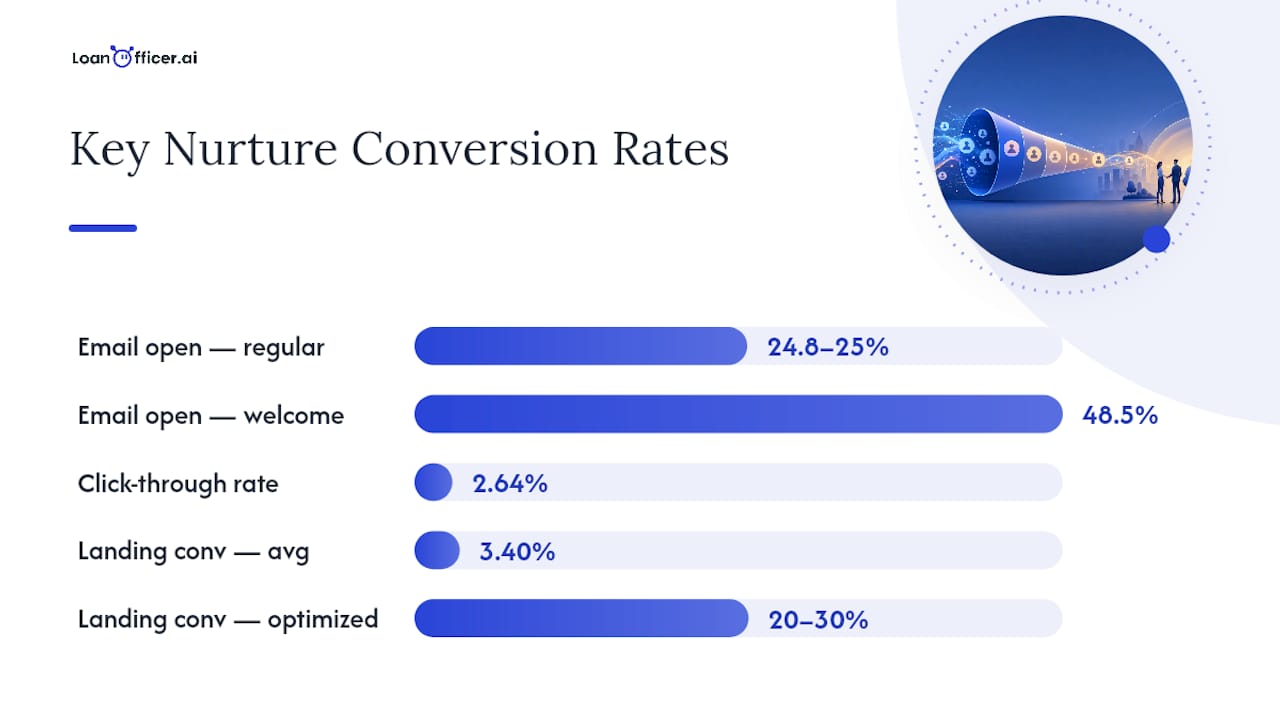
Email still earns its place in that process. Mortgage and real estate campaigns average 24.8 to 25% open rates, and optimized landing pages can push conversion into the 20 to 30% range against a broader average of 3.40%.
What nurturing actually buys you:
- Higher close rates on the same lead volume
- A steadier pipeline instead of feast-or-famine months
- Faster processing once borrowers arrive prepared
- More referrals from clients who felt looked after, not forgotten
What Should You Nurture at Each Pipeline Stage?
Each stage of the mortgage pipeline needs a different primary goal, and treating them all the same is the most common nurture mistake. Pre-qualification is about education, application is about conversion, processing is about support, and post-close is about referrals and refinance monitoring. The touch cadence should shift with the goal.
Pre-qualification stage
- Welcome message explaining the process and setting expectations
- Rate-check or affordability tool as the first call to action
- Light borrower education on the three C’s (credit, capacity, collateral) so prospects understand what underwriters weigh
Application stage
- Documents checklist sent immediately after commitment
- Reminders tied to missing items, not generic check-ins
- A direct line to a real person for questions
Processing stage
- Status updates timed to milestones (submission, conditions, clear-to-close)
- Proactive alerts before the borrower has to ask
Post-close stage
- Referral and review request within the first two weeks
- Ongoing rate and equity alerts for refinance opportunity
For shared or high-volume leads, plan on 8 to 12 touches in the first 30 days. Fewer than that, and most leads go cold before they ever see a full picture of what you offer.
Which Channels Actually Move Mortgage Leads Forward?
Email, SMS, phone calls, landing pages, and targeted social make up the core mix, and which one you lean on depends on the lead’s intent and where it came from. A rate shopper who just filled out a form responds to different pressure than a referral your loan officer partner sent over personally.

Search advertising sets a useful baseline: average CPC runs around $7.84, average CTR sits at 2.64%, and organic or SEO-driven leads convert at a notably higher 5 to 12% compared with shared aggregator leads at 0.5 to 2%.
| Channel | Best for | Typical pattern |
|---|---|---|
| Phone | Speed-sensitive, shared leads | Highest contact rate when called within minutes |
| All stages, education and updates | 24.8 to 25% open rate, higher for welcome sends | |
| SMS | Time-sensitive nudges | Short, high-visibility, use sparingly |
| Landing pages | Capturing and qualifying intent | 3.40% average, 20 to 30% when optimized |
| Referral partner touches | Agent-sourced leads | Conversion often reaches 40% |
Build your playbook around a welcome email template, a short SMS sequence for time-sensitive nudges, and a recurring cadence of check-ins with referral partners who feed you warm leads without the CPL markup.
How Much Should You Personalize Nurture Messages?
Practical personalization beats decorative personalization every time. Knowing a lead’s pipeline stage, loan purpose, and credit band drives far more conversion than swapping in a first name. Build your segments around what actually changes the message:
- Pre-qualifiers who need education before they’re ready to apply
- Rate shoppers comparing multiple lenders right now
- Purchase borrowers versus refinance borrowers, who want completely different content
- Referral prospects who already trust you through an agent relationship
AI earns its keep in a few specific spots: generating subject-line variants to test, drafting reply suggestions for common borrower questions, flagging intent signals buried in email replies, and surfacing next-best-action prompts inside your CRM so nobody guesses what to send next.
Pro Tip:Segment by loan purpose before you segment by anything else. A refinance-motivated lead and a first-time purchase lead should almost never receive the same drip sequence.
How Do You Automate Mortgage Lead Follow-Up in a CRM?
A small set of automated workflows delivers most of the gain: speed-to-lead routing, a welcome sequence, a stage-driven drip, and a reactivation campaign for cold leads. Everything else is refinement.
Build it in this order:
- Set lead routing rules so new leads hit the right originator instantly, no manual assignment delay.
- Enforce a speed-to-contact SLA, five minutes or less for shared leads.
- Trigger an automated welcome email and SMS the moment a lead enters the system.
- Build escalation rules so unanswered leads bump to a manager or ISA after a set window.
- Import offline conversions (funded loans) back into your ad platforms so bidding optimizes toward CPFL, not clicks.
- Layer in a 30-day re-score that branches cold leads into a separate reactivation track.
A workable sample sequence looks like this: call within five minutes, automated welcome email plus SMS, a three-day follow-up call, a seven-day educational drip, then a 30-day re-score that either advances the lead or routes it into reactivation.
- Lead routing and SLA enforcement map to pipeline automation tools built for this exact handoff.
- Welcome sequences and drip content map to automated multi-channel campaigns.
- Database mining for reactivation maps to tools that flag refinance and HELOC opportunity automatically.
Institutions running this kind of automation report 25 to 40% faster loan processing, largely because borrowers arrive better prepared and status updates happen without anyone remembering to send them. A mortgage CRM built for loan officer teams handles the routing and escalation pieces without you building spreadsheets to track who owns what.
What Compliance Rules Apply to Mortgage Nurture Campaigns?
Follow TCPA and CAN-SPAM basics, and document your consent and suppression lists before you scale SMS or email volume. Regulators and consumers both take unwanted contact seriously, and the FCC’s complaint process shows how quickly nuisance outreach turns into a formal complaint.
Quick checklist:
- Capture explicit consent on every lead form, not just an implied checkbox
- Honor opt-outs immediately across every channel, not just the one used to opt out
- Maintain Do-Not-Call and Do-Not-Text suppression lists and check against them before every campaign
- Retain only the data you need, for only as long as you need it
Pro Tip:Never put sensitive loan terms in an SMS. Send a secure portal link instead. It’s faster to read, safer to store, and keeps rate quotes off a phone screen someone else might see.
Which Metrics Actually Predict Mortgage Lead Nurturing Success?
Prioritize CPFL, lead-to-application rate, speed-to-contact, email open and click-through rates, and pipeline velocity over raw CPL. CPL tells you what you paid; CPFL tells you what you got.
| Metric | Typical benchmark |
|---|---|
| Email open rate | 24.8–25%, welcome emails ~48.5% |
| Click-through rate | 2.64% |
| Landing page conversion | 3.40% average, 20–30% optimized |
| CPFL, first-party | $1,200–$2,000 |
| CPFL, shared aggregator | $5,000–$15,000+ |
Import offline conversions, meaning actual funded loans, back into your ad platform. Without that loop, your ad spend optimizes toward clicks and form fills instead of closings, and you end up scaling the wrong channel because it looked cheap on paper.
What Do Ready-to-Use Mortgage Nurture Sequences Look Like?
Copy these frameworks directly and adjust the wording to your voice. Each one is built to move a lead exactly one step closer to funding, not to fill an inbox.
1. Welcome sequence (0 to 24 hours) Goal: acknowledge the lead fast and set expectations before anyone else reaches them.
- Immediate phone call attempt
- Welcome email with rate-check CTA within the hour
- Follow-up SMS if no response by hour four
2. Pre-qualification sequence (0 to 14 days) Goal: get documents started and answer the “am I ready” question.
- Educational email on the three C’s and what to expect
- Mid-week check-in call
- Second-week nudge with a specific next step, not a generic “just checking in”
3. Application-stage sequence (docs and checklist) Goal: keep the file moving without chasing.
- Personalized checklist immediately after commitment
- Automated reminders tied to specific missing items
- Escalation to a live call if documents stall past 72 hours
4. Processing-stage sequence (status updates) Goal: reduce anxiety and phone-tag.
- Milestone-triggered status emails
- Proactive alert before conditions are due
5. Post-close sequence (referral, review, refinance watch) Goal: turn a closed loan into future business.
- Referral and review request within two weeks
- Ongoing equity and rate alerts for refinance timing
Escalate to a live call or hand off to an ISA anytime a lead replies with urgency, confusion, or a rate objection. Automation should pause the moment a human conversation clearly serves the borrower better.
A Loan Officer’s View on Running These Systems Day to Day
A good nurture day means your CRM already called, texted, and emailed before you finished your coffee. A bad one means you’re digging through a spreadsheet trying to remember who you promised a callback. Check your SLA dashboard every morning, and clean your pipeline weekly so stalled leads don’t rot silently in a stage nobody’s watching.

How Does Loan Officer AI Put This Playbook Into Action?
Loan Officer AI maps directly onto everything covered here: speed-to-lead routing, stage-based nurture sequences, offline conversion tracking, and AI-assisted messaging, all running inside one platform instead of five disconnected tools.
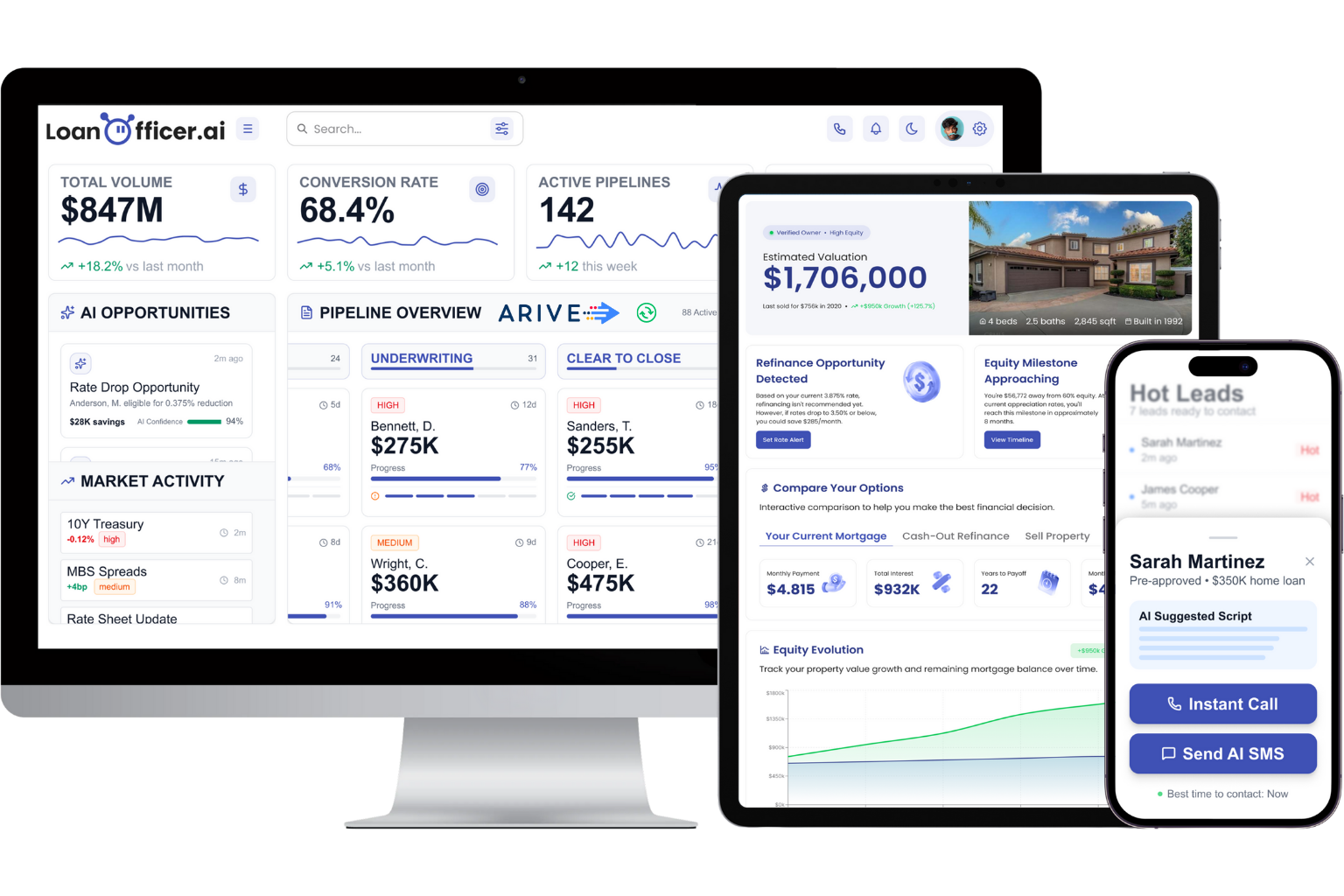
The checklist-to-feature mapping is straightforward. The five-minute SLA becomes an automated routing rule the moment a lead lands. The welcome sequence that hits 48.5% open rates runs on autopilot instead of depending on someone remembering to hit send. Database mining flags refinance and HELOC opportunities inside your existing contact list, turning cold leads back into pipeline without a fresh ad spend. Loan Officer AI reports 93% partner retention, which tracks with what happens when originators stop losing deals to slow response and inconsistent follow-up.
If you’re running this playbook manually right now, a trial of the mortgage CRM is the fastest way to see the routing, drip sequences, and reactivation tools working against your actual pipeline. Onboarding support is available to help map your current process onto the automation from day one.
Sources
These sources back the benchmarks and compliance points covered above, drawn from industry marketing research and a federal consumer protection resource.
- Mortgage Google Ads Statistics (2026 Benchmarks) | Web Tonic™
- Mortgage Lead Conversion Rates: What to Actually Expect by Source | LeadPops
- The three C’s of mortgages: Key factors for successful home financing
