GLBA Compliance in Your CRM: A Mortgage Team Playbook
Any CRM holding nonpublic personal information (NPI) for a financial institution must implement six controls to satisfy the Safeguards Rule (16 C.F.R. Part 314): a written information security program, a designated Qualified Individual, a documented risk assessment, multi-factor authentication (MFA) on every account with NPI access, encryption in transit and at rest, vendor contracts with security obligations, and continuous logging with an incident response plan. If your GLBA compliance CRM setup is missing any of these, you have an exam-ready gap.
Immediate priorities for the first 30 days:
- Designate a Qualified Individual in writing and document their reporting line
- Enable MFA on every CRM user account that can view or export NPI
- Confirm TLS 1.2+ is enforced for all CRM data in transit; verify encryption at rest
- Inventory every third-party integration that receives or returns SSNs, bank account numbers, or credit data
- Draft or update your written information security program to reference CRM-specific controls
- Enable audit logging and confirm logs are retained for at least two years
Pro Tip:Apply role-based access controls (RBAC) combined with field-level encryption on high-sensitivity fields (SSN, income, account numbers) before tackling broader controls. This limits the scope of NPI exposure immediately, which reduces both breach risk and the surface area examiners need to review.
Key Takeaways
A GLBA-compliant CRM program requires a written information security program, a designated Qualified Individual, documented risk assessments, MFA, encryption in transit and at rest, vendor contracts with security obligations, and continuous logging with a tested incident response plan.
| Point | Details |
|---|---|
| Written program and Qualified Individual | Both must be documented, signed, and reference your CRM systems specifically before any exam. |
| MFA and encryption first | These two controls reduce breach likelihood and exam findings most directly; prioritize them in the first 30 days. |
| Vendor contracts are mandatory | Every CRM vendor handling NPI needs a signed agreement with security obligations, breach notification SLAs, and audit rights. |
| Documentation is the compliance program | Logs, test reports, training records, and risk assessments are what examiners evaluate; policies alone are not evidence. |
| Loan Officer AI | Built for mortgage workflows with RBAC, audit logging, SSO/MFA support, and LOS integrations that map to Safeguards Rule requirements. |
Table of Contents
- What does GLBA actually require for CRM systems?
- Which organizations and CRM workflows fall under GLBA?
- What are the Safeguards Rule’s required program elements?
- How do you apply Safeguards Rule controls inside a CRM?
- What do vendor contracts need to cover for GLBA?
- How do you run a GLBA risk assessment for your CRM?
- What monitoring and testing do examiners expect for CRM systems?
- What policies and training does GLBA require for CRM users?
- How do you build an incident response plan for CRM breaches?
- How do privacy notices and opt-outs apply to CRM data flows?
- Your 30/60/90-day GLBA compliance checklist for CRM teams
- Which CRM features directly support GLBA compliance?
- What do regulators look for, and what happens when they find gaps?
- The part of GLBA compliance mortgage CRM teams consistently underestimate
- Loan Officer AI gives mortgage CRM teams a compliance-ready foundation
- Sources
What does GLBA actually require for CRM systems?
The Gramm-Leach-Bliley Act (GLBA) requires financial institutions to protect the NPI they collect from consumers, provide notice of their data-sharing practices, and maintain a written program of safeguards. Two rules do most of the work.
The Privacy Rule (Regulation P) governs notice and opt-out. Under FTC GLBA guidance, financial institutions must give consumers an initial privacy notice at the time of the customer relationship and, in most cases, an annual notice describing what data is shared and with whom. Consumers get the right to opt out of certain third-party disclosures.
The Safeguards Rule is where CRM teams spend most of their compliance effort. It requires a written information security program with administrative, technical, and physical safeguards, a designated Qualified Individual, and documented risk assessments. Enforcement authority is split: the FTC covers non-bank financial institutions (mortgage brokers, auto dealers, tax preparers), while the CFPB, OCC, FDIC, Federal Reserve, and state insurance regulators cover banks, credit unions, and insurers respectively.
What counts as NPI in a CRM context:
- Full name combined with SSN, account number, or credit/debit card number
- Income documentation, tax returns, and pay stubs stored in loan files
- Credit report data and underwriting notes
- Bank account and routing numbers collected for payment or verification
- Any combination of identifiers that could be used to identify a specific consumer’s financial relationship
Statistic callout: The Safeguards Rule’s 2023 updates added prescriptive technical requirements, including mandatory MFA, encryption at rest and in transit, and vendor oversight obligations, that many non-bank institutions had not previously implemented as formal controls.
Which organizations and CRM workflows fall under GLBA?
GLBA defines a “financial institution” broadly. Any company that is “significantly engaged” in financial activities is covered, regardless of whether it holds a bank charter. That definition pulls in mortgage brokers, independent loan officers, non-bank lenders, auto dealers that arrange financing, tax preparers, account servicers, and payday lenders, among others.
For CRM purposes, the question is whether your system stores or processes NPI collected in the course of a financial transaction. Loan origination workflows almost always qualify. Underwriting notes, income documentation, credit pull results, and borrower contact records tied to a loan application are all NPI. Mortgage brokers and loan originators are clearly within Safeguards Rule scope, and common gaps in their CRM environments include unsecured email integrations, shared folder access to loan documents, and unencrypted mobile device access.
Quick scoping checklist for your CRM:
- Does the CRM store SSNs, account numbers, or credit scores? If yes, it is in scope.
- Do any integrations pass NPI to or from a loan origination system (LOS), credit bureau, or document management platform?
- Are borrower income documents or tax records attached to CRM records?
- Does the CRM send or receive data via API to third-party services? Map those endpoints.
- Are marketing or follow-up automations triggered by financial data fields (loan amount, rate, equity)?
Pro Tip:Start your scoping exercise at the integration layer. Any API endpoint or data sync that accepts or returns SSNs, bank account numbers, or credit bureau data is your highest-priority scope item. Everything downstream from those connections is in scope by definition.
What are the Safeguards Rule’s required program elements?
The Safeguards Rule requires a written information security program that is appropriate to your size, complexity, and the sensitivity of the customer information you hold. For a mortgage CRM, that program must include all of the following elements.
Written information security program. A documented policy that names the program’s scope, objectives, and the controls in place. For CRM teams, this means the policy explicitly references the CRM platform, its integrations, and the NPI fields it holds.
Designated Qualified Individual. One person, internal or a qualified service provider, who is responsible for overseeing, implementing, and enforcing the program. This person must report to the board or senior management at least annually.
Written risk assessment. A documented, criteria-based assessment of reasonably foreseeable threats to NPI, the likelihood and impact of those threats, and the controls in place to mitigate them. The assessment must be reviewed and updated regularly.
Access controls. Limit who can access NPI to those with a legitimate business need. In a CRM, this means RBAC, least-privilege configurations, and field-level restrictions on sensitive data.
Encryption. Customer information must be encrypted in transit and at rest unless the institution documents why encryption is infeasible and implements compensating controls. TLS 1.2+ for transit; AES-256 or equivalent for stored data.
Multi-factor authentication. Required for any individual accessing information systems containing customer information, with limited exceptions for documented compensating controls.
Secure development. Applications that interact with NPI must follow secure development practices, including change management and testing before deployment.
Vendor oversight. Written contracts with service providers that bind them to implement appropriate safeguards and permit oversight.
Monitoring and logging. Continuous monitoring of systems and periodic testing of controls, with logs retained to support investigation and audit.
Data retention and disposal. Policies for how long NPI is retained and how it is securely disposed of when no longer needed.
Incident response plan. A written plan for detecting, responding to, and recovering from security events.
GLBA compliance checklist for program completeness:
- [ ] Written information security program exists and references CRM systems
- [ ] Qualified Individual designated in writing with documented reporting line
- [ ] Written risk assessment completed and dated within the last 12 months
- [ ] MFA enabled on all CRM accounts with NPI access
- [ ] Encryption at rest and in transit confirmed and documented
- [ ] RBAC and least-privilege access controls configured
- [ ] Vendor agreements include security obligations and breach notification SLAs
- [ ] Audit logs enabled and retained per policy
- [ ] Incident response plan drafted and tested
- [ ] Secure disposal policy covers CRM data exports and backups
Pro Tip:Map each checklist item to a named document or system artifact before your next exam. “We have a policy” is not evidence. A dated, signed policy document with a version history is.
How do you apply Safeguards Rule controls inside a CRM?
Translating the rule into CRM configurations is where most teams stall. The controls are not abstract; each one maps to a specific setting, log artifact, or vendor capability.
| Safeguards Rule Requirement | CRM Control | Evidence to Collect |
|---|---|---|
| Access controls / least privilege | RBAC roles, field-level permissions | Role assignment export, permission audit log |
| MFA | SSO with MFA enforced (Okta, Azure AD, Duo) | MFA enrollment report, authentication logs |
| Encryption in transit | TLS 1.2+ enforced on all endpoints | SSL/TLS certificate scan, network config screenshot |
| Encryption at rest | AES-256 database and backup encryption | Vendor encryption attestation, SOC 2 report |
| Audit logging | Immutable access and change logs | Log retention policy, sample log export |
| Vendor oversight | Signed DPA/BAA with security clauses | Executed vendor agreements, SOC 2 reports |
| Secure development | Change management process for CRM configs | Change log, approval records |
| Data disposal | Automated retention/deletion rules | Retention schedule, deletion confirmation logs |
| Incident response | Documented IR plan with CRM-specific playbook | Signed IR plan, tabletop exercise record |
Operational steps for a mortgage CRM environment:
- Integrate your CRM with an identity provider (Okta, Microsoft Entra ID, or similar) to enforce MFA and centralize access management
- Configure RBAC so loan officers see only their own borrower records; managers see team records; admins have time-limited elevated access
- Enable field-level encryption on SSN, income, and account number fields at the database layer, not just the application layer
- Set automated data retention rules: define how long closed-loan records are retained, and schedule secure deletion for records past the retention window
- Confirm all API connections to your LOS, credit bureaus, and document platforms use TLS 1.2+ and rotate API keys on a defined schedule
- Enable immutable audit logs and route them to a SIEM (Splunk, Microsoft Sentinel, or equivalent) for alerting and long-term retention
Pro Tip:MFA and encryption at rest are the two controls that most directly reduce both breach likelihood and exam findings for non-bank mortgage lenders. If you have limited implementation resources, start there and document everything before moving to the next control.
What do vendor contracts need to cover for GLBA?
Your CRM vendor processes NPI on your behalf. That makes them a service provider under the Safeguards Rule, and you are required to have a written agreement that binds them to protect that information. Selecting a vendor with a polished sales deck is not a substitute for a signed contract with enforceable security obligations.
Required contract elements:
- Explicit obligation to implement and maintain appropriate safeguards for NPI
- Right to audit or review the vendor’s security controls (or accept a SOC 2 Type II report as evidence)
- Data use limitations: the vendor may not use your borrower data for their own purposes
- Breach notification SLA: vendor must notify you within a defined window (24–72 hours is typical) of any security incident affecting your data
- Subprocessor disclosure: vendor must identify and obtain your approval for any subprocessors that access NPI
- Data return and deletion obligations upon contract termination
Operational oversight to document:
- Collect and retain the vendor’s most recent SOC 2 Type II report or ISO 27001 certificate before onboarding
- Document your due diligence review: who reviewed the report, what gaps were noted, and what compensating controls were agreed upon
- Schedule annual vendor reviews; calendar them and keep attendance records
- Maintain an offboarding checklist that confirms data deletion or return when a vendor relationship ends
- For high-risk vendors (those with direct database access or bulk NPI exports), conduct or commission a security questionnaire annually
Quick steps for remediating high-risk vendors:
- Immediately restrict API access to the minimum data fields required
- Request a current SOC 2 report; if unavailable, issue a written remediation timeline
- Add a data processing addendum (DPA) if one is not already in place
- Escalate to your Qualified Individual if the vendor cannot meet baseline requirements within 30 days
How do you run a GLBA risk assessment for your CRM?
The Safeguards Rule requires a written, criteria-based risk assessment, and examiners treat a missing or undated assessment as a program failure. The assessment does not need to be lengthy, but it must be documented, signed, and tied to specific CRM assets and threat scenarios. NIST SP 800-30 Rev. 1 provides a defensible methodology that examiners recognize: identify assets, enumerate threats and vulnerabilities, estimate likelihood and impact, evaluate control effectiveness, and document a mitigation plan.
Required components of a CRM risk assessment:
- Scope statement: which CRM systems, integrations, and data types are covered
- Asset inventory: CRM platform, LOS integrations, backup systems, API connections, and endpoints
- Threat scenarios: unauthorized access, credential compromise, ransomware, insider misuse, vendor breach, data exfiltration via export
- Vulnerability identification: unpatched software, weak authentication, excessive permissions, unencrypted backups
- Likelihood and impact ratings for each threat/vulnerability pair
- Current control effectiveness: which controls are in place and how well they mitigate each risk
- Risk acceptance criteria: what residual risk level is acceptable and who approves it
- Mitigation plan: specific remediation tasks, owners, and deadlines
- Review cadence: at minimum annually, and after any significant system change
Documenting the Qualified Individual:
- Name and title of the designated individual (or name of the service provider if delegated)
- Written description of their responsibilities: oversight, implementation, enforcement, and annual board reporting
- Reporting line: who they report to and how often
- If delegated to a service provider: the written agreement must specify the delegation and the provider’s qualifications
Pro Tip:The most common examiner finding is a risk assessment that lists threats generically without tying them to specific CRM assets or controls. Name the system, name the threat, name the control, and rate the residual risk. A one-page asset-to-threat matrix beats a 40-page narrative that never mentions your CRM by name.
What monitoring and testing do examiners expect for CRM systems?
Continuous monitoring plus periodic penetration tests and vulnerability assessments are required. The FTC Safeguards Rule guidance is explicit: examiners now expect logs, retained artifacts, and documented testing results, not just a written policy stating that testing occurs.
Monitoring controls to enable in your CRM:
- Immutable audit logs capturing all login attempts, record access, data exports, and configuration changes
- SIEM ingestion of CRM logs for correlation and alerting (failed login spikes, bulk data exports, off-hours access)
- Alerting thresholds for anomalous behavior: more than five failed logins, export of more than 100 records, access from an unrecognized IP
- Privileged session monitoring for admin accounts with elevated CRM access
- Automated backup integrity checks with logged results
| Test Type | Recommended Frequency | Evidence to Retain |
|---|---|---|
| Vulnerability scan (internal) | Quarterly | Scan report, remediation tracking log |
| External penetration test | Annually (or after major changes) | Signed scope agreement, test report, remediation plan |
| Internal application test | Annually | Test methodology, findings, remediation status |
| Phishing simulation | Quarterly | Campaign results, training completion records |
| Tabletop exercise (IR) | Annually | Exercise agenda, participant list, after-action report |
External penetration tests should be conducted by a qualified third party with no prior access to your CRM environment. Keep the scope agreement, the test report, and your remediation tracking document together in a single evidence folder. CISA’s incident response guidance recommends tabletop exercises that simulate realistic breach scenarios, including CRM-specific ones like a compromised loan officer credential or a bulk borrower data export.
What policies and training does GLBA require for CRM users?
Documented policies and role-based training are required elements of the Safeguards Rule information security program. A policy that exists but has never been communicated to CRM users is not a functioning control; examiners will ask for training completion records.
Policy topics your program must cover:
- Acceptable use of the CRM and NPI handling rules
- Least-privilege access: users may not access records outside their assigned role
- Removable media and data export restrictions
- Remote access requirements (VPN, MFA, approved devices only)
- Social engineering and pretexting awareness (GLBA has specific pretexting provisions)
- Password management and credential hygiene
- Incident reporting: how and to whom employees report suspected breaches
Recurring training and onboarding checklist:
- New employee onboarding: complete GLBA awareness training before CRM access is provisioned
- Annual refresher training for all CRM users; retain completion certificates
- Role-specific training for admins and privileged users covering access management and log review
- Phishing simulations at least quarterly; track click rates and require remedial training for failures
- Offboarding: CRM access revoked same day as termination; document the revocation
For new loan officers joining a team, the onboarding checklist should include a signed acceptable-use acknowledgment before any NPI access is granted. Privileged-user training deserves its own module: admins who can export bulk borrower records or modify access controls are your highest-risk users and need scenario-based training that goes beyond a general awareness video.
How do you build an incident response plan for CRM breaches?
Maintain a documented incident response plan that covers detection, containment, investigation, stakeholder notification, remediation, and regulatory reporting triggers. Without a written plan, a breach becomes a crisis; with one, it becomes a managed event with a documented outcome.
CRM-specific IR playbook items:
- Isolate compromised CRM accounts immediately: disable credentials, revoke API tokens, force session termination
- Snapshot audit logs and preserve forensic images before any remediation activity alters evidence
- Notify your Qualified Individual and legal counsel within the first hour of confirmed incident
- Document the timeline: when the event was detected, what data was potentially accessed, how many consumer records were involved
- Communicate with your CRM vendor per the breach notification SLA in your contract
- Preserve all vendor communication in writing
The FTC’s reporting threshold is clear: if a security event compromises the unencrypted NPI of 500 or more consumers, you must notify the FTC as soon as possible, and no later than 30 days after discovery. That threshold makes encryption a direct compliance lever: encrypted data that is exfiltrated without the key does not trigger the reporting obligation in the same way unencrypted data does.
Pro Tip:Run a tabletop exercise that starts with a specific CRM scenario: a loan officer’s credentials are compromised and used to export 600 borrower records overnight. Walk through every step of your IR plan against that scenario. The gaps you find in a tabletop cost nothing to fix; the gaps you find during a real breach cost significantly more. Use CISA’s IR plan framework as your exercise structure.
How do privacy notices and opt-outs apply to CRM data flows?
CRM data recipients and sharing arrangements that fall outside GLBA’s enumerated exceptions trigger initial and sometimes annual privacy notices, along with opt-out rights. The practical question for CRM teams is: which data flows in your system involve disclosures to third parties that are not covered by an exception?
What to include in privacy notices and how to wire opt-outs into your CRM:
- Initial notice at the time of the customer relationship: describe what NPI you collect, how you use it, and with whom you share it
- Opt-out mechanism: a clear, easy method for consumers to opt out of disclosures to non-affiliated third parties; store the opt-out flag in the CRM as a consent field
- Annual notice: required unless the FAST Act exception applies (no changes to your privacy practices and no disclosures that trigger opt-out rights); the FDIC compliance manual details the specific criteria
- Map CRM marketing automation triggers to consent flags: do not send third-party marketing to consumers who have opted out
Exceptions checklist (when opt-out is not required):
- Disclosures to service providers performing services on your behalf (Section 13 exception)
- Disclosures required by law or to protect against fraud (Section 15 exception)
- Disclosures to affiliates (Section 14 exception, with limits)
- Disclosures in connection with the sale of the business
Retention and reuse limits: NPI received from a third party under a Section 13 exception may only be used for the purpose for which it was disclosed. Storing it in your CRM for unrelated marketing purposes violates the rule. Build data-use tags into your CRM records to track the source and permitted use of each data element.
Your 30/60/90-day GLBA compliance checklist for CRM teams
A short, prioritized action plan closes the most common CRM GLBA gaps faster than a comprehensive program overhaul attempted all at once.
Days 1–30: Foundation
- Designate the Qualified Individual in writing; document their role, responsibilities, and reporting line
- Enable MFA on every CRM account with NPI access; no exceptions
- Confirm TLS 1.2+ on all CRM data in transit; document the verification
- Inventory all CRM integrations that handle NPI; flag any without a signed vendor agreement
- Draft or update the written information security program to reference CRM systems explicitly
- Enable audit logging; confirm logs are retained for at least two years
Days 31–60: Controls and Contracts
- Complete a written risk assessment using the NIST SP 800-30 framework; have the Qualified Individual sign it
- Configure RBAC and least-privilege access; remove any shared or generic login accounts
- Enable field-level encryption on SSN, income, and account number fields
- Execute data processing addendums with all CRM vendors and integrations that lack them
- Collect SOC 2 Type II reports or equivalent from your CRM vendor and key integrations
- Draft the incident response plan; assign roles and communication responsibilities
Days 61–90: Testing and Training
- Schedule and complete a vulnerability scan; document findings and remediation tracking
- Deliver GLBA awareness training to all CRM users; retain completion records
- Run a tabletop exercise using a CRM-specific breach scenario
- Review and update the privacy notice; confirm opt-out flags are functional in the CRM
- Schedule the annual penetration test with a qualified third party
- Present a program status summary to senior management or the board
Low-effort, high-impact fixes to prioritize:
- MFA enrollment takes hours and immediately reduces credential-compromise risk
- Revoking stale user accounts (former employees, unused service accounts) costs nothing and closes a common exam finding
- Collecting your CRM vendor’s SOC 2 report requires one email and provides immediate audit evidence
Which CRM features directly support GLBA compliance?
A CRM purpose-built for mortgage workflows can centralize evidence and speed remediation. When evaluating or configuring your platform, these features map directly to Safeguards Rule requirements.
Features and their Safeguards Rule evidence:
- Field-level encryption: Satisfies encryption-at-rest requirement; ask your vendor for an encryption architecture diagram and their key management documentation
- Immutable audit logs with configurable retention: Satisfies logging and monitoring requirements; request a sample log export showing user, timestamp, action, and record accessed
- SSO with enforced MFA: Satisfies the MFA requirement; request an MFA enrollment report and authentication log sample
- Role-based access controls: Satisfies access control and least-privilege requirements; request a role matrix and permission audit capability
- Automated data retention and deletion rules: Satisfies secure disposal requirements; request a demo of the retention schedule configuration and deletion confirmation logs
- Vendor access controls and audit trails for admin sessions: Satisfies vendor oversight and privileged-access monitoring requirements
- Secure API gateway with TLS enforcement and key rotation: Satisfies encryption-in-transit and secure development requirements
Pro Tip:When evaluating a CRM vendor’s compliance claims, ask for three specific artifacts: a current SOC 2 Type II report, a sample audit log export, and a demo of their MFA enforcement configuration. Vendors who cannot produce these during a sales process will not produce them during an exam either.
What do regulators look for, and what happens when they find gaps?
Regulators focus on written program evidence, documented risk assessments, a named Qualified Individual, and demonstrable technical controls. Lack of documentation and unencrypted NPI are the two most common exam findings. A policy that exists only as a Word document with no version history, no signatures, and no evidence of implementation is treated as a program failure.
Common deficiencies found in examinations:
- No written information security program, or one that does not reference specific systems
- Risk assessment missing, undated, or not tied to actual CRM assets
- Qualified Individual not formally designated or lacking a documented reporting line
- MFA not enforced on all accounts with NPI access
- Vendor agreements lacking security obligations or breach notification clauses
- Audit logs not enabled, not retained, or not reviewed
- No incident response plan or one that has never been tested
Enforcement consequences range from FTC consent orders requiring multi-year compliance programs and third-party assessments to civil money penalties. The FTC has authority to seek civil penalties for Safeguards Rule violations, and state attorneys general can bring parallel actions under state data protection laws.
Statistic callout: Under the updated Safeguards Rule, any security event compromising the unencrypted NPI of 500 or more consumers triggers an FTC notification obligation, with reporting required as soon as possible and no later than 30 days after discovery.
Well-kept documentation does more than satisfy an examiner. It compresses investigation timelines when a breach occurs, demonstrates good faith in enforcement proceedings, and gives your Qualified Individual a defensible record of program maturity. Examiners who find organized, dated, signed artifacts move through an exam faster and with fewer findings than those who find a folder of undated drafts.
The part of GLBA compliance mortgage CRM teams consistently underestimate
Most mortgage CRM teams treat GLBA compliance as a one-time project: get the policy written, check the boxes, move on. That framing is exactly what creates the gaps examiners find. The Safeguards Rule update shifted the standard from “do you have a policy” to “can you show it working.” Logs, test reports, training records, and vendor agreements are not administrative overhead; they are the compliance program.
For mortgage teams specifically, the highest-leverage move is not the most technically complex one. It is data minimization: stop storing NPI your CRM does not need. If your system holds income documents, tax returns, and credit reports that could live in your LOS or document management system instead, move them. Every field of NPI you remove from your CRM is a field you do not need to encrypt, log, audit, or defend in an exam.
The trade-off between speed and documentation is real, but it resolves cleanly when you build compliance into the product roadmap rather than retrofitting it after a near-miss. A CRM admin who enables MFA and audit logging during initial setup spends 30 minutes. The same admin enabling those controls after an examiner flags their absence spends weeks on remediation documentation. The math is not close.
Leadership buy-in is the actual bottleneck in most organizations. Frame compliance investment in terms of enforcement risk and breach cost, not regulatory obligation. A consent order requiring a third-party assessor for three years costs more than the entire compliance program would have.
Loan Officer AI gives mortgage CRM teams a compliance-ready foundation
Mortgage CRM teams that need to close GLBA gaps quickly benefit from a platform built around the workflows where NPI lives. Loan Officer AI’s mortgage CRM is designed for exactly this environment: pipeline management, borrower engagement, and LOS integrations, with the administrative controls that compliance programs require.
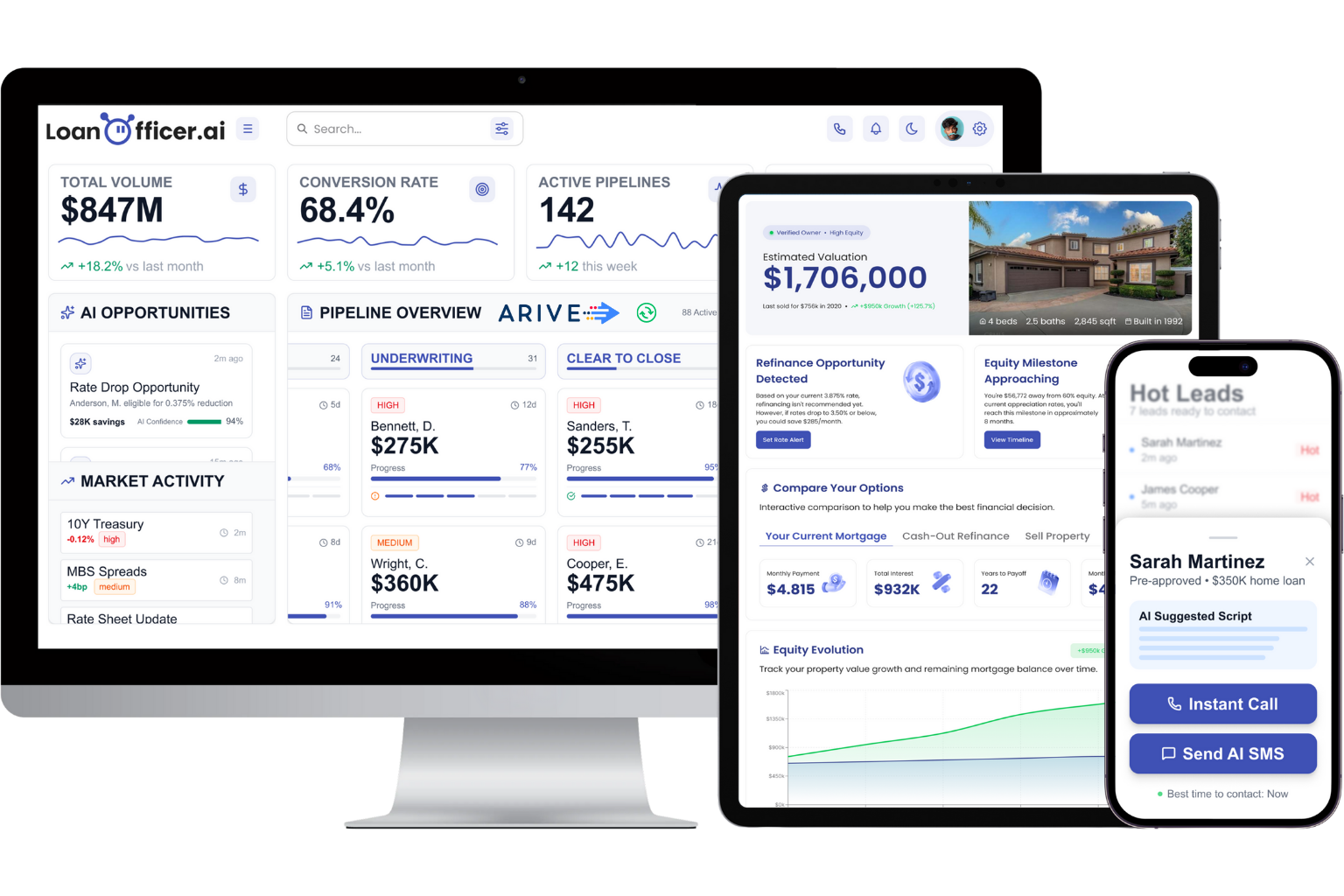
For mortgage brokerages managing multiple loan officers and borrower records, the platform’s role-based access controls, audit logging, and SSO/MFA support map directly to Safeguards Rule evidence requirements. Automated retention and deletion rules reduce the manual effort of maintaining a compliant data lifecycle. Vendor access controls and secure API integrations support the oversight obligations your written program must document.
When you evaluate Loan Officer AI as your compliance-ready CRM, request the SOC 2 report, a sample audit log export, and a walkthrough of the MFA enforcement configuration. That is the same due diligence you should apply to any CRM vendor handling your borrowers’ NPI. Start a trial to see the platform’s compliance-relevant features in your own environment before committing.
Sources
These primary regulatory and technical references belong in every mortgage CRM compliance team’s evidence packet.
- CFR-2022-title16-vol1-part314.pdf
- Gramm-Leach-Bliley Act
- Gramm-Leach-Bliley Act - FDIC Consumer Compliance Examination Manual
- NIST SP 800-30 Rev. 1
- Incident response plan basics
