Mortgage Lead Routing for Loan Officers: Higher Conversions
The single best move for any mortgage sales team right now is to deploy a real-time, rules-based routing system layered with predictive AI matching, built specifically for mortgage workflows. That combination cuts response time from hours to seconds, raises contact rates materially, and keeps your team on the right side of the Homebuyers Privacy Protection Act and the Fair Credit Reporting Act (FCRA). Platforms like Loan Officer AI are the class of tool to evaluate: mortgage-native CRMs that wire together routing logic, LOS integrations, and automated multi-channel response in one place.
Key Takeaways
Real-time mortgage lead routing, combined with license validation and automated multi-channel response, is the single highest-leverage change a mortgage sales team can make to contact rate and funded-loan conversion.
| Point | Details |
|---|---|
| Speed determines contact rate | Industry playbooks target a five-minute response window; webhook routing cuts assignment time to under two minutes. |
| License validation is non-negotiable | Route only to LOs licensed in the borrower’s state; a rules engine must check NMLS data before every assignment. |
| Trigger leads are now restricted | The Homebuyers Privacy Protection Act, effective March 5, 2026, limits credit bureau trigger-lead sales to narrow FCRA exceptions. |
| Predictive routing needs retraining | AI match models degrade as market conditions shift; retrain continuously on funded-vs-lost outcomes to maintain accuracy. |
| Loan Officer AI automates the full workflow | Loan Officer AI combines instant lead response, LOS integrations, and automated follow-up with a reported 93% partner retention rate. |
This article is general information, not a substitute for advice from a qualified financial advisor. Consult a qualified financial professional about your own circumstances before acting on anything here.
Table of Contents
- What is mortgage lead routing and why does it matter?
- What routing strategies and rules should your team actually use?
- Which CRM and integration features are essential for reliable routing?
- How do trigger-lead restrictions change your routing and acquisition strategy?
- How do you implement automated mortgage lead routing step by step?
- Which KPIs should you track and what benchmarks are realistic?
- How Loan Officer AI applies AI routing to improve lead handling
- What does implementation actually cost and how long does it take?
- What Mortgage Teams Should Do in the Next 90 Days
- Primary sources and further reading
- The part of mortgage lead routing advice that nobody says out loud
- Loan Officer AI is built for exactly this routing challenge
- Sources
What is mortgage lead routing and why does it matter?
Mortgage lead routing is the automated process of capturing an inbound lead and assigning it to the right loan officer within seconds, based on a defined set of rules. The mechanics look like this: a borrower submits a web form or calls in, a webhook fires instantly to your CRM or dialer, the rules engine evaluates the lead against your criteria, and the assigned LO gets an immediate notification. No manual sorting. No leads sitting in a shared inbox.

Why speed is the whole game
Industry playbooks consistently recommend contacting internet leads within five minutes, with many high-performing teams targeting a 60-second live-call attempt followed by an automated SMS if no answer. The gap between a five-minute response and a 30-minute response is not incremental. It often means the difference between a conversation and a voicemail that never gets returned.
Beyond speed, routing affects three other things managers often underestimate:
- Workload fairness. Without transparent assignment logic, top producers get buried while newer LOs sit idle. That creates resentment and lead ownership disputes that are genuinely hard to unwind.
- Compliance exposure. Misrouted leads, especially those tied to purchased trigger data, can create FCRA liability if the routing system lacks audit trails.
- Integration depth. Reliable routing requires your LOS, dialer, SMS provider, and web forms to exchange data cleanly. A routing system that sits outside your LOS is a manual reconciliation problem waiting to happen.
The primary routing types every team should know: round-robin (equal distribution across available LOs), geographic or license-based (match borrower state to licensed LO), loan-type specialist (FHA, VA, jumbo routed to credentialed LOs), skill-based (language, product expertise), capacity-based (cap daily volume per LO), and time-of-day fallbacks (after-hours queue or on-call assignment).
What routing strategies and rules should your team actually use?
The catalog of routing rules is longer than most teams implement. Here is how to think about each one and when it earns its place.
Geographic and license routing is non-negotiable. Routing a California borrower to an LO not licensed in California is a compliance failure, not just an operational one. Your rules engine must validate state licensure before assignment, every time.
Loan-type specialist routing pays off when your team has genuine product depth. Route VA and jumbo leads to your credentialed specialists; let round-robin handle conventional conforming.
Capacity-based routing prevents burnout and lead waste. Set a daily maximum per LO. When an LO hits the cap, leads roll to the next available agent or enter a priority queue. Without this, your best closer gets 40 leads on Monday and zero on Friday.
Time-of-day and fallback rules are where most teams leave money on the table. An after-hours lead that sits unassigned until 9 AM has already been called by two competitors. Configure fallback logic: if no LO accepts within two minutes, escalate to a backup, trigger an automated SMS acknowledgment, and queue the lead for a morning callback with a timestamp.
Example workflows
Purchase lead, business hours: Webhook fires → license check passes → round-robin among available purchase specialists → SMS + email to LO → LO has 90 seconds to accept → if no accept, escalates to team lead.
Refinance lead, after hours: Webhook fires → routed to on-call LO → automated SMS sent to borrower confirming receipt → callback queued for 8 AM with lead details pre-populated in CRM.
High-score predictive lead, any time: AI match score exceeds threshold → bypasses round-robin → routed directly to the LO with the highest historical conversion rate for that loan type and borrower profile.
When to use predictive routing over static rules
Static rules are fast to configure and easy to audit. Predictive routing, where an AI model ranks LOs by their historical performance with a given lead profile, can produce materially higher conversion when deployed correctly. Vendors have reported conversion improvements, though these figures should be considered indicative rather than guaranteed. The honest caveat: predictive models degrade as market conditions shift and must be retrained continuously on funded-vs-lost outcomes to stay accurate. A model trained on a 2024 rate environment will mislead you in a 2026 one.
| Routing Type | Best For | Key Requirement |
|---|---|---|
| Round-robin | Equal workload distribution | Availability tracking |
| Geo/license | Multi-state teams | Real-time NMLS validation |
| Loan-type specialist | FHA, VA, jumbo volume | Product credentialing data |
| Capacity-based | Preventing LO overload | Daily cap configuration |
| Predictive/AI | High-volume teams with outcome data | Continuous model retraining |
| Time-of-day fallback | After-hours coverage | On-call schedule integration |
Pro Tip:Build a transparent lead counter visible to every LO on the team. When agents can see the distribution in real time, gaming attempts drop and disputes about fairness nearly disappear.
Which CRM and integration features are essential for reliable routing?
A routing system is only as reliable as its integrations. Here is the feature checklist that separates a production-grade setup from a demo that falls apart in week two.
Must-have features:
- Webhook endpoints that accept lead data from all major sources (web forms, call tracking, third-party lead vendors) with sub-second delivery
- Rules engine with conditional logic: AND/OR operators, field-level matching, priority tiers
- License and state validation against NMLS data before assignment
- LOS integration (Encompass, Byte, Calyx, or your platform of choice) so lead data flows directly into the loan file without re-entry
- Dialer and IVR integration for immediate live-connect attempts
- Automated SMS and email triggers on assignment and on fallback
- Fallback and queuing logic with configurable SLA timers
- Audit logs with timestamps, assignment history, and override records
Nice-to-have features:
- Predictive match scoring with retraining cadence
- Real-time dashboard showing queue health, unclaimed leads, and SLA breach alerts
- Mobile app push notifications for LOs in the field
- Borrower-facing acknowledgment automation (immediate “we received your request” message)
The LOS integration deserves a specific note. When lead data flows from your routing system directly into your LOS, you eliminate the manual re-entry step that costs LOs 15–20 minutes per lead and introduces transcription errors. That time compounds fast across a team of 10 LOs handling 50 leads a week.
Pro Tip:Before signing any routing software contract, ask the vendor for a live webhook test with your actual LOS. A demo environment that works perfectly often reveals field-mapping gaps the moment it touches your real loan data.
How do trigger-lead restrictions change your routing and acquisition strategy?
The Homebuyers Privacy Protection Act amends 15 U.S.C. 1681b© of FCRA to narrow when consumer reporting agencies may furnish mortgage-related consumer reports. The practical effect: credit bureaus can no longer freely sell trigger lead data generated by a mortgage credit inquiry unless a narrow exception applies.
The law, which took effect March 5, 2026, limits permissible trigger-lead outreach to situations where the lender has an existing qualifying relationship with the consumer, the consumer has explicitly opted in to prescreening, or the outreach constitutes a firm offer of credit meeting FCRA requirements. Carve-outs favor existing servicers and depositories over independent brokers and non-bank lenders.
Industry analysis confirms that the Act materially restricts trigger-lead availability and is pushing lenders toward predictive targeting, stronger CRM automation, and referral pipelines. For independent brokers and non-bank lenders without large existing servicing portfolios, the carve-outs offer little relief. HousingWire’s coverage frames the rule plainly: credit bureaus generally cannot sell trigger leads tied to mortgage credit inquiries except under those narrow exceptions.
Compliance checklist for routing and marketing teams
- Audit every lead source for consent documentation before routing any purchased leads
- Capture explicit opt-in at the point of web form submission, not buried in terms
- Validate existing-relationship status before using the carve-out (servicer records, deposit account data)
- Require written vendor attestations confirming their lead data meets FCRA permissible-purpose standards
- Log every lead’s consent status and source in your CRM with a timestamp
- Never route a lead whose consent status is unverified, even temporarily
The operational shift is real. That is not a minor adjustment. It is a fundamental reorientation toward owned lead sources and CRM automation.
Pro Tip:Audit logs and consent proofs are not just compliance theater. When a vendor audit or regulatory inquiry arrives, a timestamped log of every lead’s consent status and routing history is what keeps a $50,000 fine from becoming a $500,000 one.
How do you implement automated mortgage lead routing step by step?
A phased rollout prevents the two most common failure modes: launching with bad field mapping and launching without LO buy-in.
Phase 1: Audit (Week 1–2)
- Map every current lead source and document the fields each one sends.
- Identify gaps between source fields and your CRM/LOS field requirements.
- Verify licensure data for every LO on the team against current NMLS records.
- Document current response-time performance as your baseline.
Phase 2: Configuration (Week 2–3)
- Build webhook endpoints for each lead source and test with live data.
- Configure routing rules in priority order: license check first, then loan type, then round-robin or predictive.
- Set fallback timers and escalation paths.
- Configure SMS, email, and dialer triggers on assignment and fallback events.
Phase 3: Pilot (Week 3–5)
- Run a defined sample (at least 100 leads) through the new system with a control group on the old process.
- Measure: response time, contact rate, lead acceptance rate, and LO satisfaction.
- Collect LO feedback on notification format and timing.
- Fix field-mapping errors and adjust fallback timers based on real data.
Phase 4: Full rollout (Week 5–8)
- Migrate all lead sources to the new routing system.
- Train every LO on the acceptance workflow and mobile notifications.
- Assign a sales ops owner for ongoing rule maintenance and exception logging.
- Schedule a 30-day post-launch review.
Common pitfalls to avoid:
- Poor field mapping is the top cause of routing failures. A lead with a blank state field cannot trigger a license check. Fix this before go-live.
- Missing notifications mean LOs never see the lead. Test every notification channel in the pilot.
- Agent opt-out happens when LOs feel the system is unfair. Transparent counters and clear escalation rules prevent most of it.
- No fallback logic means after-hours leads age out. Every routing rule needs a fallback path.
Pro Tip:Automate a mortgage lead follow-up sequence that fires the moment a lead is assigned, not when the LO manually triggers it. An immediate SMS acknowledgment to the borrower buys you 20–30 minutes before they call the next lender.
Which KPIs should you track and what benchmarks are realistic?
| KPI | Definition | Why It Matters |
|---|---|---|
| Response time | Seconds from lead creation to first contact attempt | Directly predicts contact rate |
| Contact rate | % of leads where a live conversation occurs | Primary routing health metric |
| Lead acceptance rate | % of routed leads accepted by LO within SLA | Flags notification or workload issues |
| Appointment set rate | % of contacted leads that schedule a consultation | Measures LO conversation quality |
| Application start rate | % of appointments that begin a loan application | Funnel efficiency indicator |
| Funded loan rate | % of applications that close | Ultimate conversion metric |
| Cost per funded loan | Total lead acquisition + routing cost / funded loans | ROI anchor for budget decisions |
Response time under five minutes is the threshold most industry playbooks treat as the dividing line between competitive and non-competitive. Teams moving from manual assignment to real-time webhook routing typically see response time drop from 30–60 minutes to under two minutes, with contact rate improvements that follow. Predictive routing vendors report double-digit conversion lifts, though those are vendor-cited figures and actual results vary by team size, lead quality, and model retraining cadence.
A few measurement principles worth building into your reporting:
- Track attribution from source to LO to outcome. Without source-level data, you cannot tell whether a routing change improved results or whether a better lead source did.
- Run A/B tests on routing rules with at least 200 leads per variant before drawing conclusions. Smaller samples produce noise, not signal.
- Build a real-time dashboard that shows queue depth, unclaimed leads older than five minutes, and SLA breach counts. A weekly report is too slow to catch a broken webhook.
Statistic callout: Industry guidance consistently identifies the five-minute response window as the threshold for materially higher conversion on internet leads. Teams that automate immediate SMS plus a follow-up call within one to four hours report the strongest contact rates across inbound channels.
How Loan Officer AI applies AI routing to improve lead handling
Loan Officer AI is a mortgage-native CRM built around the specific workflows loan officers and sales managers actually use: automated lead response, pipeline management, LOS integrations, and multi-channel follow-up sequences. It is not a generic CRM with a mortgage skin on it.
Key capabilities relevant to routing and lead handling:
- Automated lead capture and instant response: Leads from web forms and third-party sources trigger immediate SMS and email acknowledgments without LO intervention.
- AI-driven prioritization: The platform surfaces high-priority leads based on borrower signals and historical performance data, so LOs focus on the leads most likely to convert.
- LOS integrations: Data flows directly into compatible loan origination systems, eliminating manual re-entry and the field-mapping errors that break routing logic.
- Pipeline management: Every lead’s status, response history, and next action is visible in one place, which reduces the “where did that lead go?” problem that plagues shared inboxes.
- Reported outcomes: Loan Officer AI reports a 93% partner retention rate and significant time savings for teams that move from manual follow-up to automated workflows.
The practical takeaway from teams using the platform: the biggest gains come not from the routing logic alone but from the combination of instant response, automated nurture sequences, and current mortgage rates overview. A lead routed correctly but followed up manually still loses to a competitor with a slower router and a faster automated response.
Pro Tip:Use Loan Officer AI’s AI follow-up automation to run a 30-day nurture sequence on every lead that does not convert in the first week. Database mining for refinance and HELOC opportunities turns cold leads into pipeline without any additional acquisition spend.

What does implementation actually cost and how long does it take?
Cost factors for a mortgage lead routing implementation break into five buckets:
- Platform subscription: Mortgage-specific CRMs with routing capabilities typically run on monthly or annual SaaS pricing. Loan Officer AI offers tiered plans for individual LOs, small teams, and enterprise deployments, with an optional one-time onboarding fee.
- Integration development: Connecting to a non-standard LOS or a proprietary lead source requires custom webhook work. Budget for developer time if your LOS is not on the platform’s standard integration list.
- Dialer and SMS costs: Per-minute and per-message fees add up at volume. Get a usage estimate before committing to a plan tier.
- Training and change management: LO adoption is the most underestimated cost. Budget for at least two training sessions and a 30-day support period.
- Data migration: Moving historical lead and contact data from a legacy CRM adds time and sometimes cost depending on data volume and cleanliness.
Timeline estimates by team size:
- Small team (1–5 LOs): Audit through full rollout in 3–4 weeks. Standard integrations, minimal custom work.
- Mid-size team (6–20 LOs): 6–8 weeks. LOS integration testing and LO training add time.
- Enterprise (20+ LOs, multi-branch): 10–16 weeks. Custom LOS work, geographic licensing checks across multiple states, and phased branch rollouts drive the timeline.
For most teams, the math closes within 60–90 days of full deployment.
Pro Tip:Negotiate your onboarding fee against a 90-day performance review. If contact rate and response time do not improve measurably, you have a documented basis for renegotiation. Most vendors with a strong product will accept this.
What Mortgage Teams Should Do in the Next 90 Days
The five actions that move the needle, in priority order:
- Audit your lead sources and consent documentation (Sales ops, Week 1). Every purchased lead source needs a FCRA permissible-purpose review before March 5, 2026 compliance exposure compounds.
- Implement webhook-based lead capture for all inbound sources (IT + Sales ops, Week 2–3). Replace any polling-based integrations. Sub-second delivery is the baseline.
- Configure license validation and routing rules before going live (Compliance + Sales ops, Week 3–4). State licensure check must run before any assignment.
- Pilot predictive routing with a 100-lead sample (Sales ops, Week 4–6). Measure contact rate and funded-loan rate against your static-rules baseline before full deployment.
- Build your KPI dashboard with real-time queue health and SLA breach alerts (IT, Week 5). Weekly reporting is too slow to catch routing failures.
Teams ready to move fast should evaluate Loan Officer AI’s trial to see the routing, follow-up automation, and pipeline management capabilities in a live environment before committing to a full deployment.
Primary sources and further reading
- Congress: The primary statutory text amending FCRA. Read this before finalizing any compliance checklist.
- New trigger-lead rules: a lender’s guide (National Mortgage News): Best industry summary of the Act’s practical effects on lender acquisition strategy.
- Mortgage trigger leads restrictions (HousingWire): Clear explanation of what credit bureaus can and cannot sell after the Act.
- Trigger-lead ban takes effect (RISMedia): Confirms the March 5, 2026 effective date and explains which institutions benefit from carve-outs.
- Mortgageleads: Technical how-to on webhook mechanics, speed advantages, and routing rule configuration.
- Mortgage lead conversion playbook (HowToWorkLeads): Practical cadence guidance for response time SLAs and follow-up sequences.
- Loanofficer: Covers AI adoption trends and predictive routing applications post-trigger-lead restrictions.
The part of mortgage lead routing advice that nobody says out loud
Most articles on this topic treat routing as a technology problem. Configure the right rules, pick the right software, and your contact rate goes up. That framing is not wrong, but it misses the harder part.
The real constraint for most mortgage teams is not the routing system. It is the gap between when a lead is assigned and when an LO actually works it. A webhook that fires in 200 milliseconds does nothing if the LO ignores the notification for 45 minutes because they are on another call, or because they have learned that half the leads from that source are low quality and not worth interrupting a conversation for.
The Homebuyers Privacy Protection Act makes this worse before it makes it better. Teams that lose trigger-lead volume will feel pressure to work every remaining lead harder. That pressure, without better tooling, leads to LO burnout and cherry-picking, which are the two behaviors that break routing fairness faster than any technical failure.
The teams that will win post-Act are not the ones with the most sophisticated routing algorithm. They are the ones that combine real-time routing with automated borrower acknowledgment (so the borrower feels attended to immediately), transparent workload distribution (so LOs trust the system), and continuous retraining of their predictive models on actual funded outcomes. The technology is the easy part. The operational discipline to maintain it is where most teams fall short.
For loan officers evaluating mortgage lead management software, the question to ask is not “does this route leads fast?” It is “does this give me the visibility and automation to work every lead correctly, even when I am busy?” Those are different products.
Loan Officer AI is built for exactly this routing challenge
Replacing trigger-lead volume with first-party capture and automated routing is not a minor workflow adjustment. It requires a CRM that handles instant lead response, compliance-aware routing, and multi-channel follow-up without manual intervention at every step. That is the gap Loan Officer AI fills for mortgage teams.
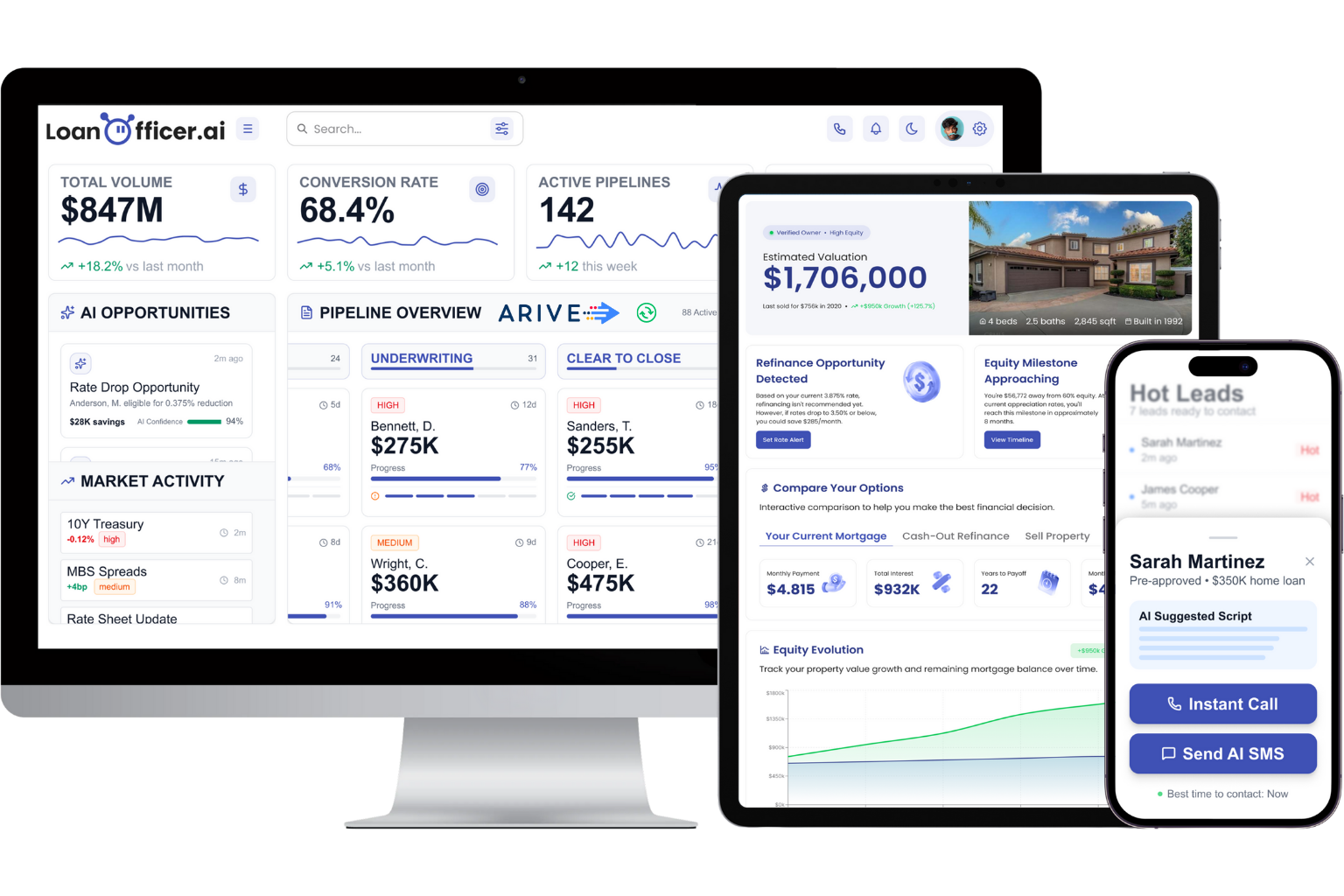
The platform connects lead capture, routing rules, LOS integrations, and automated SMS and email sequences in one mortgage-native system. LOs get notified instantly, borrowers get acknowledged immediately, and sales managers get real-time pipeline visibility without chasing status updates.
Teams evaluating the platform can Loanofficer or explore the mortgage CRM for brokerages page to see how the routing and automation features map to your team’s specific workflow.
Sources
- Congress
- New trigger-lead rules: a lender’s guide — National Mortgage News
- Law effectively banning ‘trigger leads’ takes effect — RISMedia
- Mortgageleads
