Open House Follow-Up: The 14-Day Playbook That Converts
Run this exact sequence after every open house: send a personalized text within 4 hours, make a live call on day 2, send a value email on day 5, and close with a consultation offer on day 14. That four-touch cadence over 14 days is the highest-converting sequence for open-house visitors, and it works because it matches the natural decision timeline of an active buyer.
Before you leave the property, do three things:
- Confirm your digital sign-in captured name, phone, email, and one qualifying note for every visitor.
- Send a short personalized text to every attendee while the event is still fresh.
- Add each contact to your CRM with tags for timeline, representation status, and interest level.
Your four-hour window matters more than most agents realize. Pull up your sign-in list, write one personal detail next to each name (the kitchen comment, the school question, the price concern), and fire off your texts before dinner. Schedule your day-2 calls before you close your laptop. Everything else in this guide builds on those first four hours.
Key Takeaways
A fast, structured open house follow-up sequence built on the 14-day, 4-touch cadence converts more visitors than any amount of on-site charm alone.
| Point | Details |
|---|---|
| Send the first text within 4 hours | Reference one specific detail from the visit; generic texts get ignored. |
| Run the 4-touch cadence without skipping | Day 0 text, day 2 call, day 5 email, day 14 consultation offer is the highest-converting sequence. |
| Score every lead on-site | Use the 3-question, 6-point scorecard to triage who gets a same-day call versus a monthly drip. |
| Automate capture and first contact | Connect your sign-in app to your CRM via webhook so same-day texts fire automatically. |
| Drip unconverted leads for 6–18 months | Most open-house visitors who convert do so within 6–18 months; never delete a warm contact. |
Table of Contents
- Why a fast open house follow-up converts more visitors
- What to collect at the door and how to capture it cleanly
- How to write and send same-day texts that get replies
- Phone call scripts for day-2 and day-14 outreach
- High-converting follow-up emails: templates and when to send each
- The copyable 14-day follow-up cadence
- How to qualify leads quickly with three questions and a scorecard
- Monthly drip content and re-engagement after day 14
- Which tools should you automate and which should stay manual?
- Common follow-up mistakes and U.S. compliance basics
- What the research says about the 4-touch, 14-day sequence
- A note on keeping this system sustainable week after week
- Your loan officer partner can run the same system in parallel
- Sources
Why a fast open house follow-up converts more visitors
Speed and relevance together drive contact rates. An agent who texts a visitor within hours while the home is still vivid in their mind gets a fundamentally different response than one who sends a generic email three days later.
Industry data shows roughly half of open-house attendees receive no follow-up at all when agents rely on manual processes. That gap is your opportunity. A well-marketed open house typically draws 10–30 visitors in a 2–4 hour window, which means even a modest event hands you a dozen warm contacts who already know the property, the neighborhood, and your face.
Three behavioral reasons the structured approach outperforms ad-hoc follow-up:
- Timing: Buyers are most emotionally engaged within hours of the visit. A same-day text catches them before competing listings crowd out the memory.
- Personalization: Referencing one specific detail from the conversation (the backyard, the commute question, the price range they mentioned) signals that you listened. Agents who follow up quickly with personalized outreach earn trust faster in today’s local markets.
- Multichannel consistency: Text, phone, and email each reach different buyers at different moments. Hitting all three over 14 days keeps you visible without feeling aggressive.
The agents who convert the most open-house visitors aren’t necessarily the most charming on-site. They’re the most consistent in the 14 days after.
What to collect at the door and how to capture it cleanly
Paper sign-in sheets lose data. Ink smears, handwriting is illegible, and you end up with a stack of cards you have to re-enter manually on Sunday night. A tablet-based digital sign-in solves all three problems and, when connected to your CRM via webhook, triggers your same-day text automatically.

Collect these six fields at minimum:
| Field | Why it matters |
|---|---|
| Full name | Personalizes every follow-up touch |
| Best phone number | Enables same-day text and day-2 call |
| Email address | Required for drip enrollment and email templates |
| Working with an agent? | Flags represented buyers so you don’t waste pitch energy |
| Purchase timeline | Drives triage score and urgency of follow-up |
| One qualifying note | Your personal shorthand (e.g., “loves the yard, worried about price”) |
The qualifying note is the field most agents skip, and it’s the one that makes your same-day text feel personal instead of automated. You don’t need a paragraph. Three words work: “kitchen, school district, cash buyer.” Write it while the visitor is still in the room.
On sign-in placement: put the tablet at the entrance, not the kitchen counter. Visitors who sign in on the way in give you their information before they’ve decided how interested they are. Visitors who sign in on the way out often skip it entirely.
Pro Tip:Set your sign-in app to require phone and email before the form submits. Optional fields get skipped. Required fields get filled. The 30 seconds of mild friction at the door saves you hours of chasing bad data later.
Connecting your sign-in app to your CRM via API or webhook means the contact is created, tagged, and enrolled in your same-day text sequence before the visitor reaches the kitchen. That’s the setup worth building once.
How to write and send same-day texts that get replies
Send a short, personalized text to every attendee within 4 hours of the event. Not a mass blast. Not a template with a first name swapped in. A message that references one real detail from their visit.
Three templates to swipe:
Active buyer (showed strong interest): “Hi [Name], great meeting you today at [Address]! The [specific detail they mentioned] stood out to me too. I have 2–3 listings that match what you described. Want me to send them over? — [Your name]”
Casual visitor (browsing, no clear timeline): “Hi [Name], thanks for stopping by [Address] today. No pressure at all — if you ever want a market snapshot for this neighborhood or have questions, I’m happy to help. — [Your name]”
No-show registrant (signed up but didn’t attend): “Hi [Name], sorry we missed you at [Address] today! I’d love to send you the listing details and a few photos. Want me to shoot those over? — [Your name]”
A few rules that separate texts that get replies from texts that get ignored:
- Keep it under 160 characters when possible. Long texts feel like emails.
- Lead with their name, not yours.
- Ask one question. Two questions get zero answers.
- Reference the property address or one specific detail. Generic texts read as mass blasts even when they’re not.
- Prioritize active buyers and no-shows first. Casual visitors can wait 30 minutes.
On automation versus manual sends: automate the casual-visitor template if you had more than 15 attendees. Always send the active-buyer text manually. The difference in tone is worth the extra two minutes.
Pro Tip:Under the Telephone Consumer Protection Act (TCPA), you need prior express consent before sending marketing texts to U.S. numbers. Capture consent at sign-in with a simple checkbox: “I agree to receive text messages from [Agent Name] about real estate.” One checkbox. One sentence. It protects you and it’s easy to add to any digital sign-in form.
Phone call scripts for day-2 and day-14 outreach
The day-2 call is your highest-conversion moment in the entire sequence. The visitor remembers you, the home is still relevant, and you have a real reason to call. Don’t skip it because it feels awkward. Awkward is what happens when you wait two weeks.
Call structure (all three lead types):
- Opener: reference the open house and one specific detail.
- Qualifying question: confirm timeline, representation, and financing status.
- Value offer: three relevant listings or a free consultation.
- Close: ask for one next step (showing, call, or email).
Hot lead (showed strong interest, asked about price/timeline):
“Hi [Name], this is [Agent] following up from [Address] on Sunday. You mentioned you were hoping to be in something by [month] — I pulled three homes that match what you described. Do you have 15 minutes this week to walk through them?”
Warm lead (interested but no clear timeline):
“Hi [Name], [Agent] here from the open house at [Address]. I wanted to check in and see if you had any questions after seeing it. I also put together a quick neighborhood comp report if that would be helpful — no strings attached.”
Cold lead (polite but vague, no clear signals):
“Hi [Name], [Agent] calling from the open house at [Address]. Just wanted to make sure you got everything you needed. If you’re still exploring the area, I’m happy to send over a few options when the timing is right.”
For voicemail, keep it under 20 seconds:
On ringless voicemail versus live dialing: use live dialing for hot leads on day 2. Ringless voicemail drops work well for warm and cold leads on day 14 when you’re working a large list and want to preserve personal bandwidth for your best prospects.
High-converting follow-up emails: templates and when to send each
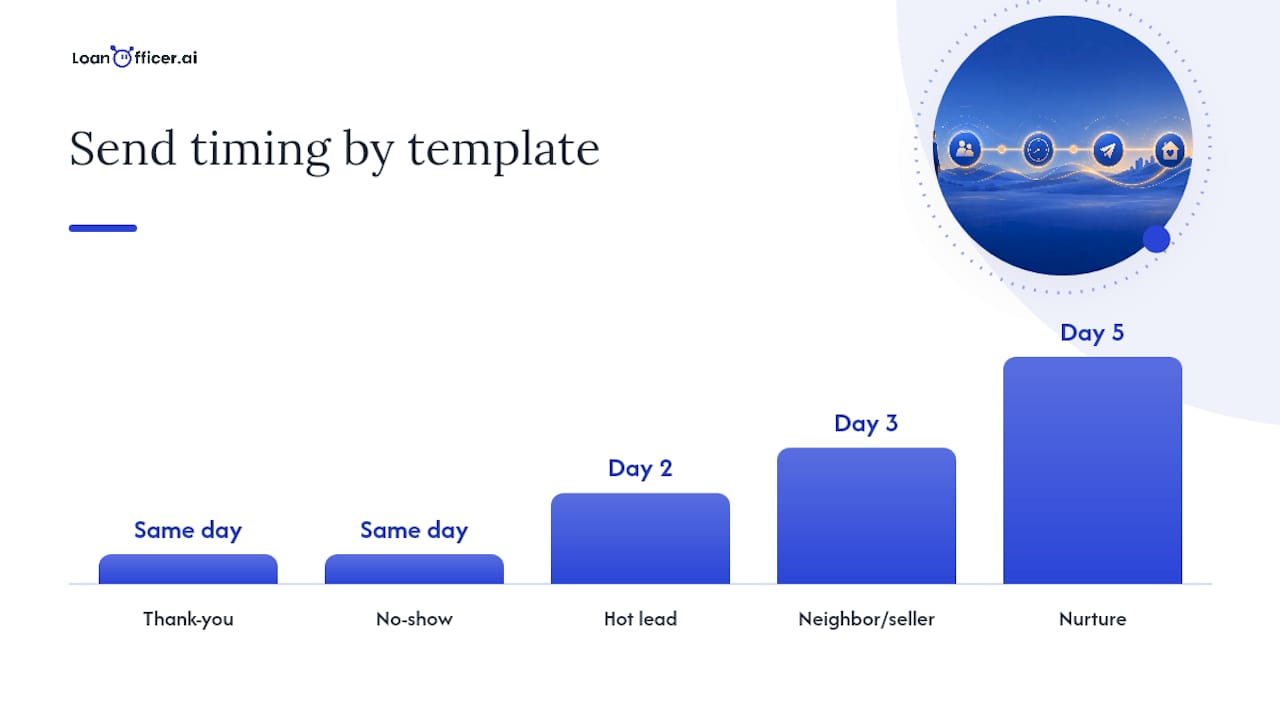
Send the first email within 24 hours. Attach the listing, a floor plan, or a neighborhood report depending on what the visitor asked about. Short, personalized subject lines and listing photos included within 24 hours consistently increase email engagement, and templates organized by visitor type improve reply rates.
Six templates, each with a subject line and a one-line CTA:
Thank-you (all visitors, send same day or next morning)Subject: “Great meeting you at [Address] — a few things I wanted to share” Body: Short note referencing one detail from their visit, listing link, and one question about their timeline. CTA: “Would it help to see a few similar homes this week?”
Hot lead urgency (active buyer, send day 2)Subject: “[Name], I found 3 homes that match what you described” Body: Three listings with photos, one sentence on each, and your availability. CTA: “Pick a time here: [scheduling link]”
Nurture (warm lead, send day 5)Subject: “Quick neighborhood update for [Area]” Body: Two or three recent sales comps, a one-paragraph market note, and a soft check-in. CTA: “Let me know if you’d like a full report.”
Neighbor/seller outreach (attendees who live nearby, send day 3)Subject: “Thinking about selling in [Neighborhood]?” Body: Brief note on buyer demand in the area, recent sale prices, and a free home valuation offer. CTA: “Want a quick estimate on your home’s value?”
No-show follow-up (registered but didn’t attend, send same day)Subject: “Missed you today — here’s everything from [Address]” Body: Listing photos, key details, open house recap, and an offer to schedule a private showing. CTA: “Want to schedule a private tour?”
Group update (all attendees, send day 7 if no response)Subject: “Update on [Address] + a few new listings” Body: Brief status on the listed property (offer activity, price, availability) and two or three new matches. CTA: “Reply and I’ll send the full details.”
A few attachment and compliance notes:
- Always include the listing link, not just a photo. Clicks are trackable; image views are not.
- Segmenting by visitor type and using targeted templates produces higher reply rates than one-size-fits-all messages.
- Under CAN-SPAM, every marketing email needs your physical address and a clear unsubscribe option. Under Fair Housing rules, never segment by protected class characteristics. Keep your segmentation based on behavior and timeline, not demographics.
The copyable 14-day follow-up cadence
| Day | Channel | Objective | Sample copy |
|---|---|---|---|
| Day 0 (same day) | SMS | First contact, personal reference | “Great meeting you at [Address]! I have a few matches — want me to send them?” |
| Day 2 | Phone call | Qualify, offer value, book next step | “I pulled 3 homes that match what you described. Do you have 15 minutes this week?” |
| Day 5 | Deliver value, stay visible | “Quick neighborhood update + 3 new listings I thought you’d want to see.” | |
| Day 14 | Phone + email | Consultation offer, triage decision | “I’d love to set up a 20-minute call to walk through your options. Are you free this week?” |
Escalation rules:
- If a lead replies to the day-0 text or day-2 call with specific questions or a showing request, move them immediately to “hot” status and skip the drip. Call back within 2 hours.
- If a lead clicks a listing link in your day-5 email, call the same day. A click is intent.
- If there’s no response after day 14, move the contact to your monthly drip. Don’t delete them. Most open-house visitors who convert do so within 6–18 months, so a quiet lead today is often a transaction next spring.
The 14-day benchmark data supports this cadence as the practical sweet spot: short enough to convert active buyers, long enough to surface those who are only weeks away from deciding.
How to qualify leads quickly with three questions and a scorecard
Ask these three questions on-site or in your day-2 call. They take under two minutes and give you everything you need to triage the list.
- “Are you working with a real estate agent right now?”
- “What’s your ideal move-in timeline — are you thinking 30 days, 90 days, or longer?”
- “Have you spoken with a lender yet, or is financing still something you’re figuring out?”
Score each answer and total the points:
Triage by score:
- 5–6 points: Call within 2 hours. This is a hot lead. Offer three listings and a showing.
- 3–4 points: Warm lead. Run the full 14-day cadence. Flag for listing alerts.
- 0–2 points: Long-term nurture. Add to monthly drip. Set a 90-day check-in reminder.
Record the score in your sign-in app or CRM immediately. A qualifying note like “Score: 4, pre-approved, 90-day timeline, no agent” takes 10 seconds to type and saves you from treating a serious buyer like a casual browser. Asking and recording one qualifying detail during the open house is the key to personalizing the same-day text and prioritizing calls.
For leads who scored 5–6 and haven’t yet connected with a lender, this is a natural handoff moment. A warm introduction to a trusted loan officer, or a referral to a mortgage CRM tool like Loan Officer AI that can handle the financing follow-up on your behalf, keeps the buyer moving without you managing two pipelines at once.
Monthly drip content and re-engagement after day 14
Unconverted leads aren’t dead leads. Move them to a predictable monthly drip: one market update, one neighborhood spotlight, and one value piece per quarter. That’s it. Low effort, high staying power.
Content ideas for the first six months:
- Month 1: Local market snapshot (median price, days on market, inventory level for their target neighborhood)
- Month 2: Top 3 new listings matching their criteria, with photos and one-line notes
- Month 3: Buyer education piece (what to expect at closing, how to read a seller’s disclosure, how to negotiate in a low-inventory market)
- Month 4: Seasonal maintenance tip for homeowners in the area (this works for neighbor/seller leads too)
- Month 5: Interest rate update and what it means for their buying power
- Month 6: Re-engagement check-in: “Still thinking about [Neighborhood]? A lot has changed — want a quick update?”
Re-engagement triggers that pull a lead back into the active 14-day cadence:
- They reply to any drip email, even just “thanks.”
- They click a listing link.
- A new listing matches their saved search criteria.
- Their stated timeline arrives (e.g., they said “6 months” in October, so April is your trigger).
Long-term nurture through monthly market updates and periodic re-engagement over 12–18 months is the standard recommendation from agents who consistently convert open-house visitors. The math is simple: if you host two open houses a month and add 10 contacts per event, you have 240 warm contacts in your drip by year-end.
For agents who want to build a parallel real estate lead generation system beyond open houses, the same drip principles apply: consistent value, low friction, and behavior-triggered escalation.
Which tools should you automate and which should stay manual?
Automate capture, first contact, and drip enrollment. Keep the day-2 call and any hot-lead outreach manual. That’s the line.
Tool categories you need:
- Digital sign-in app (tablet-based, required fields, webhook/API output): captures data cleanly and triggers automation without manual re-entry.
- CRM with conditional workflows: tags contacts by score, enrolls them in the right sequence, and escalates replies to a manual queue.
- SMS provider with templates: sends the same-day text automatically for casual visitors; flags hot leads for a manual send.
- Ringless voicemail / voicemail drop platform: useful for day-14 warm and cold leads when you’re working a large list.
- Listing alert engine: auto-enrolls leads in property match alerts based on their stated criteria.
Integration checklist:
- Sign-in app → CRM webhook fires on form submit, creates contact, applies tags.
- CRM triggers same-day text template within 5 minutes of sign-in.
- Score 5–6 leads get flagged in a manual queue for personal call within 2 hours.
- Score 3–4 leads auto-enroll in the 14-day sequence.
- Score 0–2 leads auto-enroll in monthly drip.
- Any reply or link click triggers an escalation notification to the agent.
Pro Tip:The one automation rule that saves the most agents from embarrassing themselves: set a “reply detection” trigger that pauses the automated sequence the moment a lead responds. Nothing kills a warm conversation faster than an automated “just checking in!” text sent 10 minutes after the person already replied to your last message.
For loan officers who partner with agents on open house events, AI follow-up automation can handle the mortgage-side follow-up in parallel, so buyers who need financing get contacted by the right person at the right time without the agent managing two separate outreach tracks.
Common follow-up mistakes and U.S. compliance basics
Mistakes that kill conversion:
- Waiting more than 24 hours to make first contact. By then, two other agents have already texted.
- Sending a generic mass email with no personalization. Visitors know a mail merge when they see one.
- Skipping CRM tags. Without tags, you can’t segment, you can’t score, and you can’t automate.
- Over-texting. Three texts in 48 hours from someone a buyer met once feels like harassment.
- Collecting bad data. A paper sign-in with illegible handwriting is worse than no sign-in at all.
- Treating all leads the same. A pre-approved buyer with a 30-day timeline and a curious neighbor are not the same follow-up.
U.S. compliance checklist:
- TCPA (texts): Get written or digital consent before sending marketing texts. A checkbox on your sign-in form works. Keep a record of it.
- Do Not Call (phone): Check the National Do Not Call Registry before calling numbers you don’t have a prior relationship with. Scrub your list before each call session.
- CAN-SPAM (email): Every marketing email needs your physical mailing address, a clear “unsubscribe” link, and an honest subject line.
- Fair Housing: Never segment or personalize based on race, religion, national origin, sex, disability, or familial status. Segment by behavior, timeline, and interest level only.
Pro Tip:Add a single consent line to your digital sign-in form: “By submitting this form, I agree to receive follow-up communications from [Agent Name] about real estate.” That one sentence covers your TCPA basis for texts and your CAN-SPAM basis for email. Have your broker review the exact wording once, then use it at every event.
What the research says about the 4-touch, 14-day sequence
The cadence in this guide isn’t arbitrary. Multiple industry sources converge on the same core finding: fast first contact plus four to seven touches over two weeks produces the highest contact and conversion rates for open-house leads.
| Finding | Source | Practical rule |
|---|---|---|
| ~48% of attendees receive no follow-up under manual processes | US Tech Automations / NAR Member Profile | Automate same-day contact to close the gap |
| 4-touch, 14-day cadence is the highest-converting sequence | Jamil Academy | Run day 0 / 2 / 5 / 14 without skipping touches |
| Digital sign-in + fast personalized follow-up converts more visitors | Abrams Homes | Use tablet sign-in with webhook to CRM |
| Most open-house visitors convert within 6–18 months | ListingKit | Never delete unconverted leads; drip for 18 months |
| Short subject lines + listing photos within 24 hours increase email engagement | HousingWire | Send first email same day with listing link attached |
The automation gap is the biggest single lever: agents who automate first contact reach every visitor within minutes; those who don’t miss nearly half of them entirely.
Three KPIs to track every week:
- Contact rate within 24 hours: what percentage of sign-ins received a text or call the same day? Target: 100%.
- Reply rate: what percentage of your day-0 texts and day-2 calls got a response? Track this by lead type (hot/warm/cold) to see where your scripts need work.
- Conversion to showing or consultation: how many open-house contacts booked a showing or consultation within 14 days? This is your ultimate conversion metric.
A simple weekly dashboard: pull these three numbers every Monday morning.
A note on keeping this system sustainable week after week
Sunday evening, block 20 minutes. Pull up your sign-in list from the day’s event, read through your qualifying notes, and write one personal detail next to each name. That detail is what separates your Monday texts from everyone else’s. You’re not writing the messages yet. You’re just making sure you remember who was who before the weekend fades.
Monday morning, send your hot-lead texts manually and let automation handle the rest. Review your CRM queue, confirm your day-2 calls are scheduled, and check that your drip sequences enrolled correctly. The whole review takes 15 minutes if your automation is set up right.
Tuesday is call day. Work your hot and warm leads first, in that order. If you have a transaction coordinator or a sales development rep handling warm and cold outreach, hand off the score-3-and-below list after Monday’s review. Keep the score-5-and-6 calls for yourself. Those are the conversations that turn into transactions, and no template replaces a real agent who remembers the kitchen comment.
The agents who run this system consistently don’t have more time than you do. They’ve just decided that 45 minutes across Sunday evening and Monday morning is worth more than any single showing. Over a year of open houses, that math is hard to argue with.
Your loan officer partner can run the same system in parallel
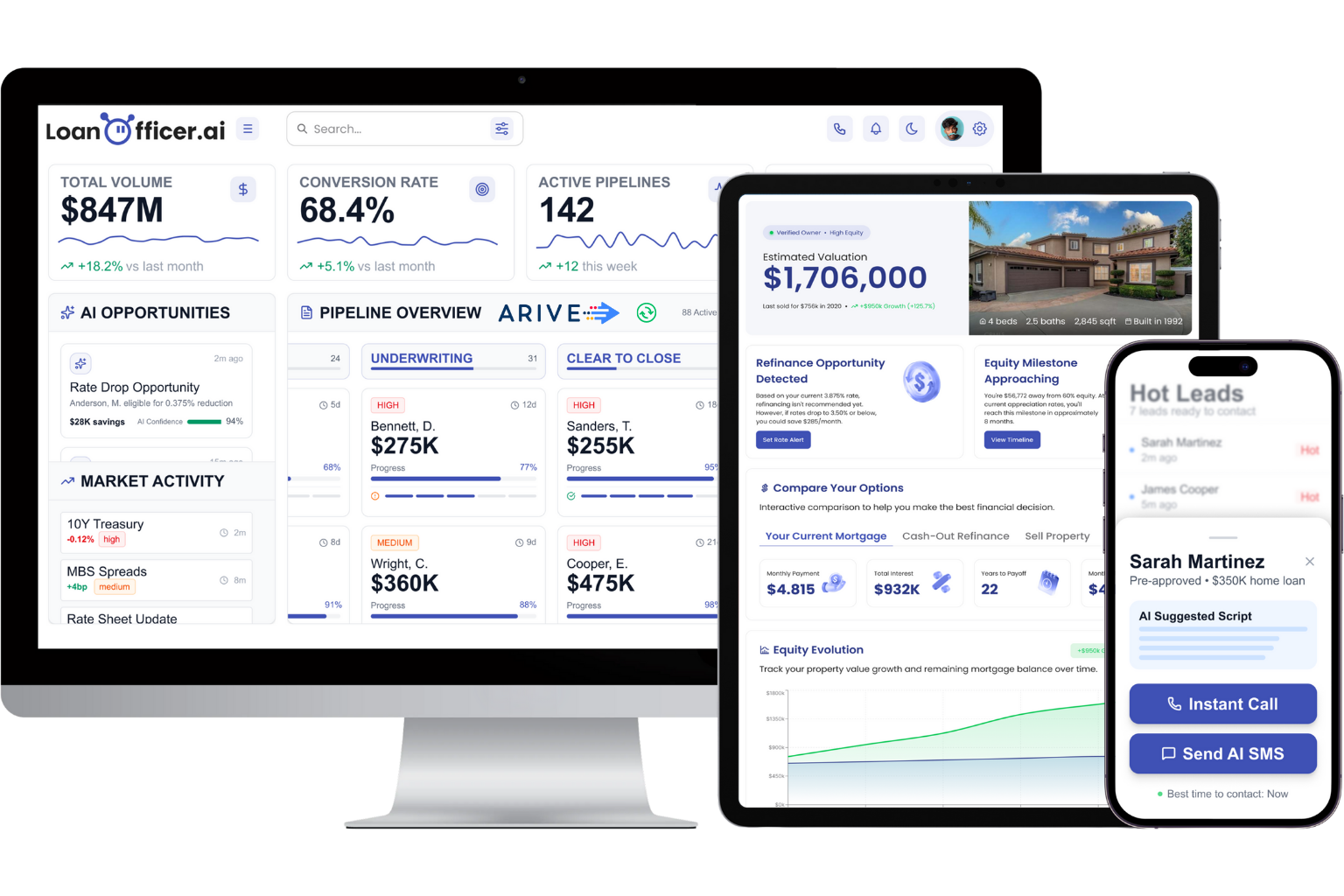
When a buyer at your open house mentions they haven’t talked to a lender yet, that’s not a dead end. It’s a handoff opportunity. Loan Officer AI is an AI-powered CRM built for mortgage professionals that automates the financing follow-up in parallel with your own outreach, so the buyer hears from both you and a trusted loan officer within hours of the event, not days.
Agents who partner with loan officers using Loan Officer AI’s realtor partnership tools get co-branded follow-up sequences, shared pipeline visibility, and automatic alerts when a buyer gets pre-approved. That pre-approval notification is your signal to move the lead back into your active 14-day cadence immediately.
If your current loan officer partner is still doing follow-up manually, show them what automated borrower engagement looks like. The buyers you refer deserve a fast response on the financing side just as much as they do on yours.
Sources
- How to Automate Open House Follow-Up for 100% Contact in 2026 | US Tech Automations
- Open house lead conversion
- Open House Follow-Up Strategy for Real Estate Agents
- Are open houses worth it? — Opendoor
- 12 Open House Follow-up Email Templates Proven to Win … | HousingWire
