Lunch and Learn Topics Realtors Actually Want to Attend

The 12 lunch-and-learn topics that consistently move the referral needle for loan officers are: financing programs for first-time buyers, down payment assistance (DPA) options, pre-approval vs. pre-qualification, winning in a competitive offer, co-marketing strategies, credit repair and buyer readiness, renovation and construction loans, investment property financing, market update and rate environment, self-employed borrower solutions, assumable mortgages, and HELOC and equity strategies. Pick one, block a date this week, and send a single paragraph invite to your top five agents.
- Financing programs for first-time buyers
- Down payment assistance options
- Pre-approval vs. pre-qualification
- Winning in a competitive offer environment
- Co-marketing strategies for agents and LOs
- Credit repair and buyer readiness
- Renovation and construction loans
- Investment property financing
- Market update and rate environment
- Self-employed borrower solutions
- Assumable mortgages
- HELOC and equity strategies
Hosting lunch-and-learn sessions is one of the most direct ways loan officers position themselves as trusted partners rather than rate vendors. The key is choosing topics that help agents win listings and convert buyers, not topics that showcase your product sheet.
Pro Tip:Pick the topic your top agent complained about last month. If she said buyers keep falling out of contract over financing surprises, run the pre-approval vs. pre-qualification session first.
Key Takeaways
The single most important thing you can do after reading this guide is pick one topic, book a date, and send the invite today. Every week you wait is a referral conversation that does not happen.
| Point | Details |
|---|---|
| Topic selection drives attendance | Choose topics that solve an agent’s current problem (DPA, competitive offers, self-employed buyers), not topics that showcase your product. |
| Handouts after, not before | Distribute printed materials after the presentation to keep agent attention on the speaker during the session. |
| Follow up within 24 hours | Send the handout PDF and a calendar link the same day; Day 3 and Day 7 personal touches convert attendees into referrals. |
| Track attendee-to-referral lag | Expect 30–60 days between the event and first referral; use this lag to set realistic pipeline forecasts. |
| Loan Officer AI automates the sequence | Tag attendees, trigger follow-up campaigns, and track referral source with Loan Officer AI’s realtor partnership tools. |
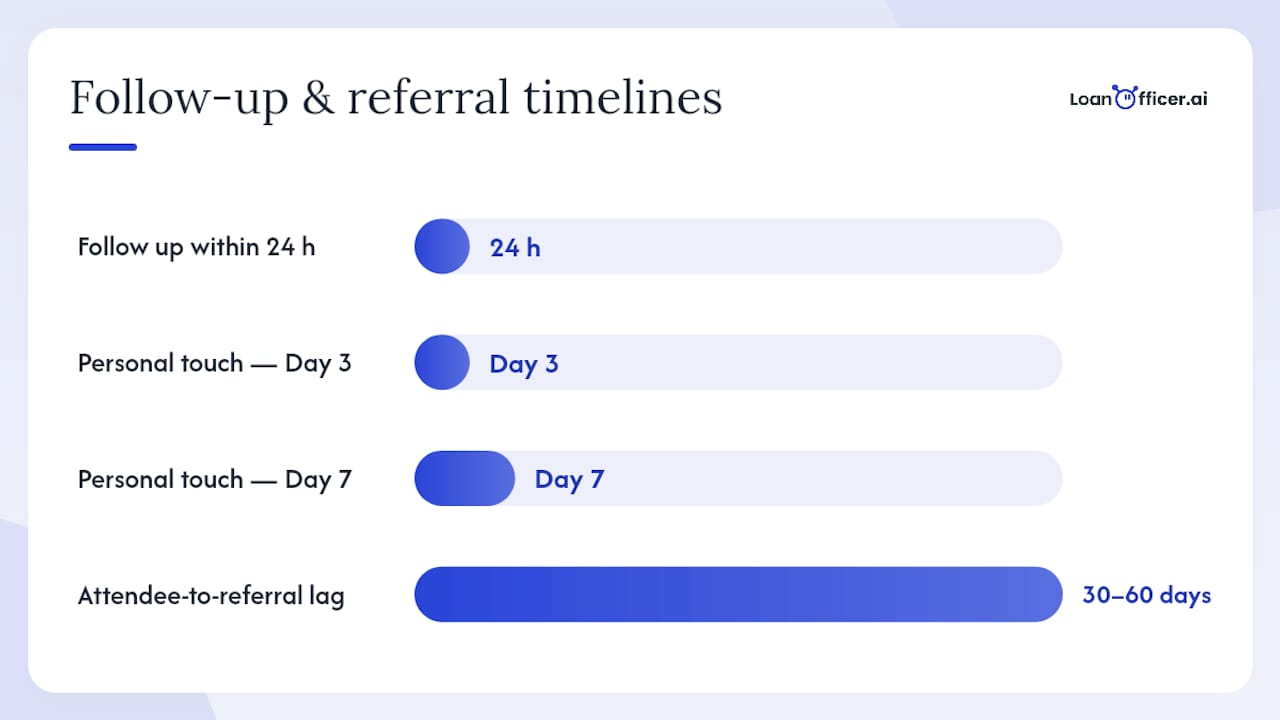
Table of Contents
- What Are the Best Lunch and Learn Topics for Realtors?
- Sample Agendas and Slide Templates for Every Format
- How to Fill the Room and Handle Logistics
- The Follow-Up Playbook That Turns Attendees Into Referrals
- Compliance and Co-Marketing Best Practices
- How to Measure Whether Your Events Are Working
- What Actually Works: Field-Tested Lessons from Loan Officers
- Loan Officer AI Turns Event Follow-Up Into Pipeline Automatically
- Sources
What Are the Best Lunch and Learn Topics for Realtors?
Teaching a class rather than chasing one-to-one is a proven way to attract referrals at scale. Here is what each of the 12 topics looks like when you actually run it.
1. Financing programs for first-time buyers
Objective: Show agents which loan programs exist beyond conventional 30-year fixed so they can set accurate buyer expectations. Who benefits: New agents and teams working entry-level price points. Duration: 30 minutes. 5-slide outline: (1) Title + your contact info, (2) FHA vs. conventional vs. USDA at a glance, (3) Income and credit thresholds, (4) Real scenario: buyer qualifies for more than they thought, (5) How to refer a buyer to you today. Handout: One-page program comparison card with your logo and phone number.
Pro Tip:Co-brand the handout with the agent’s headshot and brokerage logo. Agents keep co-branded materials; they toss generic ones.
2. Down payment assistance options
Objective: Arm agents with DPA talking points so they stop losing buyers who think they need 20% down. Who benefits: Agents working first-time and moderate-income buyers. Duration: 30–45 minutes. 5-slide outline: (1) Title, (2) What DPA actually is (grants vs. forgivable seconds vs. deferred loans), (3) State and local programs available in your market, (4) Income and purchase price limits, (5) How to identify a DPA-eligible buyer in 60 seconds. Handout: State-specific DPA cheat sheet.
3. Pre-approval vs. pre-qualification
Objective: Eliminate the confusion that costs agents offers. Duration: 20 minutes. 5-slide outline: (1) Title, (2) The real difference and why it matters in a competitive market, (3) What a fully underwritten pre-approval looks like, (4) How to coach buyers before showing homes, (5) Your turnaround time guarantee. Handout: Buyer prep checklist agents can hand directly to clients.
4. Winning in a competitive offer environment
Objective: Give agents concrete financing tools that strengthen offers without waiving appraisal. Who benefits: Top producers in competitive markets. Duration: 45 minutes. 5-slide outline: (1) Title, (2) Financing contingency language that protects buyers and reassures sellers, (3) Appraisal gap coverage options, (4) Escalation clause coordination with lender, (5) Your pre-approval letter customization process. Handout: Offer-strength checklist with financing column.
Pro Tip:Bring a title rep or real estate attorney as a co-presenter. Agents trust multi-voice sessions more than solo pitches, and the co-host promotes the event to their own contact list.
5. Co-marketing strategies for agents and LOs
Objective: Show agents how to market together without violating RESPA. Duration: 45 minutes. 5-slide outline: (1) Title, (2) What co-marketing is and what it is not under RESPA, (3) Joint social content ideas, (4) Co-branded buyer seminars, (5) How to split costs compliantly. Handout: Co-marketing agreement template (reviewed by your compliance team).
Co-branded materials and consistent execution are what separate one-off referrals from a durable pipeline.
6. Credit repair and buyer readiness
Objective: Help agents convert “not yet” buyers into closings within 90–180 days. Duration: 30 minutes. 5-slide outline: (1) Title, (2) The three credit factors that move scores fastest, (3) What to fix vs. what to ignore, (4) Your credit monitoring and coaching process, (5) How to refer a buyer for a free credit review. Handout: Credit action plan template.
7. Renovation and construction loans
Objective: Open the conversation on listings with deferred maintenance that scare conventional buyers. Duration: 45 minutes. 5-slide outline: (1) Title, (2) FHA 203(k) vs. Fannie Mae HomeStyle at a glance, (3) How the draw process works, (4) Listing scenarios where renovation financing wins, (5) Your renovation loan checklist. Handout: Renovation loan scenario card.
8. Investment property financing
Objective: Position yourself as the go-to LO for investor clients agents already work with. Who benefits: Agents with investor buyer clients. Duration: 45–60 minutes. 5-slide outline: (1) Title, (2) DSCR loans vs. conventional investment financing, (3) Reserve requirements and down payment realities, (4) Portfolio loan options, (5) How to identify an investor-ready buyer. Handout: Investor financing comparison card.
9. Market update and rate environment
Objective: Give agents a concise, credible market briefing they can repeat to clients. Duration: 20–30 minutes. 5-slide outline: (1) Title, (2) Where rates are and why, (3) Local inventory and price trend snapshot, (4) What buyers are asking right now, (5) Your market update email signup. Handout: One-page market snapshot with your branding.
10. Self-employed borrower solutions
Objective: Stop agents from steering self-employed clients away from homeownership. Duration: 30 minutes. 5-slide outline: (1) Title, (2) Bank statement loans explained, (3) P&L-only options, (4) Common documentation mistakes and how to avoid them, (5) Your self-employed pre-approval process. Handout: Self-employed buyer document checklist.
11. Assumable mortgages
Objective: Give agents a listing tool that most of their competitors do not know how to use. Duration: 30 minutes. 5-slide outline: (1) Title, (2) Which loan types are assumable (FHA, VA, USDA), (3) How the assumption process works, (4) Buyer qualification requirements, (5) How to identify assumable listings in your MLS. Handout: Assumable mortgage FAQ card.
12. HELOC and equity strategies
Objective: Help agents retain past clients and generate repeat business. Duration: 30 minutes. 5-slide outline: (1) Title, (2) HELOC vs. cash-out refinance, (3) When a HELOC makes sense for a move-up buyer, (4) How to identify equity-rich clients in an agent’s database, (5) Your equity review process. Handout: Equity strategy one-pager.
Sample Agendas and Slide Templates for Every Format
30-minute agenda
- Welcome and introductions (2 min)
- Core topic presentation, 8–10 slides (20 min)
- Q&A (5 min)
- CTA: schedule a buyer consultation or co-marketing call (3 min)
45-minute agenda
- Welcome (3 min)
- Core topic, 12–15 slides (25 min)
- Case study or scenario walkthrough (10 min)
- Q&A (5 min)
- CTA and handout distribution (2 min)
60-minute agenda
- Welcome and icebreaker (5 min)
- Core topic, 15–18 slides (30 min)
- Interactive scenario or small group discussion (12 min)
- Q&A (8 min)
- CTA, handout, and next-session preview (5 min)
Slide count guidance: 8–10 slides for 30 minutes, 12–15 for 45 minutes, 15–18 for 60 minutes. Every deck needs a data slide, one real-scenario slide, a handout preview slide, and a CTA slide. Per MGIC’s facilitator guide, distribute printed handouts after the presentation, not before, to keep attention on the speaker.
Tech checklist:
- In-person: HDMI adapter, clicker, printed handouts, name tags, backup PDF on USB
- Virtual (Zoom/Teams): co-host access enabled, waiting room on, recording permission confirmed, chat moderation assigned
- Hybrid: second camera pointed at the room, dedicated mic for in-room presenter, chat monitor for remote attendees
How to Fill the Room and Handle Logistics
Practical skills and clear promotion drive attendance more than free food. That said, execution details matter.
Venue and setup:
- Book a private room at a local restaurant, your office conference room, or a title company’s training space
- Confirm AV availability 48 hours before the event
- For virtual sessions, send the Zoom link in the calendar invite and again the morning of the event
Catering:
- Budget $15–$25 per person for in-person sessions; keep it simple (sandwiches, salads, coffee)
- Skip catering for virtual sessions; a $5 Starbucks e-gift card sent post-event outperforms a Doordash credit nobody uses
- Never tie food to a referral arrangement; that crosses into RESPA territory
Invitation playbook:
- Two weeks out: email invite with topic, date, time, and RSVP link
- One week out: personal text to your top 10 agents
- Day before: reminder email with agenda and parking/login details
- Morning of: brief text to confirmed RSVPs only
Pro Tip:Ask your co-host (title rep, home inspector, or financial planner from a partner like Friendly Financial Group) to send the invite to their own contact list. You can double attendance without doubling your effort.
For broader promotional reach, local marketing resources like the CompareSpot blog cover event promotion tactics that translate well to professional networking events.
The Follow-Up Playbook That Turns Attendees Into Referrals
Reliable follow-up and co-marketing are what agents actually remember, not the free lunch.
Follow-up sequence
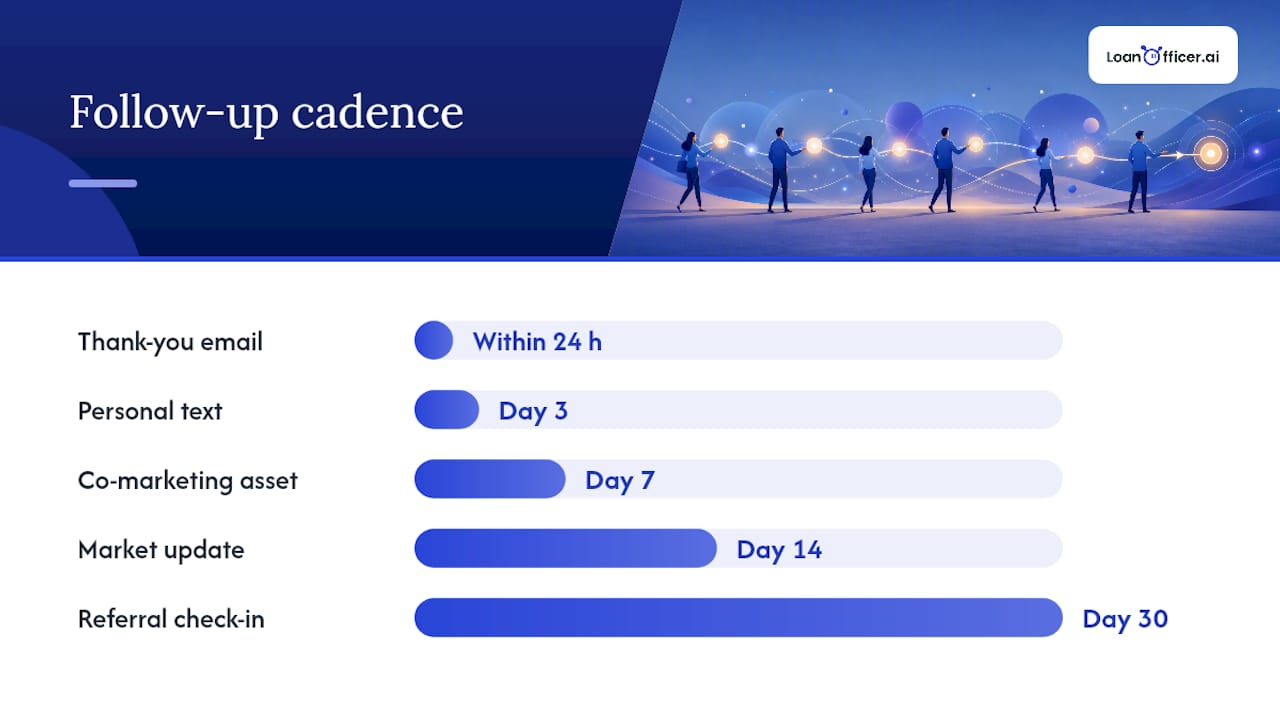
- Within 24 hours: Send a thank-you email with the handout PDF attached, a one-line recap of the session’s key takeaway, and a calendar link to book a one-on-one.
- Day 3: Personal text: “Hey [Name], any questions from Tuesday? Happy to walk through a scenario for a buyer you have in mind.”
- Day 7: Send a co-marketing asset (social post template, co-branded buyer guide) with a note: “Made this for you to use with your clients.”
- Day 14: Share a relevant market update or rate alert specific to the topic you covered.
- Day 30: Check in with a referral ask: “I have capacity for two more buyer clients this month. Know anyone who’s been thinking about buying?”
Sample thank-you email:
Subject: Your handout from today’s session + one quick idea
Hi [Name],
Thanks for joining today. Attached is the [topic] reference card we covered. If you have a buyer who fits the profile we discussed, I can turn a pre-approval around in 24 hours. Want to grab 15 minutes this week?
[Your name, NMLS#, phone]
CRM tagging and automation:
- Tag every attendee with the event name and topic (e.g., “LnL_DPA_March2026”)
- Set an opportunity alert to trigger if the agent submits a referral within 60 days
- Automate the Day 3 and Day 7 touches so they send even when you are in back-to-back closings
- Log each referral against the originating event to measure which topics produce the most pipeline
Automated follow-up and opportunity alerts improve partner response and retention compared to manual outreach, according to Loan Officer AI’s follow-up benchmark research.
Compliance and Co-Marketing Best Practices
RESPA Section 8 prohibits giving or receiving anything of value in exchange for a referral of settlement service business. That means you cannot pay an agent to attend, give a gift card tied to a referral, or split marketing costs in a way that compensates the agent for sending you business.
Do:
- Split costs for joint seminars proportionally, based on actual value received by each party
- Use co-branded materials that display both parties’ contact information and services equally
- Document all co-marketing arrangements in writing before spending money
Don’t:
- Pay for an agent’s CE credits in exchange for referrals
- Offer raffle prizes or gifts at events where attendance is conditioned on sending business
- Use vague “marketing fee” arrangements that mask referral compensation
Recommended disclaimer for all co-branded materials: “[Your name], NMLS# [number], is a licensed mortgage professional. This material is for informational purposes only and does not constitute a commitment to lend.”
Pro Tip:Run every new co-marketing arrangement past your company’s compliance officer before printing anything. A 10-minute call saves a potential RESPA headache.
How to Measure Whether Your Events Are Working
Track these KPIs after every session:
- Attendance rate: RSVPs confirmed vs. actual attendees
- Leads generated: agents who requested a buyer consultation within 30 days
- Referrals submitted: loan applications tied to event attendees within 90 days
- Pipeline value: total loan volume from event-sourced referrals
- Attendee-to-referral lag: average days between the event and first referral submission (set realistic expectations; 30–60 days is common)
Reporting cadence: Check pipeline weekly. Run a quarterly event ROI review comparing total event spend (venue, food, materials, time) against closed loan revenue from event-sourced referrals.
Simple ROI formula:
(Closed loan revenue from event referrals) ÷ (Total event cost) = Event ROI multiple
If you spent $300 on a lunch session and closed one $350,000 loan from an attendee referral, your revenue from that loan far exceeds the event cost. Even a single referral per quarter justifies the investment for most loan officers.
Panels and agent classes that focus on practical skills generate measurable pipeline when combined with consistent follow-up.
What Actually Works: Field-Tested Lessons from Loan Officers
The loan officers who run consistent, effective lunch-and-learns share a few habits that rarely show up in the how-to guides.
First, they pick three to five priority agents and run sessions specifically for those agents’ client bases, rather than blasting invites to 50 people who barely know them. A room of eight engaged agents beats a room of 25 distracted ones.
Second, co-hosting with a title rep, home inspector, or financial planner changes the dynamic entirely. The session feels like a panel, not a pitch. Agents ask better questions, stay longer, and refer more freely because they see you operating as part of a professional team rather than as a solo vendor.
Third, the sessions that directly produce referrals are almost never the ones about rates. The DPA session, the competitive offer session, and the self-employed borrower session consistently outperform market update talks because they solve a problem the agent has right now, not a theoretical future problem. Agents do not value generic rate discussions at events; they want content that helps them win listings or convert buyers, a point reinforced by MGIC’s facilitator materials.
On the in-person vs. virtual question: in-person sessions build stronger initial relationships, but virtual sessions are easier to repeat monthly and reach agents across a wider geography. The most productive approach is to run one in-person session per quarter to anchor the relationship, then maintain momentum with monthly 20-minute virtual updates.
Loan Officer AI Turns Event Follow-Up Into Pipeline Automatically
Running great sessions is only half the equation. The follow-up is where referrals actually get logged, nurtured, and converted, and that is where most loan officers lose momentum.
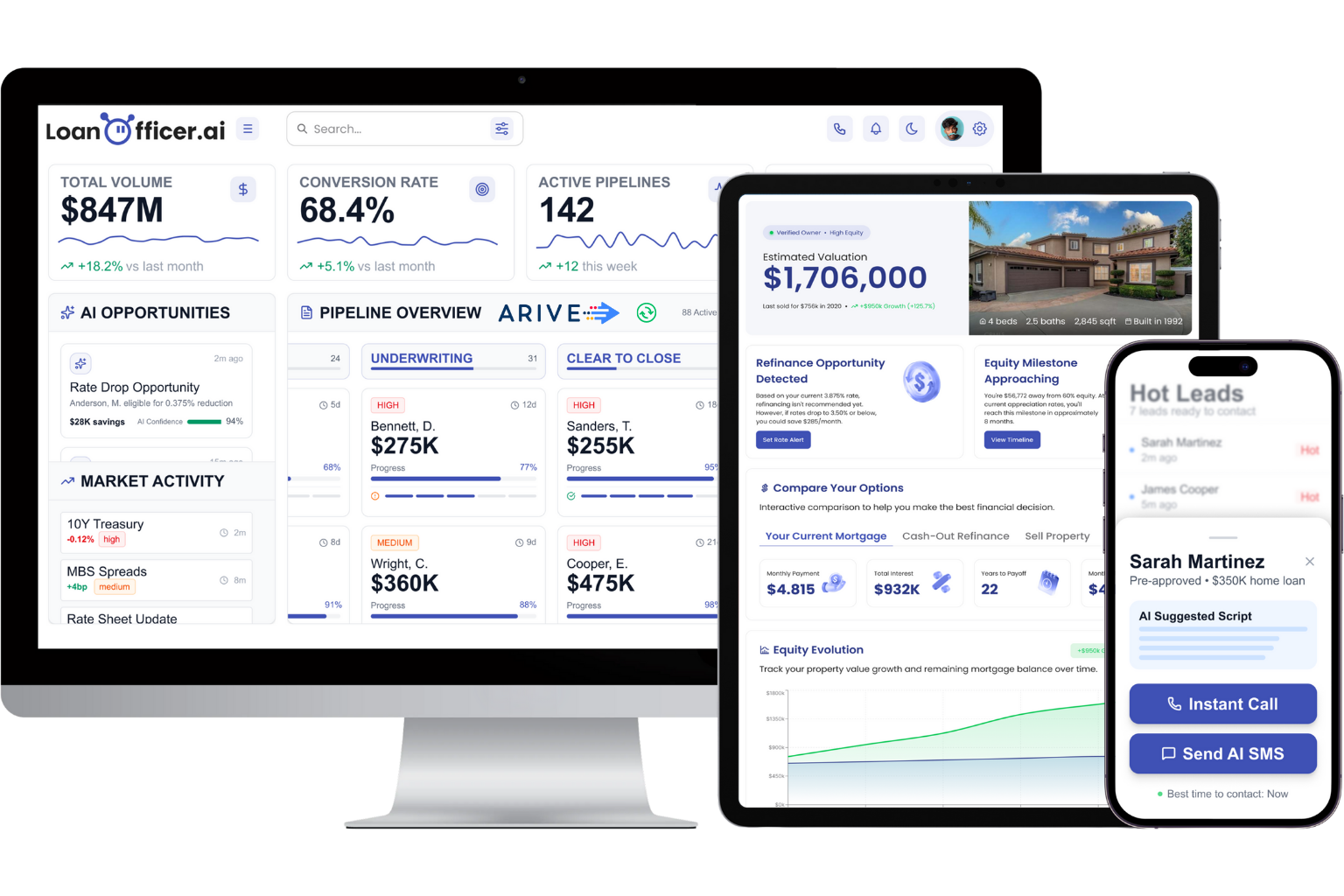
Loan Officer AI’s realtor partnership tools let you tag every attendee by event and topic, trigger automated email and text sequences on the exact timeline described in this guide, and surface opportunity alerts when an agent’s buyer is ready to apply. The platform reports 93% partner retention among teams that automate follow-up, compared to the drop-off that comes with manual outreach. Co-branded asset generation, pipeline tracking by referral source, and LOS integrations mean you can see exactly which lunch-and-learn topic produced which closed loan. Start a trial of the AI-powered mortgage CRM and have your first post-event sequence running before your next session.
Sources
- Feeding Minds: Innovative Lunch and Learn Topics for the Modern Loan Officer | Loan Officer Magazine
- Attract, Don’t Chase: Realtor Class Strategy with Geoff Zimpfer - Loan Officer Life: Hustle, Heart & Homeownership
- How Loan Officers Turn Realtor Relationships Into a Real Referral Pipeline
- 20-50172-facilitator-notes-pdf-for-sale-to-sold.pdf (03/05/21)
- Beyond Lunch & Learns: How Top LOs Are Scaling Realtor Referrals… | Mortgage Marketing Radio
- Realtor Partnership Strategy: Building Referral Relationships That Drive Mortgage Production
For compliance questions on RESPA, co-marketing arrangements, and referral rules, consult your company’s compliance officer or a licensed attorney before implementing any co-marketing program.
This article is general information, not a substitute for advice from a qualified lawyer. Consult a qualified legal professional about your own circumstances before acting on anything here.
