Missed Call Text Back: Your 2026 Setup Guide

Missed call text back is an automated SMS sent within seconds of an unanswered call to immediately re-engage the caller before they move on. Up to 85% of missed callers never call back, which means every unanswered call is a real lead at risk of disappearing permanently. The industry term for this practice is “automated SMS follow-up,” though “missed call text back” is the phrase most businesses use when searching for solutions. Compliance matters from day one: the Telephone Consumer Protection Act (TCPA) and A2P 10DLC registration govern how automated texts reach consumers in the United States.
What is missed call text back and why does it matter?
Missed call text back converts a dead-end voicemail into a live conversation. When a call goes unanswered, the system detects the missed call and fires an SMS to the caller’s number within 30–60 seconds. That speed is the entire point. 87% of consumers read a new text within 15 minutes, compared to the much lower open rates for voicemail. A text sits in the caller’s pocket, visible and easy to reply to. A voicemail requires effort most people simply skip.
The business case is straightforward. Between 62% and 85% of calls to small businesses go unanswered on any given day. Without an automated reply, the vast majority of those callers choose a competitor. With a well-timed text, you restart the conversation on your terms. For mortgage professionals, this is especially critical: a borrower shopping for rates will not wait more than a few minutes before dialing the next loan officer on their list.

What tools and prerequisites do you need?
Getting the system working requires three things: a compatible platform, a properly configured phone number, and SMS compliance registration.
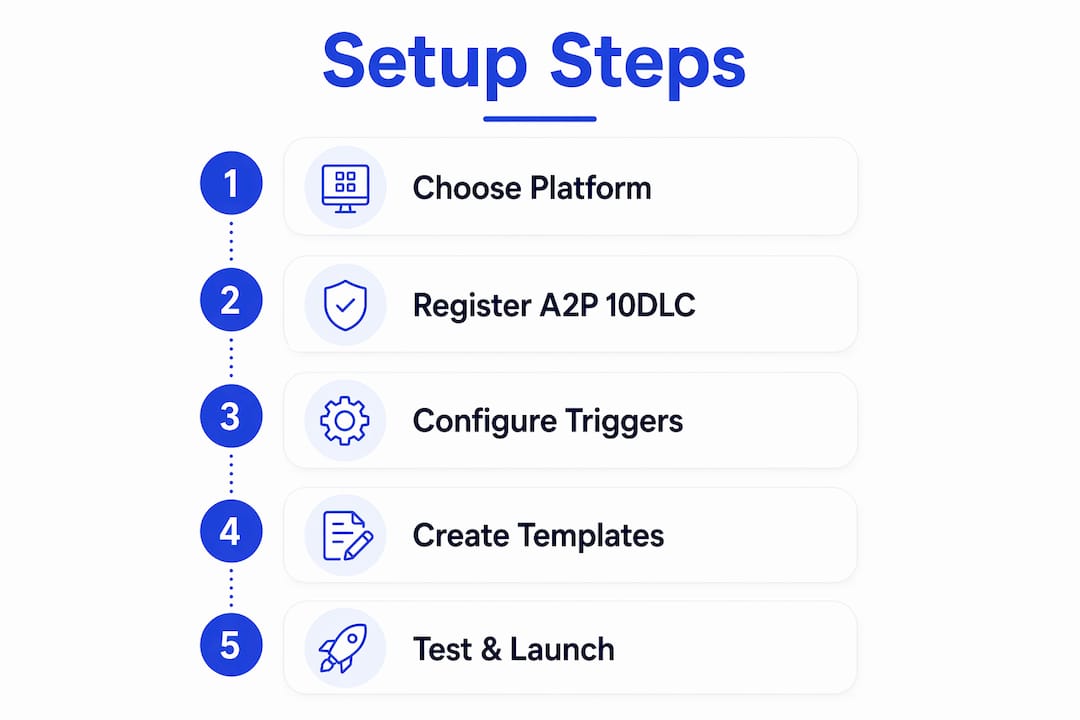
Platform selection is your first decision. Any platform you choose must support SMS automation and connect to your existing business phone number. You have three options for number integration: porting your current number to the platform, setting up call forwarding so missed calls trigger the SMS workflow, or using a virtual number assigned by the platform. Each approach works, but porting gives you the cleanest setup because all call data stays in one place.
A2P 10DLC registration is non-negotiable. The term stands for Application-to-Person 10-Digit Long Code, and it is the carrier-level registration system that tells networks your automated texts are legitimate business messages. Without A2P 10DLC registration, carriers routinely filter automated business SMS, meaning your platform shows “sent” while the message never reaches the caller. This is the single most common reason a new text back system appears to work but produces zero responses.
Message templates need to be drafted before you go live. Every template must include your business name, a clear next step for the caller, and an opt-out instruction such as “Reply STOP to unsubscribe.” TCPA compliance requires that opt-out language in every automated commercial text.
Key prerequisites at a glance:
- A platform that supports SMS automation and call trigger detection
- Phone number integration via porting, forwarding, or virtual number
- Completed A2P 10DLC registration with your carrier or platform
- Compliant message templates with opt-out instructions
- A CRM or notification system to alert your team when a reply comes in
Pro Tip:Check whether your platform handles A2P 10DLC registration on your behalf or whether you must file independently. Many entry-level tools leave this step entirely to you, which causes delivery failures that look like technical bugs.
How to set up a missed call text back system step by step
A clean setup takes less than an hour if your prerequisites are in place.
Define your missed call trigger. Log into your platform and set the condition that fires the SMS. Most platforms define a missed call as any inbound call that rings without being answered, or any call that goes to voicemail. Confirm which definition your platform uses and whether forwarded calls count.
Build your SMS template. Write a message that sounds like a person, not a bot. Include your name or business name, acknowledge the missed call directly, and give the caller one clear action. Example: “Hi, this is [Name] at [Business]. I just missed your call. I’d love to help. Reply here or book a time at [link].” Keep it under 160 characters to avoid multi-part SMS fees.
Set the send delay. A 30-second delay before sending reduces carrier filtering risk and prevents the message from arriving while the caller is still hearing your voicemail greeting. Set this delay in your platform’s workflow settings.
Add a team notification. Configure the system to alert you or your team the moment a caller replies. A text back that goes unanswered for 20 minutes defeats the purpose. Push notifications or CRM task creation work well here.
Run test calls. Call your business number from a personal cell phone, let it ring to voicemail, and verify the SMS arrives within 60 seconds. Check the message formatting, the link, and the opt-out language. Test from multiple carriers if possible.
Connect to your CRM. Map incoming replies to a lead record so every conversation is logged. This step is what separates a one-off text from a full automated lead follow-up workflow.
| Setup step | Common mistake | Fix |
|---|---|---|
| Define trigger | Including answered calls | Set trigger to “no answer” or “voicemail” only |
| Write template | Generic, robotic copy | Use caller’s name if available; add one clear next step |
| Set delay | Sending instantly | Add a 30-second delay to avoid carrier flags |
| Team notification | No alert configured | Add push notification or CRM task on reply |
| Test calls | Testing only once | Test across multiple carriers and times of day |
| CRM integration | Skipping this step | Map replies to lead records for full tracking |
Pro Tip:Use dynamic variables in your template. If your platform captures the caller’s name from your contact list, insert it automatically. A message that opens with the caller’s first name gets significantly higher reply rates than one that starts with “Hi there.”
Common mistakes to avoid when setting up text back
The most damaging mistake is skipping A2P 10DLC registration. Businesses that skip this step often spend weeks troubleshooting what they assume is a platform bug. The platform reports messages as sent. The caller receives nothing. Proper SMS compliance is frequently overlooked, and the resulting delivery failures are easy to misread as workflow errors.
The second most common problem is generic message copy. A text that reads “We missed your call. We will get back to you soon.” tells the caller nothing useful and gives them no reason to reply. Conversational, human-toned messages with a single clear next step are the standard that actually moves callers to respond.
Other mistakes worth avoiding:
- No human follow-up loop. Automation starts the conversation, but a real person needs to close it. If no one monitors replies, the lead goes cold again within minutes.
- No duplicate call handling. If the same number calls twice in one hour, sending two identical texts looks like a spam campaign. Set a suppression window of at least two hours for repeat callers.
- Skipping CRM integration. A reply that lives only in your SMS platform is invisible to your sales process. Every reply should create or update a lead record automatically.
Speed is the point of missed call text back, but the timing still needs calibration. A text that arrives before the voicemail greeting ends looks like a machine. A text that arrives 10 minutes later loses to the competitor who replied in 45 seconds. The 30-second window is the standard that balances both risks.
Advanced strategies to maximize text back effectiveness
Basic setup recovers leads. Advanced strategy converts them at a higher rate.
Personalize with caller data. If the caller is already in your CRM, pull their first name and any relevant context into the message. Dynamic variables like caller name and a booking link dramatically improve SMS response rates. A borrower who receives a text that references their name and a specific next step feels recognized, not processed.
Build multi-touch follow-up sequences. A single text back is a starting point, not a complete strategy. The most effective systems integrate text back into broader lead nurturing workflows that include a follow-up text 24 hours later, an email, and a scheduled call attempt. Each touchpoint increases the chance of conversion without requiring manual effort.
Add AI phone answering for full coverage. AI answering services complement text back by handling calls live, answering common questions, booking appointments, and routing leads in real time. When a caller reaches an AI agent instead of voicemail, the missed call problem disappears entirely. Text back then serves as the safety net for calls that still slip through. Loanofficer’s AI-powered CRM combines both layers for mortgage professionals.
Adjust messaging by business hours. A text sent at 9:00 PM should read differently from one sent at 10:00 AM. After-hours messages should set realistic expectations: “I’ll follow up first thing tomorrow morning.” Business-hours messages should offer an immediate next step. Most platforms support time-based message variants.
Track and refine with response metrics. Personalized, conversational texts achieve 12–18% engagement, compared to 3–8% for generic automation. That gap is measurable. Monitor your reply rate weekly and test one variable at a time: message length, call-to-action phrasing, or send timing. Small adjustments compound into meaningful conversion gains over a quarter.
Key Takeaways
Missed call text back works because speed, compliance, and personalization together convert unanswered calls into active conversations before callers reach a competitor.
| Point | Details |
|---|---|
| Speed is the core advantage | Send your automated SMS within 30–60 seconds of a missed call to beat competitors. |
| A2P 10DLC registration is required | Skipping carrier registration causes silent delivery failures that look like platform errors. |
| Message quality drives replies | Personalized, conversational texts with one clear next step achieve up to 18% engagement. |
| Automation needs a human loop | Configure team alerts so a real person responds to replies within minutes. |
| Advanced integration multiplies results | Pairing text back with AI answering and multi-touch sequences captures leads at every stage. |
Why I think most businesses set this up wrong
Jared here. I’ve watched businesses spend real money on text back platforms and then wonder why their reply rates are flat. Nine times out of ten, the problem is not the platform. It’s the message.
Most people write their first SMS template the same way they’d write an out-of-office email: formal, vague, and focused on the business rather than the caller. That approach kills the response before it starts. The caller does not care that you “value their time.” They care whether you can solve their problem right now.
The second thing I see consistently is the compliance gap. A2P 10DLC registration sounds like a bureaucratic detail, so people skip it or assume the platform handles it. Then they spend two weeks convinced their automation is broken when the real issue is that carriers are quietly filtering every message they send. Fix the registration first. Everything else is secondary.
My honest view on the future: text back is a bridge, not a destination. Within the next two years, AI conversational agents will handle the first three exchanges of most missed call follow-ups automatically, qualifying the lead before a human ever gets involved. The businesses that build clean text back workflows now will have the infrastructure to plug AI agents in without rebuilding from scratch. Start simple. Get the compliance right. Then layer in the intelligence.
— Jared
How Loanofficer handles missed call follow-up for mortgage pros
Mortgage professionals lose more leads to missed calls than almost any other industry. Borrowers move fast, and a 10-minute delay in follow-up often means a lost deal.
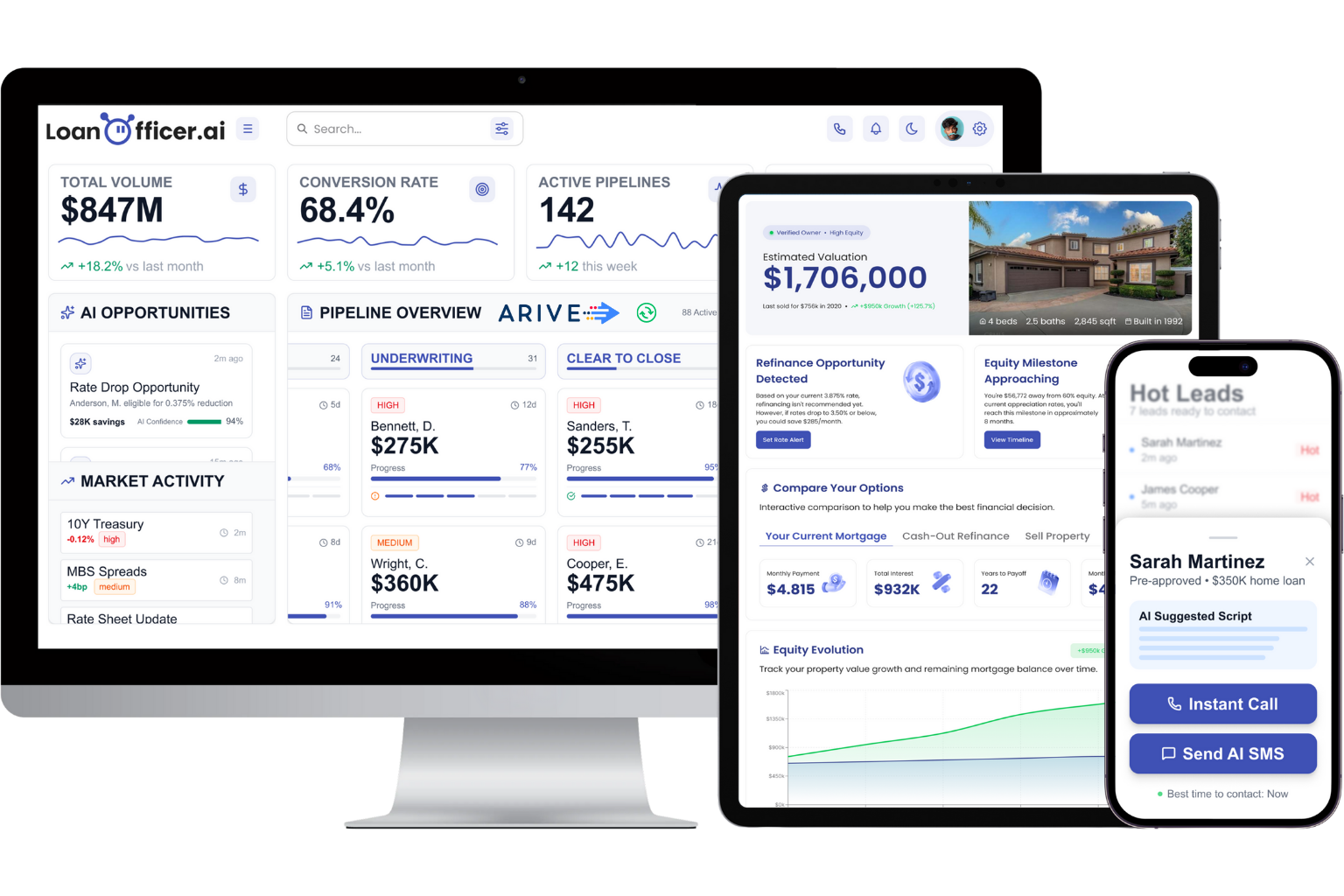
Loanofficer’s mortgage brokerage CRM includes built-in automated text back, AI-powered lead nurturing sequences, and real-time pipeline alerts that notify your team the moment a lead replies. The platform handles A2P 10DLC compliance, dynamic message personalization, and CRM logging automatically, so you spend time on conversations rather than configuration. Loanofficer reports a 93% partner retention rate, which reflects what happens when follow-up runs without gaps. If recovering missed call leads is a priority for your mortgage practice, explore the AI lead nurture tools built specifically for loan officers.
FAQ
What is a missed call text back?
A missed call text back is an automated SMS sent to a caller within seconds of an unanswered call. It re-engages the caller immediately and prevents the lead from going cold.
How long should I wait before sending the text?
A 30-second delay is the standard. Sending instantly risks carrier filtering and can arrive before the caller has finished hearing your voicemail greeting.
Do I need A2P 10DLC registration to send automated texts?
Yes. Without A2P 10DLC registration, carriers commonly filter automated business SMS, causing delivery failures even when your platform reports the message as sent.
What should a missed call text back message say?
Include your name or business name, acknowledge the missed call, and give the caller one clear next step such as a reply prompt or a booking link. Keep it under 160 characters and include an opt-out instruction.
How does text back compare to voicemail drops for mortgage professionals?
Text back outperforms voicemail drops for immediate engagement because 87% of consumers read a new text within 15 minutes, while voicemail open rates are significantly lower. For mortgage professionals, combining both tactics covers callers who prefer audio with those who respond faster to text.
