Annual Mortgage Review: Your 2026 Homeowner’s Guide

An annual mortgage review is a yearly financial check-up of your home loan. You examine your current interest rate, loan balance, home equity, and personal finances to confirm your mortgage still fits your life and the market. Think of it the way mortgage professionals do: like a doctor’s visit, catching small problems before they become expensive ones.
Most homeowners treat their mortgage as a set-it-and-forget-it product. That’s a costly habit. Rates shift, your income changes, your equity grows, and the loan you signed five years ago may no longer be the best fit for where you are today.
What an annual mortgage review actually covers
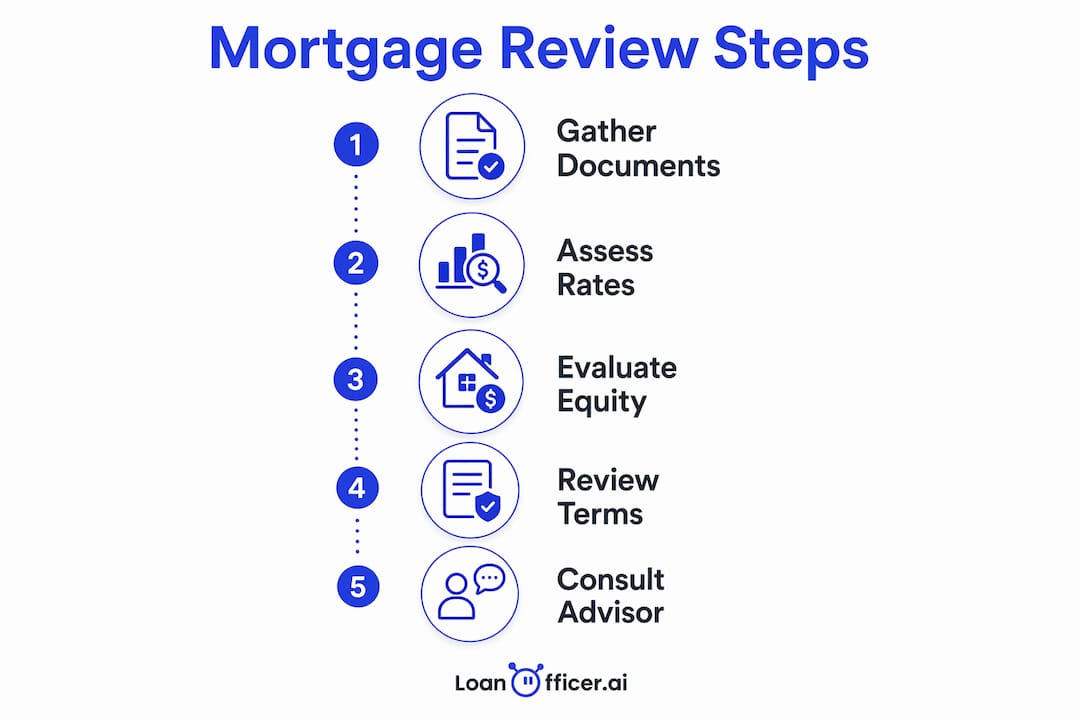
A yearly mortgage assessment is not just about whether you should refinance. It’s a structured look at several moving parts that together determine whether your loan is working for you or against you.
- Current interest rate vs. market rates: Are you paying more than today’s borrowers? Even a modest rate gap compounds over a 30-year term.
- Loan balance and remaining term: How much principal have you paid down, and does your payoff timeline still match your retirement or financial goals?
- Home equity position: Your equity is a financial asset. Knowing its current value opens doors to refinancing, a home equity line of credit (HELOC), or debt consolidation.
- Refinancing options: Could you lower your monthly payment, shorten your term, or switch from an adjustable to a fixed rate?
- Private mortgage insurance (PMI): Lenders do not remove PMI automatically once you hit 20% equity. You have to ask.
- Credit score and income changes: A higher credit score or a raise can qualify you for better programs you couldn’t access when you first closed.
Key components of a thorough home loan review
Each piece of your mortgage profile connects to the others. Pull on one thread and the rest move.

Interest rates and market conditions set the baseline. When the Federal Reserve adjusts its benchmark rate, mortgage rates tend to follow, though not always immediately or proportionally. Knowing where rates stand relative to your note rate tells you whether refinancing pencils out.
Loan terms cover your remaining balance, monthly payment breakdown, and how many years you have left. A homeowner who’s been paying for seven years on a 30-year loan might find that recasting or making extra principal payments accelerates payoff without the closing costs of a full refinance.
Home equity deserves its own attention. Your equity grows as you pay down principal and as your home appreciates. That built-up value can fund home improvements, consolidate high-interest debt, or serve as a down payment on an investment property.
Your financial profile rounds out the picture. Income changes, new debts, or a credit score improvement all affect which loan programs you qualify for. Updating your financial profile can unlock better terms that simply weren’t available to you at closing.
Why the benefits go beyond just saving money
The clearest win from a yearly mortgage check-up is cost savings, but that’s only part of the story.
- PMI elimination: Once your equity crosses 20%, you can request PMI removal and save hundreds yearly that would otherwise disappear into insurance premiums.
- Faster payoff: Identifying even a modest amount of extra monthly principal payment can shave years off your loan and reduce total interest paid.
- Debt management: Using home equity to pay off high-rate credit card balances often cuts your effective interest rate significantly.
- Better financial planning: Your mortgage is likely your largest monthly expense. Reviewing it annually keeps your broader budget aligned with your goals.
- Peace of mind: Reviews provide clarity even when no changes are needed. Knowing your loan is still the right fit is itself a valuable outcome.
Many homeowners skip this step and miss out on PMI removal and interest savings simply because they never asked. The mortgage doesn’t change itself.
How to prepare and conduct your review effectively
Preparation takes about 30 minutes and makes the actual review conversation far more productive.
Gather these documents before you sit down:
- Your most recent mortgage statement (shows balance, rate, and payment breakdown)
- A current credit report from AnnualCreditReport.com
- Recent pay stubs or proof of income
- Your homeowner’s insurance declaration page
- Any recent home appraisal or property tax assessment
Once you have those in hand, bring them to your review with a mortgage advisor or loan officer. Walk through what has changed in the past year: income, credit, home value, and your financial goals. Ask specifically about current rates, available programs, and whether your equity position opens any new options.
Pro Tip:You don’t need to refinance to reduce your total interest. Making one extra principal payment per year, or recasting your loan after a lump-sum payment, can shorten your term and cut interest without the closing costs of a new loan.

If you work with a loan officer who uses a platform like Loan Officer AI, they may already be tracking your equity position and rate changes through AI rate monitoring and will reach out proactively when an opportunity appears.
Signs it’s time to do your mortgage check-up now
The annual calendar is a good default, but certain triggers make a review urgent regardless of timing.
- Rates have dropped noticeably since you closed. Even a 0.5% reduction can meaningfully lower your payment on a large balance.
- Your credit score has improved. A score jump of 40–60 points can move you into a better rate tier or qualify you for programs you previously missed.
- You’ve hit or are approaching 20% equity. Request PMI removal the moment you cross that threshold.
- A major life event has occurred: job change, marriage, divorce, a new child, or an approaching retirement all shift your financial priorities.
- You’re planning a large expense in the next 12–24 months. Setting up a HELOC before you need it gives you a credit line at a lower rate than most alternatives.
Waiting for the “right time” usually means waiting too long. Any of these triggers warrants a call to your loan officer this week.
Common challenges during a mortgage review and how to handle them
The most common obstacle is simply not knowing what to ask. Many homeowners walk into a review without a clear picture of their current rate, remaining balance, or equity position. Pulling your mortgage statement and a free credit report beforehand solves most of that.
A second challenge is inertia. Refinancing feels complicated, so homeowners avoid the conversation entirely. The fix is separating the review from the decision. A review is just information gathering. You don’t commit to anything by having the conversation.
Finally, some homeowners discover their credit has slipped or their income has changed in ways that limit their options. That’s still useful information. Knowing where you stand lets you work on improving your profile before the next review, so you’re positioned to act when rates or programs align.
How your credit score and financial status shape the outcome
Your credit score is one of the most direct levers in a mortgage review. A score above 740 typically qualifies you for the best available rates. A score between 620 and 680 may still get you approved for a refinance, but at a higher rate that could erase the savings.
Income changes matter just as much. A raise or a new job with higher pay can improve your debt-to-income ratio, which lenders use to determine how much you can borrow and at what terms. Conversely, a gap in employment or new debt can temporarily close doors that were open at your last review.
The practical takeaway: treat your credit score and debt load as inputs you actively manage between reviews, not just numbers you check once a year. Small improvements compound over time and show up as real savings when you’re ready to act.
How market trends affect your refinancing opportunities
Mortgage rates in the United States are influenced by Treasury yields, Federal Reserve policy, inflation data, and broader economic conditions. When rates fall, the refinancing window opens. When they rise, the math often favors staying put and focusing on equity growth instead.
The 2022–2024 rate environment pushed most homeowners out of refinancing consideration. As rates stabilize or ease in 2026, mortgage opportunity alerts from your loan officer become genuinely useful. Knowing the moment your break-even point on a refinance drops below two years is the kind of real-time intelligence that turns a passive homeowner into an active one.
Market trends also affect home values, which directly impact your equity position and your ability to tap it. A neighborhood where values have risen gives you more equity to work with, even if your principal paydown has been modest. Tracking both sides of that equation is part of what makes a yearly mortgage assessment worth doing.
Key Takeaways
An annual mortgage review is the single most effective habit for keeping your home loan aligned with your financial life and the current market.
| Point | Details |
|---|---|
| PMI removal requires action | Lenders don’t drop PMI automatically; you must request removal once equity reaches 20%. |
| Credit score drives your options | A score improvement of 40–60 points can qualify you for better rates or new loan programs. |
| Preparation speeds the review | Bring your mortgage statement, credit report, and income verification to every annual check-up. |
| Extra payments reduce interest | One additional principal payment per year can shorten your loan term without refinancing costs. |
| Market shifts create windows | Rate drops and rising home values both create refinancing or equity opportunities worth tracking. |
Loan Officer AI helps your loan officer stay ahead for you

The homeowners who benefit most from yearly mortgage assessments are the ones whose loan officers reach out before they even think to ask. Loan Officer AI gives mortgage professionals the tools to do exactly that: real-time equity tracking, rate change alerts, and automated follow-ups so no client misses a savings window.
If you’re a loan officer or broker looking to deliver this kind of proactive service at scale, the AI-powered mortgage CRM from Loan Officer AI is built for it. Your clients get the annual check-up they deserve. You close more deals with less manual effort.
