Loan Officer Scripts That Actually Convert Clients
What are loan officer scripts and why do they matter?
Loan officer scripts are structured conversation guides that help mortgage professionals navigate client interactions with confidence and consistency. They are not rigid word-for-word recitations. The best ones are flexible frameworks that keep you on track while leaving room to respond naturally to what the borrower actually says.
Why do they matter? Because contacting a lead quickly after inquiry significantly increases conversion rates. That kind of speed requires preparation. You cannot improvise a sharp, trust-building opener every time the phone rings. A well-built script means you pick up the phone already knowing what to say, how to qualify, and where to take the conversation next.
Scripts also solve a problem most loan officers do not talk about openly: cold-call reluctance. Having a plan removes the hesitation. You stop dreading the call and start focusing on the client.
Here is what effective loan officer call scripts accomplish:
- Rapid qualification: They move prospects from “just browsing” to pre-qualification in a single call by asking the right questions in the right order.
- Rapport building: Personalized openers referencing the client’s property type, target location, or loan goal signal that you did your homework.
- Objection handling: Pre-planned responses to common pushbacks (“I’m just comparing rates” or “I need to think about it”) keep the conversation moving instead of stalling.
- Consistent professionalism: Every client gets the same quality of interaction, regardless of whether it is your first call of the day or your fifteenth.
- Pipeline velocity: Scripts shorten the time between first contact and application by eliminating aimless conversation.
The underlying principle is simple. Personalizing scripts with client property details, timeline, and credit readiness data significantly increases trust and conversion likelihood. Generic pitches signal that you have not paid attention. Specific ones signal that you have.
Table of Contents
- What are the real benefits of using mortgage scripts?
- Scripts for every client scenario a loan officer faces
- How do you use scripts without sounding scripted?
- What does the research say about timing and script strategy?
- Put your scripts to work with Loan Officer AI
- Key Takeaways
What are the real benefits of using mortgage scripts?
The case for scripts goes beyond just sounding polished on the phone. Loan officers who use structured dialogues consistently outperform those who wing it, and the reasons are practical, not theoretical.
- Faster lead qualification: A script with targeted discovery questions gets you the information you need in the first call, so you spend time on leads who are actually ready to move.
- Reduced cognitive load: When the framework is already in your head, you can focus on listening rather than scrambling for what to say next.
- Scalable outreach: Scripts let you maintain a high volume of personalized contacts without sacrificing quality. You are not reinventing the wheel on every call.
- Better objection handling: Rehearsed responses to common objections feel natural rather than defensive, which keeps the conversation collaborative.
- Training efficiency: New loan officers ramp up faster when they have proven scripts to practice rather than learning entirely through trial and error.
- Measurable improvement: Scripts give you something concrete to test and refine. You can track which openers generate callbacks, which discovery questions surface the best leads, and which closes convert.
The consistency piece deserves emphasis. When every client interaction follows a thoughtful structure, your brand reputation builds steadily. Referrals come from clients who felt heard and helped, not just processed.
Scripts for every client scenario a loan officer faces
This is where preparation pays off. Different clients need different conversations, and having the right script ready for each situation is what separates top producers from average ones.
New lead initial contact
Speed is everything here. Fire your first outreach within minutes of lead capture. An instant branded text with a self-booking link sent immediately after lead capture significantly increases show rates compared to a cold call alone.

When you do call, open with context, not a pitch:
“Hi [Name], this is [Your Name] with [Company]. I saw you were exploring mortgage options. Are you actively looking at homes right now, or still in the research phase?”
That single question segments the lead immediately. If they are actively looking, move straight to pre-qualification. If they are researching, shift to education and relationship building: “That’s smart. Let me send you a quick overview of what the process looks like. When you’re ready to get specific, I can have numbers for you within 24 hours.”
Property-specific inquiries
When a lead has submitted details about a target property or price range, use that information in your opener. Specificity builds trust faster than any generic introduction.
“Hi [Name], I see you’re looking at properties in the $450,000 range in [City]. Let me walk you through the current rate options for that market and what your monthly payment would look like at a few different down payment levels.”
This approach, referencing their specific loan needs and property type, is one of the most effective mortgage leads conversion practices because it directly addresses what the borrower is already thinking about.
Pre-approved buyers
Pre-approved buyers need urgency and clarity, not more education. They already trust you enough to go through pre-approval. Your job now is to keep them engaged and moving.

“[Name], your pre-approval is solid. The next step is making sure you’re positioned to move fast when you find the right home. I can have a letter ready for any offer within two hours. Are you working with an agent yet, or would a referral help?”
Re-engaging cold leads
Dead leads can generate new volume when approached with transparency rather than pressure. The key is acknowledging the gap without making it awkward.
“Hi [Name], this is [Your Name]. We spoke a while back about your home purchase. I know things don’t always move on a straight timeline, and I’m not calling to push. I just wanted to check in and see where things stand. Are you still thinking about buying, or has the plan changed?”
That honest, low-pressure opener often unlocks conversations that a harder pitch would shut down. For a deeper playbook on reactivating old leads, the approach is the same: transparency first, discovery second.
Probing buyer and seller motivations
Open-ended questions are your most powerful tool here. The goal is to understand the “why” behind the inquiry, because the why shapes everything about how you structure the loan conversation.
“What’s driving the timing on this purchase for you?”“If you could describe your ideal outcome from this mortgage, what would that look like?”“What’s the biggest concern you have about the process right now?”
These questions do more than gather data. They signal that you are a counselor, not just a salesperson.
Explaining total cost analysis (TCA) breakdowns
Most borrowers fixate on the interest rate. Your job is to shift the conversation to total cost, which is where the real comparison happens.
“I want to show you something from this guía para préstamos responsables en México that most loan officers skip. Two loans can have the same rate but very different total costs depending on fees, points, and how long you plan to stay in the home. Let me walk you through a side-by-side so you can see the full picture.”
This positions you as an educator, not a closer. Leading with educational content rather than promotions builds borrower trust and reduces the likelihood they will switch to a competitor mid-process.
Prospects comparing competitors
When a borrower tells you they are shopping around, do not get defensive. Get curious.
“That’s a smart approach. Can I ask what you’re comparing? I want to make sure you’re looking at the same things across lenders, because sometimes the rate looks better but the total cost is higher once you factor in fees.”
Then offer to do a side-by-side comparison using their actual numbers. You are not attacking the competition. You are demonstrating that you do the work others skip.
Earning referrals from past clients
Referrals are the highest-quality leads a loan officer can get, and most loan officers leave them on the table by never asking. A direct, warm script works:
“[Name], I really enjoyed helping you get into your home. Helping people like you is the best part of this job. If you know anyone, a friend, family member, or coworker, who’s thinking about buying or refinancing, I’d love to help them the same way I helped you.”
Keep it personal. Reference the specific closing date or property if you can. Generic referral asks get generic results.
Earning refinance business
Pull the borrower’s estimated current rate from your CRM data and lead it with savings, not process.
“[Name], based on what I’m seeing, it looks like we could save you around $300 a month. That’s $3,600 a year. Want me to pull the exact numbers so you can see the full picture?”
For refinance specialists, the script should always calculate savings on the first call rather than scheduling a follow-up to “run numbers later.” Momentum dies in the gap between calls.
Pro Tip:Always address the closing cost objection before the borrower raises it. Say: “Closing costs will run roughly $4,500 to $6,000, but you’ll recoup that in about [X] months of savings. We can also roll them into the loan if you’d prefer nothing out of pocket.” Proactive transparency converts fence-sitters.
Personalizing scripts for different client profiles
A first-time buyer needs more hand-holding and education. An investor wants numbers fast and skips the emotional framing. A VA borrower may have specific entitlement questions. A refinance client already knows the process and just wants to know if the math works.
The structure of your script stays the same. The vocabulary, the pace, and the depth of explanation shift based on who you are talking to. Gathering client data from the initial inquiry form, including loan purpose, property value, and timeline, gives you the raw material to personalize before you even dial.
Handling objections with scripted responses
The three most common objections in mortgage sales are “I need to think about it,” “I’m just comparing rates,” and “I’m not ready yet.” Each one has a scripted response that keeps the conversation alive.
For “I need to think about it”: “Absolutely. What’s the main thing you’re weighing? I want to make sure you have everything you need to make the decision.”
For “I’m just comparing rates”: “That’s fair. Can I show you what to look for beyond the rate? A lot of borrowers end up surprised by how different the total cost can be.”
For “I’m not ready yet”: “No problem at all. When do you think you’ll be ready to start? I can put a reminder on my end so I reach out at the right time for you.”
Follow-up scripts that do not feel robotic
The worst follow-up call starts with “I’m just checking in.” It signals that you have nothing new to offer. Every follow-up needs a reason to exist.
“Hi [Name], I wanted to reach out because rates shifted a bit this week and it actually works in your favor. I ran your numbers again and the payment came down about $40 a month. Worth a quick conversation?”
Or, if there is no rate news: “How’s the home search going? I have some time this afternoon or tomorrow morning if you have questions about the mortgage process.”
Always give the borrower a specific, low-friction next step.
How do you use scripts without sounding scripted?
The biggest fear loan officers have about scripts is sounding robotic. That fear is valid, but the solution is not to abandon scripts. It is to internalize them.
- Know your script well enough to forget it. Practice until the words feel natural, not recited. Record yourself and listen back. If it sounds like you are reading, keep practicing.
- Use your CRM. CRM-triggered workflows that shift messaging based on prospect behavior outperform static drip sequences. When your system tells you a lead clicked a rate comparison link, your follow-up call has a specific, relevant hook. That context is what makes a scripted call feel personal.
- Maintain a disciplined call cadence. A structured cadence of six calls and five emails over the life of a lead achieves much higher conversion rates. Consistent persistence, delivered with value, is highly effective.
- Never “just check in.” Generic check-in calls are a top reason prospects disengage. Every call needs a specific reason: a rate change, a new program, an answer to a question they asked last time.
- Build in pauses. Scripts work best when you leave space for the client to talk. Ask a question, then stop. The silence is not awkward. It is where trust gets built.
- Treat the script as a guide, not a cage. If the client takes the conversation somewhere unexpected, follow them. You can return to your framework after you have addressed what they actually care about.
- Measure and adjust. Track which openers generate the most callbacks, which discovery questions surface the best leads, and which closes convert. Scripts are living documents. The ones that work in a high-rate environment may need adjustment when rates drop.
For loan officers who want to automate the timing and delivery of follow-up without losing the personal touch, AI-powered follow-up tools can fire the right message at the right moment based on borrower behavior, freeing you to focus on the conversations that actually need a human.
What does the research say about timing and script strategy?
The data on lead response time is stark. Contacting a mortgage lead promptly after inquiry can greatly increase conversion rates compared to slower responses. Most loan officers do not come close to that window. The ones who do, often with the help of automation, have a structural advantage that scripts alone cannot create.
Beyond speed, the research points to several other factors that separate high-converting loan officers from the rest:
- Behavior-triggered workflows beat static drips. CRM sequences that respond to prospect actions, like clicking a link or submitting a form, outperform time-based drip campaigns because the message matches what the borrower just did. A trigger is not just a marketing tool. It tells you exactly when to pick up the phone.
- Educational content builds trust before the application. Loan officers who lead with education rather than promotion position themselves as advisors, which reduces the likelihood a borrower shops elsewhere during the process.
- Instant texts warm cold leads before calls. An automated branded text with a self-scheduling link sent immediately after lead capture shifts the lead from cold to warm before the first human call. The borrower arrives at the call already familiar with your name and ready to engage.
- Re-engaging dead leads works. Transparent discovery scripts applied to previously unconverted prospects can unlock new volume from a database you already paid for. The script matters less than the tone: honest, curious, and pressure-free.
- Human interaction at the right moment closes deals. Automation handles volume. Human judgment handles the close. The goal of behavior-triggered workflows is not to replace the loan officer. It is to make sure the loan officer shows up at exactly the right moment, with the right context already established.
For loan officers building out their mortgage lead follow-up systems, the combination of fast automated first touch and disciplined human follow-up is the formula that consistently produces results. Scripts are the language of that system. Timing is the engine.
Put your scripts to work with Loan Officer AI
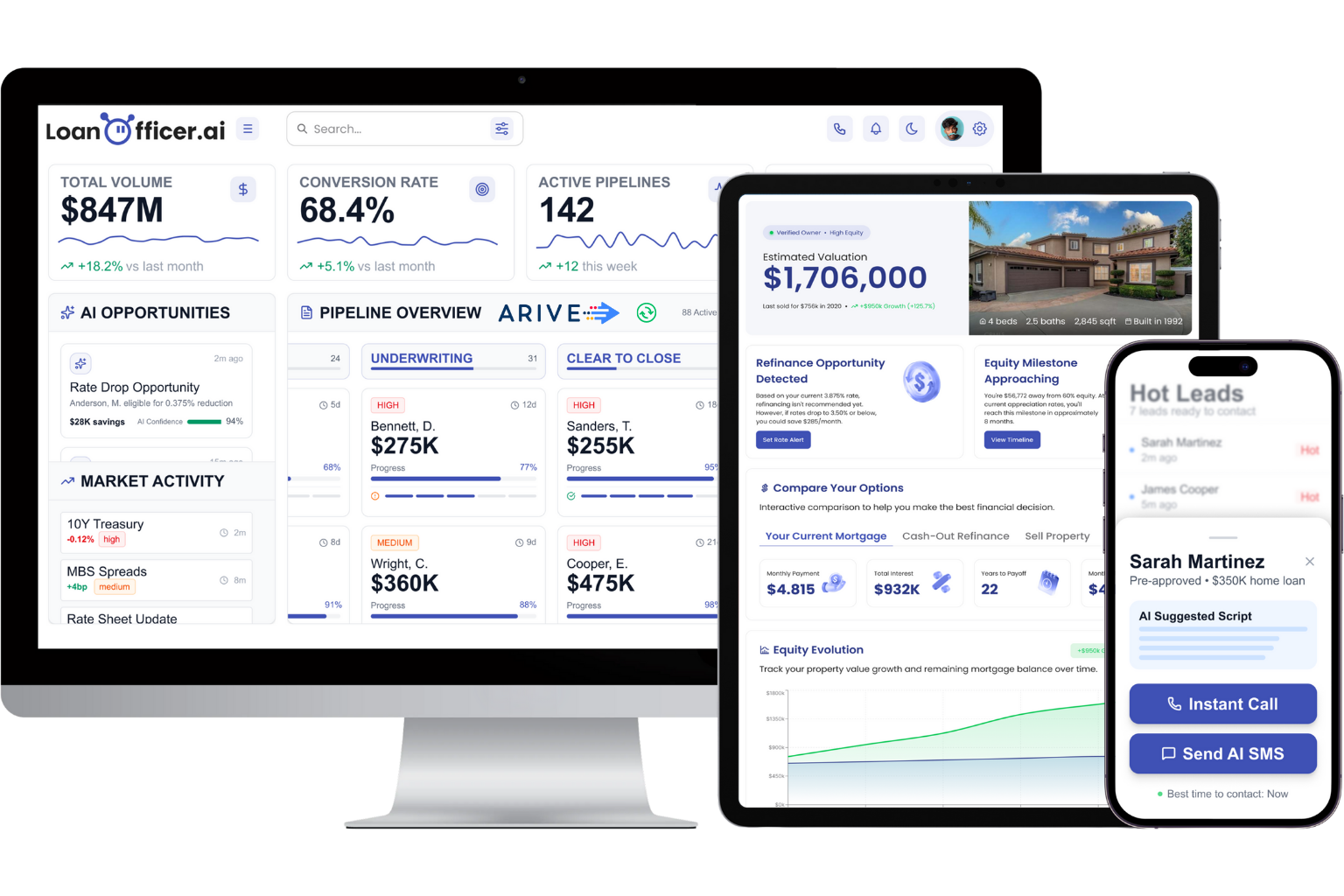
Scripts are only as effective as the system behind them. Loan Officer AI gives mortgage professionals an AI-powered mortgage CRM that fires the right message at the right moment, tracks every touchpoint, and alerts you when a borrower is ready for a human conversation. From instant lead response to behavior-triggered follow-up sequences, the platform is built around the same principles that make great scripts work: speed, personalization, and persistence.
If you are ready to stop losing leads to slower competitors, start with Loan Officer AI and see what a fully connected script and automation system looks like in practice.
Key Takeaways
The most effective loan officer scripts combine rapid first contact, educational tone, and behavior-triggered follow-up to move borrowers from inquiry to application faster than generic outreach ever will.
| Point | Details |
|---|---|
| Speed drives conversion | Contacting a lead promptly after inquiry can greatly increase conversion rates. |
| Personalization builds trust | Referencing a borrower’s property type, location, and timeline signals preparation and accelerates rapport. |
| Cadence beats one-and-done | A structured six-call, five-email cadence over the life of a lead achieves much higher conversion rates. |
| Every follow-up needs a reason | Generic check-in calls cause disengagement; every contact should deliver a rate update, new program, or specific next step. |
| Behavior-triggered workflows outperform static drips | CRM sequences that respond to prospect actions deliver the right message at the right moment, making human follow-up more effective. |
