Best Surefire CRM Alternatives for Loan Officers 2026

For mortgage loan officers who want more automation and less daily busywork, the strongest Surefire CRM alternatives right now are Loan Officer AI, Total Expert, Jungo, Shape (Setshape), Salesforce, and HubSpot. Loan Officer AI is the recommended pick for most producing LOs and small teams.
TL;DR:
- AI-first automation: Loan Officer AI responds to new leads automatically, runs multi-channel follow-up campaigns, and syncs with Encompass and other LOS platforms without manual triggers.
- LOS integrations built in: Native connectors mean loan status updates flow from your LOS into the CRM automatically, cutting the manual entry that consumes a significant portion of a loan officer’s productive time.
- Lower daily busywork: Automated pipeline management, AI lead scoring, and pre-built mortgage campaign templates reduce the admin load that causes most CRM adoptions to stall.
One caveat: if your team runs 50+ users, requires deep enterprise reporting, or is already embedded in an ICE Mortgage Technology ecosystem, a larger platform may fit better. For everyone else, read on.
Table of Contents
- How do these Surefire CRM alternatives compare at a glance?
- Detailed profiles: what each alternative actually delivers
- How do you pick the right alternative for your team?
- Why do CRM replacements fail, and how do you avoid it?
- Key Takeaways
- The tradeoff nobody talks about when leaving a legacy mortgage CRM
- Loan Officer AI is built for what Surefire’s alternatives miss
- Useful sources and further reading
How do these Surefire CRM alternatives compare at a glance?
| Dimension | Loan Officer AI | Total Expert | Jungo | Shape (Setshape) | Salesforce | HubSpot | Surefire (ICE) |
|---|---|---|---|---|---|---|---|
| Best for / use case | Solo LOs and small teams wanting AI automation | Mid-to-large mortgage teams needing compliance + marketing | Salesforce-native mortgage teams | Growing mortgage teams, multi-channel outreach | Enterprise orgs with custom needs | Marketing-led teams, flexible CRM | Marketing-first mortgage shops |
| Pricing posture | Transparent monthly subscription | Enterprise contract, custom pricing | Add-on to Salesforce license | Mid-market, published tiers | High; per-user + implementation | Freemium to mid-market | Enterprise, bundled with ICE |
| LOS integrations | Encompass + others | Encompass, Byte, others | Via Salesforce connectors | Encompass + others | Custom via API | Custom via API/Zapier | Deep ICE/Encompass native |
| Automation & AI | AI lead response, scoring, campaigns | Rule-based automation, marketing library | Salesforce Flow automation | Multi-channel automation | Highly customizable | Strong marketing automation | Content automation, compliance |
| Marketing/content library | Pre-built mortgage templates | Large compliance-reviewed library | Salesforce AppExchange content | Solid template library | Build-your-own | Extensive, general purpose | Deep mortgage content library |
| Ease of use/adoption | Fast onboarding, modern UX | Moderate; training required | Steep; Salesforce admin needed | Moderate | High admin overhead | Moderate | Moderate; legacy UI |
| Reporting & analytics | Pipeline and lead analytics | Strong compliance reporting | Salesforce reporting engine | Standard dashboards | Best-in-class, complex | Good, customizable | Standard mortgage reporting |
| Compliance/auditability | Audit trails, compliant campaigns | Strong; built for regulated teams | Inherits Salesforce compliance | Basic compliance controls | Configurable | Limited out of box | Strong; mortgage-specific |
| Mobile/field use | Full mobile app | Limited mobile | Salesforce mobile app | Mobile-friendly | Salesforce mobile | Mobile app | Limited |
| Support & onboarding | Dedicated CSM, fast setup | Implementation team, longer ramp | Salesforce partner ecosystem | Onboarding support | SI partner required | Self-serve to managed | Implementation team |
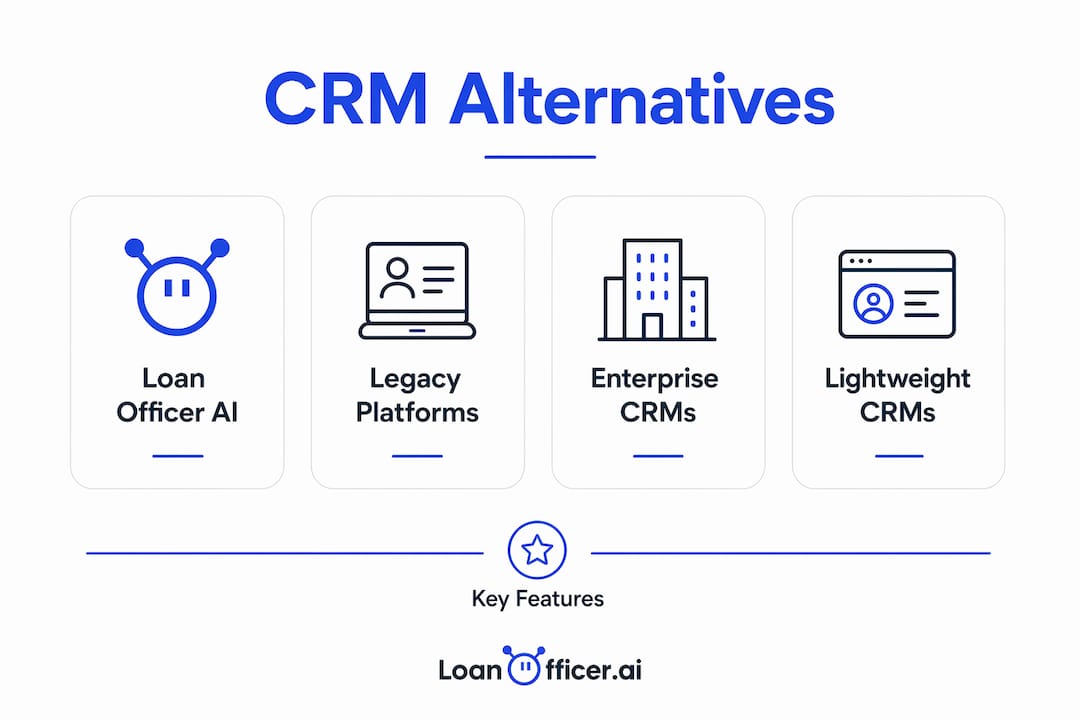
For a typical producing loan officer running 20–50 active loans, Loan Officer AI hits the sweet spot: fast to deploy, mortgage-specific workflows out of the box, and AI automation that actually reduces the manual work that kills adoption on legacy platforms. Small-team mortgage CRM pricing generally runs $50–150 per user per month, while enterprise platforms with full implementation can reach $500–2,000+ monthly. Total cost of ownership matters more than the per-seat sticker price.
Detailed profiles: what each alternative actually delivers
Loan Officer AI
Loan Officer AI is built from the ground up for mortgage professionals, which means you are not configuring a generic CRM to behave like a mortgage tool. The platform ships with pre-built workflows for lead response, active loan management, database mining for refinance and HELOC opportunities, and realtor partnership engagement.
Core features:
- AI-powered lead response and follow-up (multi-channel: email, SMS, calls via smart dialer)
- Pipeline management with real-time loan status visibility
- Native Encompass integration and other LOS connectors
- Automated marketing campaigns with mortgage-specific templates
- Property and equity data analytics for refi opportunity detection
- Mobile app for field use
- Dedicated CSM and structured onboarding
Pros: Fast setup (days, not months), AI automation that runs without manual triggers, mortgage-specific content library, 93% partner retention reported by the platform, full mobile access.
Cons: Designed for LOs and small teams; very large enterprise deployments with complex org hierarchies may need to evaluate the team tier carefully.

Ideal for: Independent loan officers, small brokerages, and producing branch managers who want automation running on day one.
Migration note: Most users are operational within two weeks. Core contacts and active pipeline migrate first; historical data follows in a second phase.
Industry-focused legacy mortgage marketing platforms (Surefire, Total Expert)
These platforms were built specifically for mortgage and carry deep compliance-reviewed content libraries, referral partner tools, and loan-stage automation templates. Surefire (now part of ICE Mortgage Technology) is the archetype: strong marketing content, tight Encompass integration, and compliance controls that regulated teams rely on.
Pros: Pre-approved marketing content, strong compliance auditability, deep LOS ecosystem ties, large content libraries.
Cons: Legacy interfaces and slower product update cadence are common tradeoffs. Enterprise pricing and longer implementation timelines (often 3–6 months for full deployments) add to total cost.
Ideal for: Mid-to-large mortgage lenders with dedicated marketing and compliance staff who need a proven, regulated content engine.
Migration note: Data exports from Surefire require planning. Expect 4–8 weeks minimum for a mid-market migration; enterprise moves often run longer.
General-purpose enterprise CRMs (Salesforce, HubSpot)
Salesforce and HubSpot offer platform flexibility that no mortgage-specific CRM can match on raw configurability. The tradeoff is real: general-purpose CRMs require admin skill and implementation resources to tune for mortgage workflows. A Salesforce deployment for a mortgage team without a dedicated admin or SI partner routinely takes 3–6 months and costs significantly more than the license fee alone.
Pros: Best-in-class reporting (Salesforce), strong marketing automation (HubSpot), massive integration ecosystems, highly customizable.
Cons: High admin overhead, no native mortgage workflow templates, compliance controls require custom configuration, expensive implementation.
Ideal for: Enterprise lenders with IT and ops resources, or marketing-led teams that already run HubSpot for other business lines.
Migration note: Plan for a 3–6 month implementation window and budget for a Salesforce implementation partner or HubSpot onboarding package.
Lightweight and small-team CRMs (Jungo, Shape)
Jungo runs on top of Salesforce, giving mortgage teams access to the Salesforce ecosystem with mortgage-specific overlays. Shape (Setshape) targets growing mortgage teams with multi-channel automation and published pricing tiers.

Pros (Jungo): Salesforce reporting engine, AppExchange integrations, mortgage-specific fields and workflows layered on a familiar platform.
Cons (Jungo): You still need Salesforce admin capacity; the combined license cost adds up quickly.
Pros (Shape): Solid multi-channel automation, mid-market pricing, reasonable onboarding support.
Cons (Shape): Compliance tooling is lighter than legacy mortgage platforms; reporting is less deep than Salesforce.
Ideal for: Jungo fits teams already invested in Salesforce. Shape fits growing teams that want more automation than a basic CRM but are not ready for enterprise pricing.
Pro Tip:Before signing with any Salesforce-based mortgage CRM, ask the vendor to show you a live Encompass sync in a demo environment. Many advertise LOS integration but deliver it via a third-party middleware that adds latency and a separate support contract.
How do you pick the right alternative for your team?
The biggest evaluation mistake is letting a vendor demo dazzle you with feature count. Adoption depends on daily workflow fit, not the number of modules in the platform. Ask yourself: does this CRM support what I do every single day — lead response, active loan updates, partner communication, and database nurture — without requiring manual steps?
Selection criteria that actually matter
- Daily workflow fit: Can an LO run their full day inside the CRM without switching to spreadsheets or email?
- LOS integration depth: Is the Encompass (or your LOS) connector native, or does it route through a third-party middleware?
- Automation that reduces manual work: Does the system trigger follow-ups automatically, or does someone have to push a button?
- Onboarding support: Is there a dedicated CSM, or are you handed a knowledge base?
- Compliance controls: Are campaign templates pre-approved, or does your compliance team need to review everything?
- Total cost of ownership: Add implementation fees, per-loan charges, and data migration costs to the monthly seat price.
- Mobile usability: Can your LOs close tasks and send messages from their phones without a degraded experience?
Demo checklist
- Ask the vendor to trigger a live lead response in the demo environment and time it.
- Request a live Encompass sync showing a loan status update flowing into the CRM automatically.
- Pull up the campaign template library and count mortgage-specific templates versus generic ones.
- Ask: “What does data export look like, and what format does it come in?”
- Request the implementation timeline in writing, broken into phases.
Vendor questions that surface hidden costs
- Are there per-loan or per-contact fees above the base subscription?
- What does data migration cost, and who owns that work?
- Are custom integrations included, or billed separately?
- What is the SLA for LOS connector support when the integration breaks?
Red flags to watch for: Vague migration promises (“we’ll handle it”) with no written scope, LOS integrations listed on a website but not demonstrable in a live environment, automation that requires manual triggers to fire, and implementation timelines quoted in months for what should be a weeks-long setup.
Pro Tip:Run a 30-day parallel pilot with your top five active loans and five new leads before committing to a full migration. That sample is enough to validate lead response speed, LOS sync reliability, and daily usability without disrupting your pipeline.
Why do CRM replacements fail, and how do you avoid it?
CRM failure rates across industries hover between 50% and 55%, and the mortgage industry is not exempt. The primary driver is not bad software; it is the accumulation of manual data entry and administrative busywork that pulls loan officers away from revenue-generating activity until the CRM feels like a burden rather than a tool.
Feature overload compounds the problem. A platform with 40 modules that an LO uses three of is not a productivity tool; it is a distraction. Role-specific training and designated power users consistently outperform broad feature-driven rollouts in actual adoption rates.
Adoption best practices for mortgage teams:
- Designate one power user per team or branch who owns the CRM configuration and trains peers.
- Run role-specific training: LOs learn lead response and pipeline views; processors learn status update workflows; managers learn reporting.
- Use a phased rollout: move active loans and core contacts first, run LOS integrations in parallel, migrate historical data last.
- Measure adoption weekly for the first 60 days (logins, tasks completed, campaigns sent).
- Preserve LOS data links throughout the migration to avoid disrupting active closings.
Pro Tip:Set up automated LOS-to-CRM status mappings on day one. When a loan moves from “processing” to “clear to close” in Encompass, that trigger should fire a borrower update and a realtor notification automatically. That single automation alone reclaims hours of weekly manual work.
The productivity math is straightforward. Loan officers who spend roughly 23% of their productive time on manual CRM entry are effectively giving up one full day per week to administrative work. Automations that sync LOS status to CRM triggers reclaim that time directly.
Key Takeaways
Loan Officer AI is the recommended Surefire CRM alternative for most producing loan officers: it ships with native LOS integrations, AI-driven lead response, and mortgage-specific workflows that reduce manual entry from day one.
| Point | Details |
|---|---|
| CRM failure is mostly an adoption problem | Manual busywork and poor change management cause 50%–55% of CRM implementations to fail, not bad software. |
| Daily workflow fit beats feature count | Evaluate how the CRM supports lead response, active loans, and partner updates simultaneously, not how many modules it has. |
| Implementation timelines vary widely | Simple platforms can deploy in a short timeframe; enterprise deployments often take several months. Budget time and cost accordingly. |
| Hidden costs add up fast | Implementation fees, data migration, custom integrations, and per-loan charges can double the apparent seat price. |
| Loan Officer AI | Built for mortgage LOs with AI automation, Encompass integration, and a reported 93% partner retention rate. |
The tradeoff nobody talks about when leaving a legacy mortgage CRM
Most conversations about switching off Surefire or a similar legacy platform focus on features: does the new tool have a content library, does it connect to Encompass, does it have a mobile app. Those are the right questions, but they miss the harder one.
The real tradeoff is organizational. Legacy mortgage marketing platforms become load-bearing walls over time. Your compliance team has approved the templates; your processors know the status update workflow; your referral partners receive automated co-branded emails from a system they have never seen. When you switch, all of that institutional knowledge has to move with you, and most of it is not in the data export.
The platforms that handle this transition best are the ones that ship with pre-built mortgage workflows, not blank slates. An AI-native mortgage CRM like Loan Officer AI reduces the rebuild time because the mortgage logic is already there. A general-purpose CRM like Salesforce gives you more flexibility but hands you a blank canvas and a long implementation clock.
The teams that switch successfully run a tight pilot first, designate a power user who owns the transition, and treat data migration as a phased project rather than a one-time export. The teams that struggle try to move everything at once and discover mid-migration that their active pipeline is sitting in a format the new system cannot read cleanly.
Choose the platform that fits how your team actually works today, not the one with the longest feature list or the most impressive demo.
Loan Officer AI is built for what Surefire’s alternatives miss
This article is published by Loan Officer AI, an AI-powered mortgage CRM designed specifically for loan officers and brokers who want automation without a six-month implementation project.
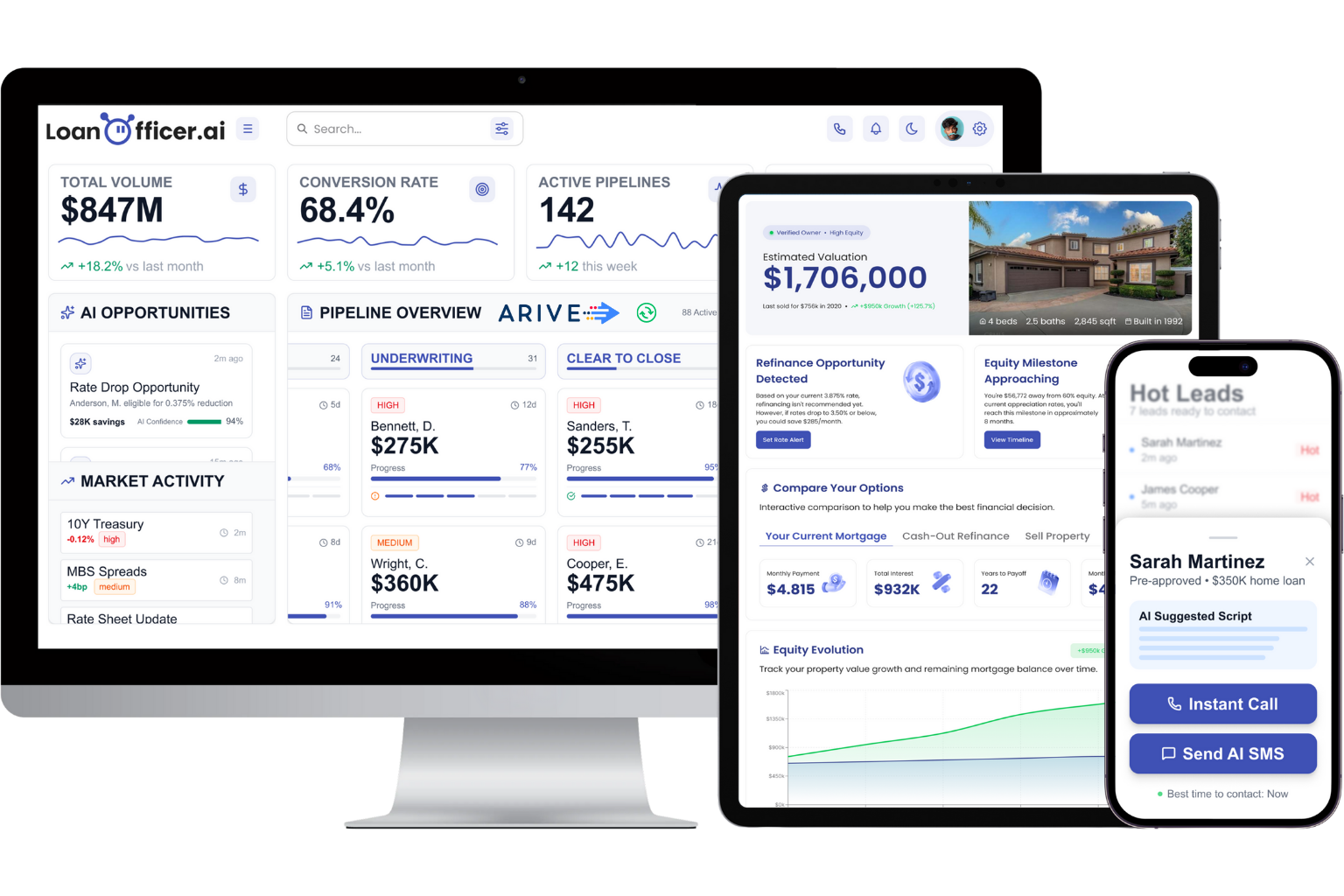
Where legacy platforms give you a content library and a compliance engine, Loan Officer AI gives you a system that works on day one: AI lead response fires automatically, Encompass syncs without manual triggers, and your borrower engagement runs on pre-built mortgage campaign templates. The platform reports 93% partner retention, and most users are fully operational within two weeks.
What you get out of the box:
- AI-powered lead response and multi-channel follow-up
- Native LOS integrations (Encompass and others)
- Pipeline management with real-time loan status visibility
- Database mining for refinance and HELOC opportunities
- Realtor partnership engagement tools
- Full mobile app access
- Dedicated CSM and structured onboarding
Whether you are an independent loan officer evaluating your first serious CRM or a brokerage team ready to replace a legacy platform, the next step is a live demo. Visit loanofficer.ai/mortgage-crm to see the platform in action and talk to an onboarding specialist about your migration timeline.
This article is published by Loan Officer AI for general informational purposes. Pricing, features, and integration availability should be confirmed directly with each vendor before making a purchase decision.
Useful sources and further reading
These sources support the claims in this article and are worth bookmarking if you are actively evaluating mortgage CRM platforms.
- The Hidden Truth: Why Your Mortgage CRM Is Sabotaging Your Success | ProPair — Quantifies how manual data entry and CRM busywork reduce loan officer productivity; the source for the 23% productive time figure and the 50%–55% CRM failure rate cited in this article.
- Mortgage CRM Solutions Review: Top Platforms for 2026 | Sure Send Blog — Vendor-neutral review covering legacy mortgage CRMs, general-purpose platforms, and AI-native options; useful for cross-referencing category tradeoffs.
- Mortgage Broker CRM: Complete Guide to Systems & Selection | Vida AI Agent OS — Covers implementation timelines, pricing ranges, change management best practices, and phased migration guidance; the source for the $50–150/user pricing range and the 2-week to 6-month deployment window.
- Best CRM for Loan Officers in 2026 | LoanOfficer.ai Blog — Long-form buyer guidance with detailed evaluation criteria and case studies for LOs comparing platforms.
- Best Loan Officer CRM in 2026: 7 Top Platforms Compared | LoanOfficer.ai — Feature mapping and migration timeline comparisons across the major mortgage CRM categories.
- Top CRM Alternatives Roundup | Morning Options Blog — External perspective on alternative platforms from a technology research blog; useful for a second opinion on category positioning.
Key research finding: CRM implementations fail at a rate of 50%–55% across industries, with manual data entry and feature overload as the leading causes. The fix is not a better feature list. It is a platform that reduces manual work on day one, paired with a phased rollout and designated power users who own the transition.
