Rate Drop Alerts for Mortgage Pros: AI CRM Setup Guide
Implement behavior-triggered, borrower-specific rate-drop alerts in your AI CRM, route engaged borrowers to live follow-up, and watch your refinance pipeline fill itself. Here is the short version of what that looks like in practice:
- Set borrower-specific savings thresholds (not market-only signals) so alerts fire only when a real opportunity exists for that borrower.
- Enable behavior-triggered workflows with a pause-on-application webhook so marketing stops the moment a borrower enters your pipeline.
- Route high-intent responders directly to a live loan officer with context: their current rate, estimated savings, and the message they replied to.
Behavior-triggered workflows consistently outperform time-based drips because they fire on borrower intent, not a calendar. Loan Officer AI is the recommended platform to build this system end to end.
Table of Contents
- Why rate drop alerts beat calendar drips every time
- Which triggers and thresholds reliably surface refi opportunities?
- How to segment contacts so alerts reach the right borrowers
- What do effective alert workflows and message templates look like?
- What data feeds and integrations does your system actually need?
- How do you measure and improve rate-drop campaigns?
- TCPA, Do Not Call, and recordkeeping: what you must get right
- Key Takeaways
- What top loan officers actually do with rate alerts
- Loan Officer AI puts this system on autopilot for you
- Useful sources and further reading
Why rate drop alerts beat calendar drips every time
A rate-drop alert, in mortgage terms, is an event-driven notification that fires when market conditions or a borrower’s specific profile create a meaningful savings opportunity. It is not a monthly newsletter. It is not a “rates are moving” blast to your whole database. Done right, it is a personalized message that tells one borrower: your current rate is X, today’s rate is Y, and here is what that difference costs you every month.
Event-driven alerts beat calendar drips for three reasons: relevance (the message matches the borrower’s actual situation), timing (you reach them before a competitor does), and personalization (the savings math is specific to their loan). A generic drip sent on Tuesday regardless of what rates did last week is noise. An alert fired 6 hours after a 50-basis-point drop, addressed to a borrower sitting on a 7.25% rate, is a phone call they were waiting for.
Speed compounds this advantage. A 25-basis-point drop can trigger a spike in refinance inquiries within 48 hours. The loan officers who convert in that window are the ones whose systems fired automatically, not the ones who noticed the rate move on Monday morning.

Burst-based marketing triggered by rate movements outperforms always-on campaigns in volatile rate environments. Activate intensive nurture when a window opens, then return to monitoring mode when it closes.
Which triggers and thresholds reliably surface refi opportunities?
Not every rate move is worth an alert. The goal is to fire on real opportunities and suppress noise. These are the trigger types worth configuring:
- Absolute market move: a drop of 25–50 basis points in the 30-year benchmark within a defined window.
- Borrower-specific rate gap: the difference between a borrower’s current rate and today’s available rate, accounting for closing costs and payback horizon.
- Loan-age trigger: loans originated 18–36 months ago that have not been refinanced.
- ARM adjustment trigger: adjustable-rate mortgages within 60–90 days of a reset date.
- 10-year Treasury signal: a sustained move below a defined floor, used as a leading indicator before mortgage rates follow.
- Sustained movement confirmation: require the rate move to persist for a set window (4–8 hours minimum) before firing high-volume alerts, to avoid reacting to intraday noise.
For numeric thresholds, a 0.50–0.75% borrower-specific gap is the practical range most teams use once closing costs and payback timelines are factored in. Teams with higher confidence requirements often set 0.75% as their floor.
| Rate Gap | Priority | First-Touch Channel |
|---|---|---|
| ≥ 0.75% | Hot | SMS within 1 hour |
| 0.50–0.75% | Warm | Email within 4 hours |
| < 0.50% | Monitor | No outreach; re-evaluate next cycle |
Pro Tip:Use borrower-specific gap thresholds rather than market-only signals. A 50-basis-point market drop means nothing to a borrower already sitting at a competitive rate — and alerting them anyway burns trust and opt-in status.
How to segment contacts so alerts reach the right borrowers
Segmentation is what separates a useful alert system from a spam machine. Start with these five buckets:
- Refi candidates: borrowers originated in 2021–2023 at rates above current market, with sufficient equity and remaining loan balance to make refinancing worthwhile.
- ARMs at reset: adjustable-rate borrowers within 90 days of a rate adjustment, regardless of current market levels.
- Recent leads (30–90 days): prospects who inquired but did not close, now potentially re-engageable if rates have moved.
- Long-range prospects: leads beyond 90 days, moved to low-frequency monitoring with quarterly touches.
- Closed clients with equity: past borrowers whose LTV has improved enough to support a cash-out refi or HELOC.
Score each contact by combining four inputs: rate gap (weighted highest), loan age, LTV/equity position, and recent engagement score (email opens, link clicks, reply history). A borrower with a 0.80% gap, a 2022 origination, 25% equity, and a recent email click is your highest-priority alert target.
Suppression rules are as important as scoring. Tie your CRM to your LOS via webhooks so marketing pauses automatically when a borrower submits an application. Also suppress contacts with active Do Not Contact flags, recent outreach within 14 days, and opt-out records. After two non-responses in 30 days, move the contact to monitor mode for 90 days before re-enabling.
What do effective alert workflows and message templates look like?
Short, personalized, and specific. A message that says “rates dropped” is forgettable. A message that says “your rate is 7.125% — today’s rate could save you $340/month” is a conversation starter.
Sample SMS (hot lead, fire within 1 hour of alert):“Hi [First Name], rates moved today. Based on your current rate, you may save around $[Savings]/mo. Worth a quick call? [Calendar Link]”
Sample email (warm lead, fire within 4 hours):“[First Name] — I was reviewing your file and noticed today’s rates could reduce your payment by roughly $[Savings]/month on your [Loan Balance] balance. I wanted to reach out before this window closes. Here’s a link to grab 10 minutes: [Calendar Link]. — [LO Name]”
Personalized messages sent under the loan officer’s name produce significantly higher open and reply rates than generic broadcast emails. The sender identity matters as much as the content.
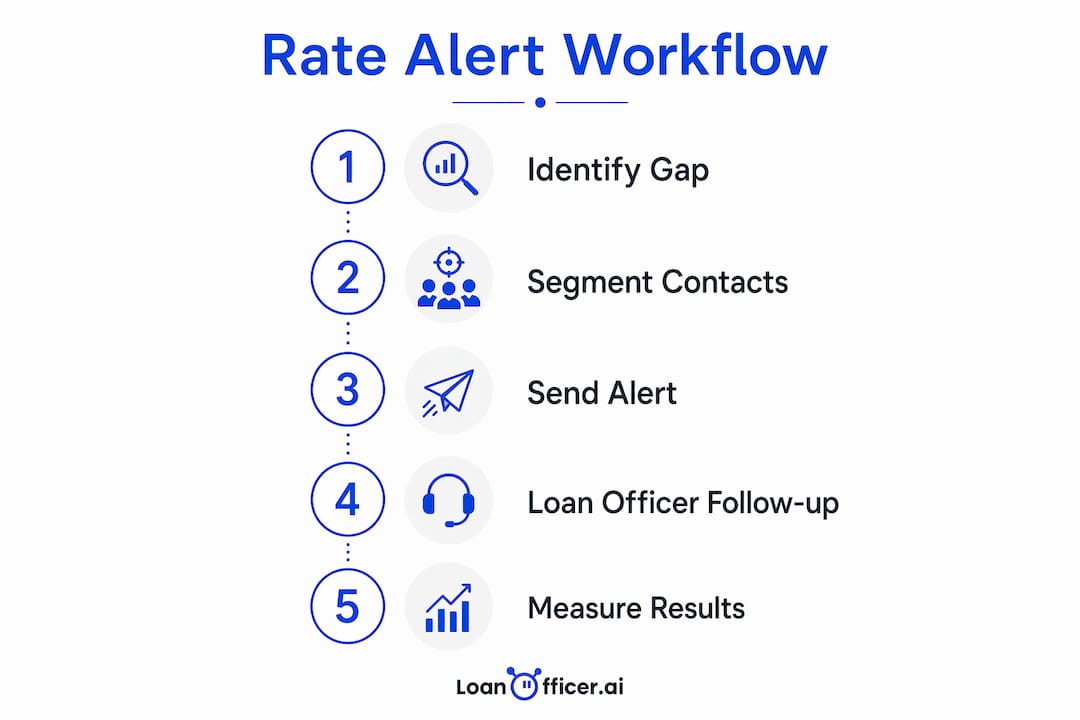
Workflow sequence:
- Alert fires based on borrower-specific threshold.
- Personalized email sends immediately under LO name.
- SMS nudge fires 3–6 hours later if no email open or reply.
- On reply or link click, route to live LO with borrower context (current rate, savings estimate, message history).
- Pause all marketing the moment an application is submitted (webhook trigger).
- After 2 non-responses in 30 days, suppress for 90 days and re-evaluate.
SMS consistently delivers open rates above 90% and response rates 5–10 times higher than email for initial contact, which is why it belongs in the first-touch sequence for hot leads, not as a follow-up.
Pro Tip:For your highest-intent responders, skip the next automated message entirely and have the LO call within 15 minutes of a reply. Automation gets the conversation started; a human closes it.
What data feeds and integrations does your system actually need?
Reliable alerts require clean, timely data. Configure these before you go live:
- Real-time rate feed: 30-year fixed benchmark updated every 15–60 minutes, plus 10-year Treasury as a leading signal.
- Borrower current-rate field: pulled from your LOS and kept current; stale rate data produces false positives.
- Loan balance and LTV feed: updated at least monthly to keep savings estimates accurate.
- LOS webhook sync: bidirectional, so application milestones suppress marketing automatically.
- Consent and opt-out flags: synced in real time; a consent record that lags by 24 hours is a TCPA liability.
| Channel | Best Use | Delivery Priority |
|---|---|---|
| SMS | Hot leads, urgent alerts | First |
| Detailed savings breakdown | Second | |
| Push/in-app | Engaged app users | Third |
| Voice prompt | Highest-intent responders | On reply/click |
Build in feed-failure monitoring. If your rate feed goes silent, your system should alert you, not fire alerts based on stale data. Add duplicate-suppression logic so a borrower who qualifies under two triggers only receives one message per cycle.
How do you measure and improve rate-drop campaigns?
Track these KPIs from day one: email open rate, SMS response rate, opt-out rate per campaign, applications started within 7 and 30 days of an alert, funded loans attributed within 90 and 180 days, and pipeline velocity change for alerted cohorts versus control groups.
For A/B tests, run these in priority order:
- Personalized savings math vs. market-only message (expect a meaningful reply-rate difference).
- SMS-first vs. email-first for warm leads.
- 0.50% threshold vs. 0.75% threshold — measure opt-outs and application starts per cohort.
Set a 90-day attribution window for application starts and 180 days for funded loan attribution. Design test cohorts with different threshold sensitivities and measure reply-to-application conversion within 7 days for hot cohorts and within 30–90 days for warm cohorts. During active rate-drop windows, review cadence and thresholds weekly. In stable markets, monthly cohort analysis is enough.
Campaign shelf life compresses in volatile markets, so treat your creative and thresholds as modular, not set-and-forget.
TCPA, Do Not Call, and recordkeeping: what you must get right
Consent verification is non-negotiable before any SMS or autodial campaign. TCPA violations carry per-message penalties that scale fast, and “we didn’t know” is not a defense.
- Obtain and document written consent for SMS before adding any contact to an alert sequence.
- Maintain a current DNC suppression list and cross-reference it before every send.
- Process opt-out requests within 24 hours and confirm suppression in your CRM and LOS.
- Include a clear message identifier and opt-out instruction in every SMS (“Reply STOP to opt out”).
- Retain timestamped consent records and message logs for a minimum of four years.
- Use LOS milestone webhooks to suppress marketing on active applicants — conflicting messages during underwriting create compliance exposure, not just annoyance.
Pro Tip:Log everything: timestamped consent, message content, delivery confirmation, and opt-out processing. When an aggressive but lawful campaign gets questioned, your audit log is your defense. Consult counsel for edge cases, especially around autodial and reassigned numbers.
Key Takeaways
Behavior-triggered, borrower-specific rate-drop alerts outperform time-based drips because they fire on real savings opportunities, not calendar dates, producing higher reply rates and faster application starts.
| Point | Details |
|---|---|
| Use borrower-specific thresholds | A 0.50–0.75% rate gap, not a market-only signal, is the practical trigger range after accounting for closing costs. |
| Suppress on application | Tie your CRM to your LOS via webhooks so marketing pauses automatically when a borrower submits an application. |
| SMS leads the sequence | SMS open rates exceed 90% and response rates run 5–10 times higher than email, making it the right first-touch for hot leads. |
| Attribute over 90–180 days | Track application starts within 90 days and funded loans within 180 days to measure true campaign ROI. |
| Loan Officer AI automates this | Loan Officer AI’s Rate Watch, LOS webhooks, and borrower scoring handle detection, suppression, and routing in one platform. |
What top loan officers actually do with rate alerts
The loan officers who convert the most from rate-drop windows are not the ones with the most aggressive blast campaigns. They are the ones who treat alerts as advisory touches, not sales calls. The automation does the detection; the human does the closing.
The practical behavior looks like this: the system identifies the 40 borrowers in your database who genuinely benefit from today’s rate move, fires a personalized message under your name, and flags the three who clicked or replied. You call those three with a single sentence: “I was thinking about your situation and wanted to make sure you saw this.” That is not a sales pitch. That is a trusted advisor doing their job.
The burst strategy matters too. When a rate window opens, activate intensive nurture for your hot and warm segments. When it closes, revert to monitoring mode. Running the same intensity year-round burns your list and trains borrowers to ignore you. The Bill Rice Strategy Group’s guidance on burst-based marketing is correct: match your campaign intensity to market conditions, not to a content calendar.
Loan Officer AI puts this system on autopilot for you
Fewer than half of loan officers have a system that fires a personalized alert within an hour of a rate move. Loan Officer AI closes that gap with a platform built specifically for mortgage professionals.
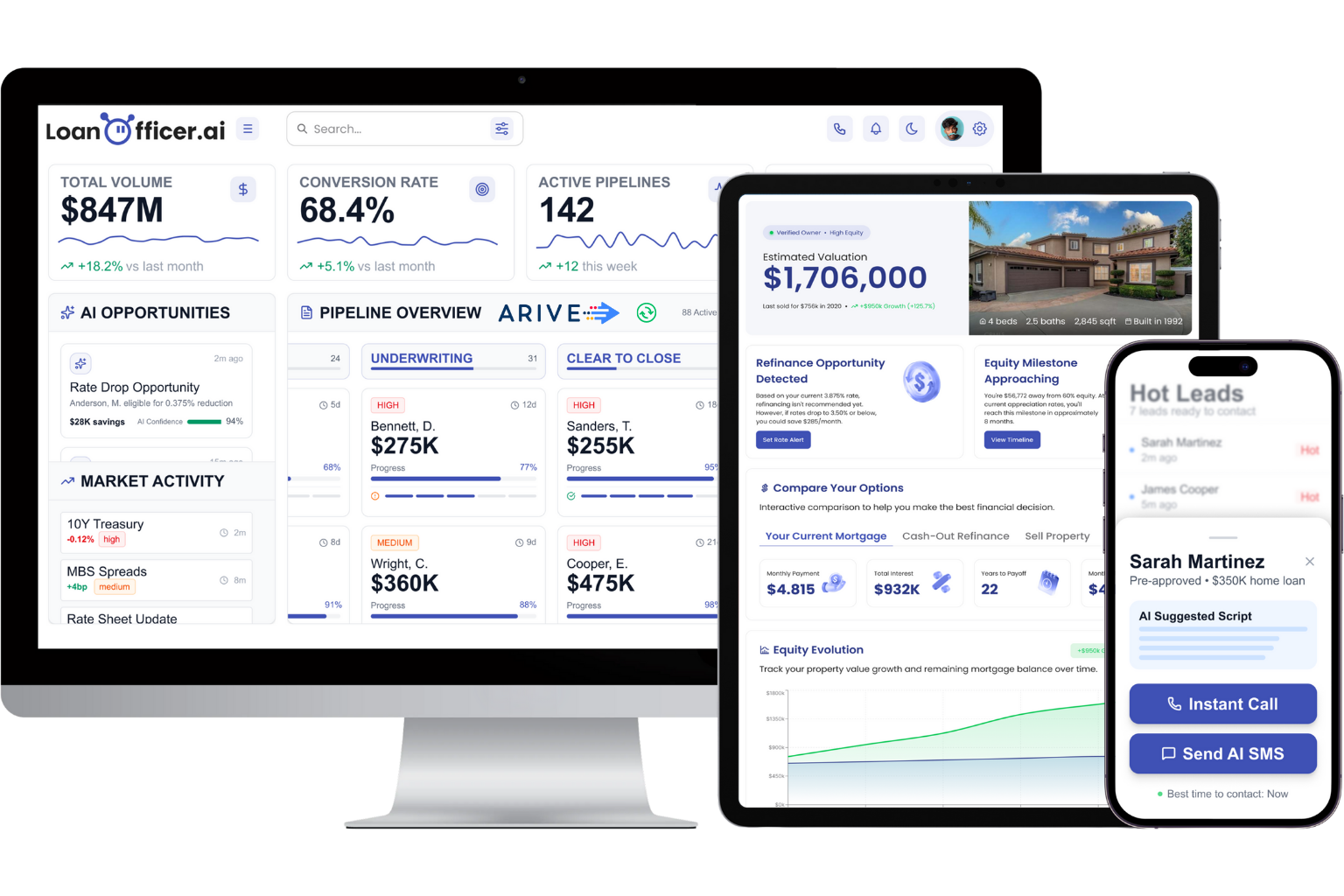
The Rate Watch feature monitors rates continuously, cross-references each borrower’s current rate and profile, and fires personalized alerts under your name when a real opportunity appears. LOS webhooks pause marketing automatically on application. Borrower scoring surfaces your hottest refi candidates first. Multi-channel templates handle SMS, email, and call prompts without manual setup.
The platform reports 93% partner retention, and the Rate Watch success story shows what happens when detection and routing work together. Start a pilot with your 2022–2023 refi candidates: configure thresholds, run for 30 days, and measure reply rate and application starts. Start your trial and see how fast the first refi opportunities surface.
This article is general information for mortgage professionals, not legal or compliance advice. Confirm current TCPA rules, DNC requirements, and consent standards with qualified legal counsel for your specific situation.
Useful sources and further reading
- Behavior-triggered vs. time-based drip campaigns — evidence for event-driven alert design over calendar drips.
- Mortgage marketing in volatile rate environments — Bill Rice Strategy Group on burst strategies and adaptive campaign design.
- Automating mortgage lead nurturing — implementation order, suppression logic, and LOS webhook integration.
- Generating refinance leads on autopilot — threshold guidance (0.50–0.75% gap), personalization evidence, and sustained-movement confirmation.
- Mortgage lead conversion playbook — speed-to-contact data, cohort test design, and attribution windows.
- Mortgage lead nurturing for the 80% not yet ready — SMS open and response rate data; channel priority rationale.
- Loan Officer AI Rate Watch — technical monitoring cadence, sample workflows, and testing recommendations.
- Loan Officer AI opportunity alerts — platform-level detail on refi and HELOC detection logic.
- Loan Officer AI pipeline management — routing, milestone suppression, and LOS integration specifics.
- For TCPA compliance and DNC requirements, consult the FTC’s Telemarketing Sales Rule and qualified legal counsel for your specific outreach programs.
