TCPA Compliance Texting for Mortgage Teams: 2026 Guide
Before you send a single marketing text to a lead or past client, you need prior express written consent on file, the exact disclosure language logged, and an opt-out process that fires automatically. That’s the short version. The longer version is what separates mortgage teams that text confidently from those that face $500–$1,500 per-message class-action exposure.
Three things your team must do right now:
- Collect a compliant opt-in before any marketing text goes out, using a disclosure that names your business, discloses automated texting, and states consent is not required to receive services.
- Honor opt-outs immediately — standard keywords and plain-English revocations alike — and suppress that contact across every campaign.
- Send only during recipient local hours from a registered business sender number (10DLC).
Pro Tip:At the moment of opt-in, capture a system screenshot or audit token showing the exact disclosure text, timestamp, and source. That contemporaneous record is your strongest defense if a claim ever gets filed.
Table of Contents
- What TCPA compliance for texting actually requires from mortgage teams
- Which mortgage messages need written consent vs. a lower bar
- How to capture and store valid consent in your CRM
- How to process opt-outs and revocations correctly
- Why your CRM automation doesn’t protect you from TCPA liability
- What records to keep and how to build an audit trail
- Your TCPA compliance checklist for mortgage texting
- Key Takeaways
- The compliance burden is real, but it’s manageable with the right system
- Loan Officer AI keeps your texting compliant while your pipeline grows
- Useful sources and recommended reading
What TCPA compliance for texting actually requires from mortgage teams
The Telephone Consumer Protection Act (TCPA) draws a sharp line between marketing texts and transactional ones. Cross it without the right consent, and each unauthorized message carries a $500 statutory penalty, rising to $1,500 for willful violations. A campaign that hits 2,000 contacts without valid opt-ins can generate seven-figure exposure before a single hearing.

For marketing texts — rate promotions, refinance offers, new loan products — the standard is prior express written consent. According to TCPA best practices guidance, that consent must identify the specific business sending messages, disclose that automated dialing or texting may be used, and confirm that consent is not a condition of receiving services.
Required disclosure elements for a compliant opt-in:
| Element | What it must say |
|---|---|
| Business identification | Full legal name of the lending entity |
| Automated messaging disclosure | “You may receive automated text messages from [Business]” |
| Consent not required | “Consent is not required to obtain a loan or services” |
| Message frequency | “Message frequency varies” or estimated frequency |
| Data rates | “Message and data rates may apply” |
| Help/Stop instructions | “Reply STOP to opt out, HELP for help” |
| Privacy/Terms link | URL to your privacy policy and terms of service |
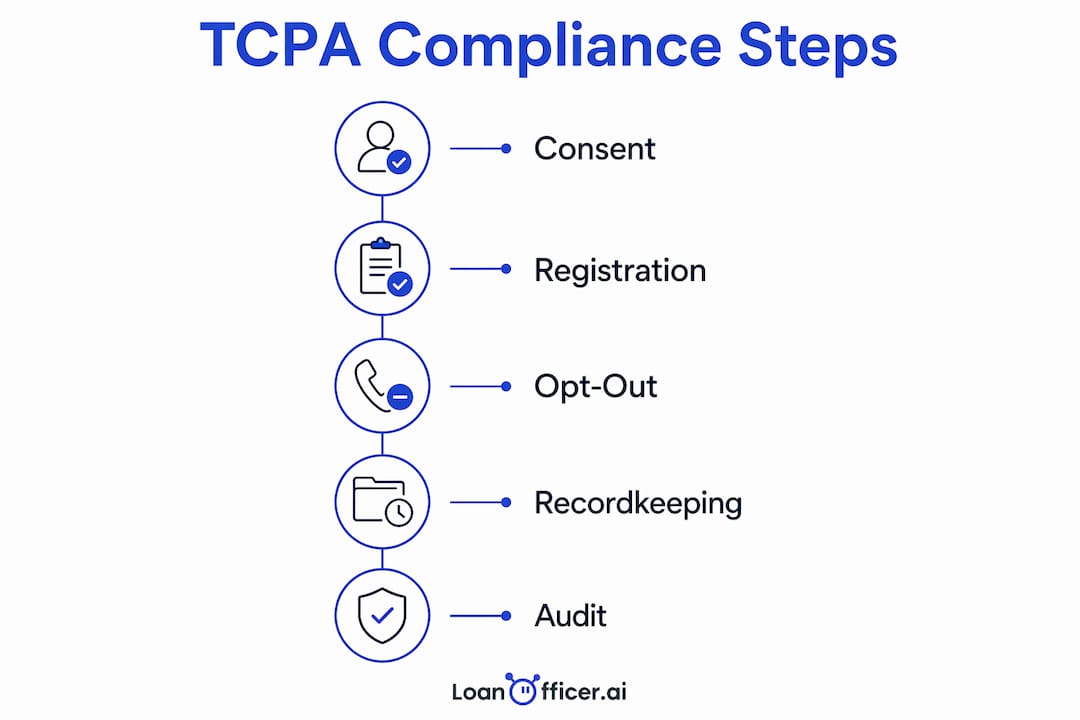
For A2P messaging on local 10-digit numbers, 10DLC registration with The Campaign Registry (TCR) is also required. Carriers can and do block messages from unregistered brands.
Pro Tip:Never use a shared short code for mortgage marketing. A dedicated 10DLC number tied to your registered brand gives you a cleaner audit trail and reduces carrier filtering.
Which mortgage messages need written consent vs. a lower bar
Not every text you send requires prior express written consent. The distinction matters because collecting full written opt-ins for every touchpoint is operationally heavy. Getting the classification wrong in the other direction is where litigation starts.
Marketing/promotional messages (highest consent bar):
- Rate promotion texts (“Rates dropped — you may qualify for a lower payment”)
- Refinance or HELOC opportunity outreach
- New loan product announcements
- Any message with a promotional offer, even if framed as informational
Transactional/informational messages (express consent, lower bar):
- Application status updates
- Document request reminders
- Closing date confirmations
- Appointment reminders tied to an active loan file
The trap: adding a single promotional sentence to a transactional message flips its classification. “Your appraisal is scheduled for Thursday — and rates are still historically low, call us to lock” is now a marketing text.
| Message type | Consent required | Timing restriction |
|---|---|---|
| Marketing/promotional | Prior express written consent | 8 AM–9 PM recipient local time |
| Transactional/informational | Express consent | 8 AM–9 PM recipient local time |
| Emergency/safety | None required | Any time |
How to capture and store valid consent in your CRM
The method you use to collect consent matters less than what you capture and store at the moment of opt-in. Any of these four methods can produce a compliant record:
- Web form with unchecked checkbox: The disclosure appears next to an unchecked box. The consumer must actively check it. Pre-checked boxes do not satisfy written consent.
- Keyword opt-in: Consumer texts a keyword (e.g., “RATES”) to your number. Your system replies with the full disclosure and asks them to confirm. The confirmation reply is the consent record.
- Signed electronic form: A DocuSign or equivalent e-signature on a form that includes the full disclosure block.
- In-person device consent: Consumer signs or taps consent on a tablet at point of sale, with the disclosure visible on screen.
Sample web form opt-in disclosure (copy-ready):
Metadata your CRM must capture automatically:
- Exact disclosure text shown at opt-in
- Timestamp (date, time, time zone)
- IP address or device identifier
- Opt-in source/channel (web form, keyword, signed form)
- Campaign ID or workflow version
- Confirmation message sent (for keyword opt-ins)
Many CRM platforms do not capture this metadata by default. Require your vendor to confirm it does — in writing.
How to process opt-outs and revocations correctly
The FCC’s position is clear: consumers can revoke consent by any reasonable means. Your system needs to handle both the standard keywords and the plain-English variations.
- Honor standard keywords immediately: STOP, END, UNSUBSCRIBE, QUIT, CANCEL, REVOKE. These must trigger suppression with no delay.
- Recognize non-standard revocations: “Don’t text me anymore,” “Remove me from your list,” “I don’t want these messages” — a reasonable person reading these understands them as revocation requests. Your system must treat them the same way.
- Send a single confirmation: One message confirming the opt-out. Nothing else.
- Suppress across all campaigns: Remove the contact from every active workflow, not just the one that received the STOP.
- Log the opt-out event: Record the message content, timestamp, and suppression action in your audit log.
- Internal SLA: Process and suppress within 10 business days at the outside. Immediately is the standard to aim for.
Note on the FCC’s “Revoke All” rule: the FCC extended its effective date to January 31, 2027, meaning the requirement to treat a single opt-out as applying to all unrelated campaigns from the same caller is still on hold. All other revocation obligations remain fully in force now.
Pro Tip:Program your opt-out recognition to catch misspellings and partial matches (“sto p”, “unsub”, “stop texting me”). Failing to catch these is a documented compliance gap that invites litigation.
Why your CRM automation doesn’t protect you from TCPA liability
Automation reduces manual work. It does not reduce legal responsibility. Loan officers remain liable for every message their CRM sends, regardless of whether a human triggered it. The workflow is yours; so is the exposure.
Controls to enforce in every automated workflow:
- Consent gating: The system must check for a valid, logged consent record before any message sends. No consent record, no message.
- Timezone mapping: Map each recipient’s phone number to their local time zone and restrict sends to 8 AM–9 PM local. A contact in Hawaii gets different send windows than one in New York.
- Registered sender numbers: All A2P campaigns must run through your registered 10DLC number, not personal cell phones. Personal-device texting creates audit blind spots and opt-out handling gaps that are nearly impossible to defend.
- Opt-out intercept: Every workflow must check the suppression list before sending, not just at enrollment.
Audit protocol: Quarterly at minimum, run these tests. Send a test opt-in through each channel and verify the metadata captures correctly. Send a test STOP and a non-standard revocation phrase, then confirm suppression fires. Review a sample of message logs for timezone compliance. Keep a change log every time a workflow rule is modified.
For governance guidance on AI-driven workflows, Loan Officer AI’s responsible AI practices page outlines the audit controls built into the platform.
What records to keep and how to build an audit trail
If a TCPA claim lands, your defense lives or dies on documentation. Keep consent records and message logs for at least five years — one year beyond the four-year statute of limitations.
| Record type | Fields to retain | Retention |
|---|---|---|
| Consent record | Disclosure text, timestamp, IP/device, opt-in source, campaign ID | 5 years |
| Message logs | Message content, recipient number, send timestamp, delivery status | 5 years |
| Opt-out records | Revocation message/method, timestamp, suppression confirmation | 5 years |
| Workflow versions | Rule logic, effective dates, change log | 5 years |
| 10DLC/TCR registration | Brand registration, campaign registration proof | Duration + 5 years |
Building an evidence packet: Export the consent record with the exact disclosure text shown. Pull the message thread log for the relevant number. Include your 10DLC/TCR campaign registration confirmation. Attach the workflow change log showing the version active at the time of the message. That package answers every question a plaintiff’s attorney will ask.
Pro Tip:Store consent snapshots as immutable records — a PDF or image of the opt-in form as it appeared to the consumer, not just a database field. Database fields can be edited; a timestamped snapshot cannot.
Your TCPA compliance checklist for mortgage texting
A practical SOP your team can implement this week. For a broader view of mortgage broker compliance management, the linked guide covers CRM audit alignment and SOP setup in detail.
Setup steps:
- Register your brand and campaigns with TCR for 10DLC A2P messaging
- Configure consent gating in your CRM so no message sends without a logged opt-in
- Enable automatic metadata capture: disclosure text, timestamp, IP, source, campaign ID
- Set timezone enforcement rules per recipient phone number
- Build and activate opt-out suppression lists that apply across all campaigns
Copy-ready templates:
Web form opt-in: “By checking this box, I agree to receive automated text messages from [Company] about mortgage products and services. Msg & data rates may apply. Consent is not required to receive services. Reply STOP to opt out.”
Keyword opt-in confirmation: “You’re confirmed to receive texts from [Company]. Msg & data rates may apply. Reply STOP to opt out, HELP for info.”
STOP confirmation: “You’ve been unsubscribed from [Company] texts. No further messages will be sent. Contact us at [phone/email] for assistance.”
QA tests to run before launch:
- Submit a test opt-in via each channel and verify all metadata fields populate
- Reply STOP from a test number and confirm suppression fires within seconds
- Send a non-standard phrase (“please stop messaging me”) and verify it triggers suppression
- Pull a consent snapshot and confirm it shows the exact disclosure text
- Schedule a quarterly compliance audit on your calendar now
Key Takeaways
TCPA compliance for mortgage texting requires prior express written consent, logged metadata, immediate opt-out suppression, and a five-year audit trail before any marketing campaign runs.
| Point | Details |
|---|---|
| Written consent is mandatory | Collect prior express written consent for all marketing texts; log disclosure text, timestamp, and source. |
| Register your sender number | 10DLC registration with TCR is required for A2P messaging; unregistered numbers risk carrier blocking. |
| Honor all opt-outs immediately | Suppress standard keywords and plain-English revocations across every campaign within 10 business days. |
| Keep records for 5 years | Retain consent records, message logs, opt-out events, and workflow change logs for at least five years. |
| Loan Officer AI centralizes compliance | Loan Officer AI’s CRM enforces consent gating, timezone-aware sends, opt-out suppression, and audit logging in one platform. |
The compliance burden is real, but it’s manageable with the right system
Mortgage teams that text at scale face a genuine tension: the outreach cadence that drives pipeline growth is the same one that creates TCPA exposure if the underlying controls are loose. What I’ve seen trip up otherwise well-run operations isn’t ignorance of the law — it’s the assumption that automation handles compliance by default.
It doesn’t. A CRM that sends 500 texts a day without consent gating isn’t a productivity tool; it’s a liability generator. The teams that get this right treat compliance as an infrastructure problem, not a legal checkbox. They build consent capture into every lead source, enforce timezone rules at the workflow level, and assign someone to own the quarterly audit. That person doesn’t need to be a lawyer. They need a system that makes the right behavior the default behavior.
The practical reassurance: with proper controls in place, you can run high-volume automated outreach and stay clean. The mortgage communication audit process is not a one-time project — it’s a recurring governance habit. Assign a compliance owner, put the quarterly review on the calendar, and make sure your CRM vendor can show you the consent metadata on demand. Those three habits cover most of the risk.
Loan Officer AI keeps your texting compliant while your pipeline grows
Fragmented texting from personal phones is the single biggest compliance gap mortgage teams carry into 2026. Loan Officer AI eliminates it by centralizing every outbound text through a CRM that enforces consent gating, logs opt-in metadata automatically, and suppresses opted-out contacts across all active campaigns before a message ever sends.
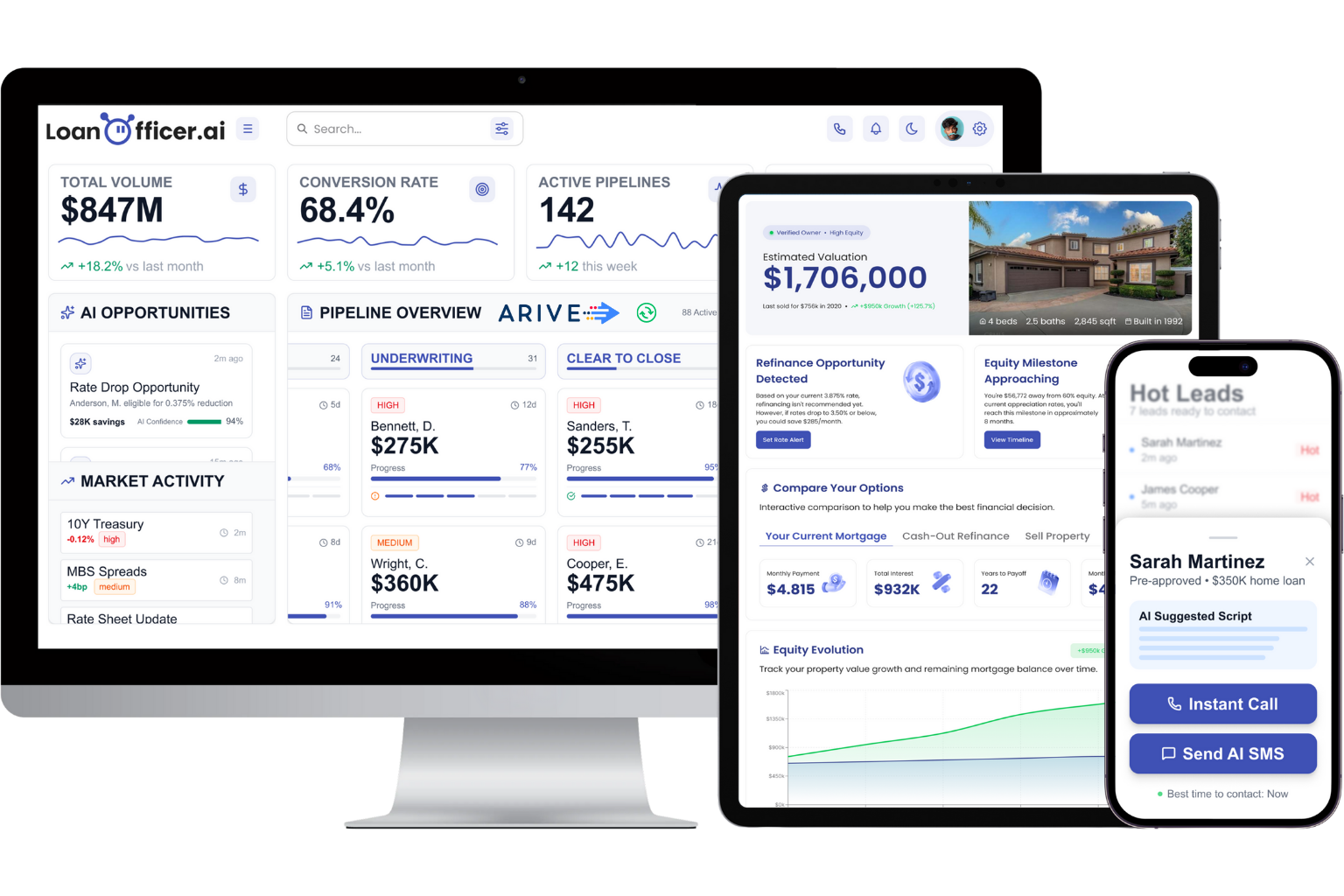
The platform’s timezone-aware send windows prevent out-of-hours messages without manual oversight. Audit logs capture message content, timestamps, and workflow versions in a format you can export for legal review. And 10DLC/A2P sender support means your campaigns run through registered business numbers, not personal devices with no paper trail.
For independent loan officers, small teams, and brokerages managing high-volume outreach, Loan Officer AI turns a compliance checklist into a default operating mode. See how it fits your workflow with a mortgage CRM trial — or explore the full feature set at loanofficer.ai/mortgage-crm.
This article is general information, not legal advice. Consult qualified legal counsel to confirm how current TCPA and FCC rules apply to your specific messaging programs.
Useful sources and recommended reading
Primary regulatory sources:
- FCC DA 26-12 — TCPA “Revoke All” Rule Extension Order (January 6, 2026) — the primary FCC order extending the Revoke All effective date to January 31, 2027. Essential for legal counsel reviewing current revocation obligations.
- Mac Murray & Shuster LLP — FCC Pushes Back TCPA “Revoke All” Rule — practical legal analysis of what the delay means and which revocation rules are currently in force.
- Nelson Mullins — Mobile Messaging in 2026: Mind Your Opt-Ins and Opt-Outs — best for legal teams interpreting the “reasonable means” revocation standard.
Operational implementation guides:
- Foster LLP — Five Best Practices to Avoid Violating the TCPA — concise legal-firm guidance on consent disclosure elements; use this with counsel for rule interpretation.
- TextBolt — TCPA Compliance Checklist — practical operational checklist covering common failure points; useful for CRM configuration and QA testing.
- Twilio — Guide to US Messaging Compliance — detailed A2P/10DLC implementation guidance and opt-out keyword handling; best for technical teams configuring sender registration.
For mortgage-specific compliance integration:
- Loan Officer AI — Responsible AI Practices — governance and audit controls for AI-driven mortgage CRM workflows.
- Loan Officer AI — Mortgage CRM — platform features for consent logging, timezone enforcement, and audit trail management.
