Mortgage Email Templates for Loan Officers: 2026 Guide
What mortgage email templates should you use right now?
The templates below cover the eight highest-impact moments in a loan officer’s pipeline. Copy, personalize, and send.
1. New inquiry response
- Subject: “Re: Your mortgage question from [Source]”
- Body points: confirm receipt, state your NMLS ID, offer two call times, set a 24-hour expectation
- Goal: respond within 5 minutes to increase contact success over 8 times compared to delays
2. Pre-approval granted
- Subject: “[First Name], your pre-approval letter is ready”
- Body points: state approved amount, list next steps, attach nothing sensitive, link to your secure portal
3. Rate update alert
- Subject: “[First Name], your rate scenario just changed”
- Body points: cite the old rate vs. current APR, show estimated monthly savings, include a TILA-compliant disclosure line, add a clear call to action
4. Refinance opportunity
- Subject: “A quick look at your equity, [First Name]”
- Body points: reference their original close date and rate, show current market comparison, invite a no-cost analysis call
5. Conditional approval follow-up
- Subject: “One step left on your loan, [First Name]”
- Body points: list outstanding conditions, link to your encrypted document portal, give a deadline
6. Realtor partner update
- Subject: “[City] market update for your listing appointments”
- Body points: share two or three local data points, offer a co-branded one-pager, keep it under 150 words
7. Closing-day checklist
- Subject: “What to bring to closing tomorrow, [First Name]”
- Body points: personal check, government ID, wire confirmation number, no sensitive attachments
8. Post-close review request
- Subject: “A 2-minute favor, [First Name]?”
- Body points: thank them, link directly to your Google or Zillow profile, keep the ask to one sentence
Pro Tip:Personalize at minimum three elements per template: the borrower’s name, their loan purpose, and a local or situational detail. Generic mass sends get ignored; stage-specific emails get replies.
Why mortgage email marketing drives pipeline results
Email remains the most cost-effective channel for loan officers to maintain borrower relationships between touchpoints. A single well-timed message, like a rate-drop alert sent the morning rates shift, can reactivate a cold lead that no amount of calling would have reached.

Drip campaigns are where the real efficiency lives. A mortgage drip campaign sequences messages automatically based on pipeline triggers: inquiry received, pre-approval issued, application stalled, closing scheduled. That automation removes the mental load of remembering who needs a nudge and when.
The core email types loan officers use fall into three buckets:
- Transactional: pre-approval letters, conditional approval notices, closing checklists
- Nurture: rate watch newsletters, annual mortgage checkups, re-engagement sequences
- Referral and partner: realtor market updates, CPA outreach, post-close review requests
Each type serves a different relationship stage. Mixing them without a trigger system leads to the wrong message at the wrong time, which is worse than no message at all.
What federal rules govern mortgage email compliance?
Compliance is not optional, and the rules are specific enough that vague good intentions will not protect you; using consent-based marketing strategies is essential for managing and building mortgage marketing email lists legally.
CAN-SPAM Act requires a valid physical business address, a working unsubscribe mechanism, and no deceptive subject lines or bait-and-switch language. Unsubscribe requests must be honored within 10 business days. Violations carry per-email civil penalties.
FTC Safeguards Rule mandates multi-factor authentication and data encryption for any system handling non-public personal information, including your CRM and email platform.
GLBA and TILA/Regulation Z require that any rate advertised in an email carry the APR alongside it, with a disclosure that rates are subject to change. Phrases like “guaranteed lowest rates” violate both FTC rules and CAN-SPAM guidance.
Document handling is its own risk category. Never send sensitive documents like tax returns or bank statements as email attachments. Use an encrypted, HTTPS-secured portal every time.
Email signatures must include your full legal name, NMLS ID, company name, Equal Housing disclosure, and a confidentiality disclaimer. Every email you send is a legally discoverable business record.
The Homebuyers Privacy Protection Act (HPPA) adds another layer: trigger lead restrictions now require opt-in consent or an existing relationship before contact, making purchased email lists a compliance liability.
Compliance shortcut: A mortgage CRM automates disclosures, tracks opt-ins, and manages unsubscribes so compliance does not depend on individual loan officers remembering every rule on every send.
Which mortgage CRM platforms support email automation best?
Two platforms stand out for loan officers who need both template automation and compliance management built in.

| Feature | Jungo | LoanOfficer.ai Mortgage CRM |
|---|---|---|
| Core features | Full CRM on Salesforce: lead management, co-marketing, drip email campaigns, compliance tracking | AI-powered CRM: lead response automation, pipeline management, database mining, smart dialer |
| Marketing automation | Drip email campaigns, customizable flyers, post-closing cards | Automated multi-channel campaigns, real-time rate alerts, refinance opportunity detection |
| Compliance management | Compliance tracking and reporting built on Salesforce infrastructure | Automated disclosures, opt-in tracking, regulatory adherence workflows |
| LOS integration | Salesforce-native integrations | LOS integrations included |
| Ease of use | Salesforce learning curve; deep customization available | Purpose-built for mortgage pros; minimal setup |
| Customer support | Salesforce Partner Badge; dedicated mortgage CRM support | Onboarding support; 93% partner retention reported |
| Best for | Teams needing Salesforce infrastructure and co-marketing tools | Loan officers prioritizing AI automation and real-time market insights |
| Rating | 4.5★ (215 reviews) | — |
Jungo runs on Salesforce, which gives it enterprise-grade infrastructure and the Salesforce Partner Badge as a verified trust signal. Its co-marketing tools, including customizable flyers and post-closing cards, suit loan officers who run active realtor partnership programs. The Salesforce foundation means deep customization, though that also means a steeper learning curve for loan officers who want to be up and running in a day.
LoanOfficer.ai Mortgage CRM is purpose-built for mortgage professionals who want AI doing the heavy lifting on follow-up and opportunity detection. Its database mining identifies refinance and HELOC candidates from your existing contacts using real-time equity and market data, so the right email goes to the right borrower without manual sorting. For independent loan officers or brokerages that need fast deployment and consistent automated outreach, it fills a gap that general-purpose CRMs leave open.
How do you choose the right mortgage email and CRM tool?
Five criteria separate a tool that helps from one that creates more work:
- Compliance automation: look for built-in unsubscribe management, opt-in logging, and automatic disclosure insertion. Manual compliance is a liability.
- LOS integration: your CRM should pull loan status data directly from your loan origination system so pipeline-triggered emails fire without manual updates.
- Drip campaign flexibility: the best platforms let you build sequences by borrower stage, loan type, and local market context, not just by date.
- Ease of adoption: a tool your team does not use is worthless. Prioritize platforms with mortgage-specific templates pre-loaded and minimal configuration required.
- Support and training: mortgage regulations change. A vendor that provides ongoing compliance updates and responsive support protects you when rules shift.
How AI-powered CRM changes mortgage email outreach
AI does not just automate sending. It changes which emails get sent and when.
Loan Officer AI monitors your database for refinance triggers, like a borrower whose original rate is now materially above current market, and generates a personalized outreach automatically. That is the difference between a scheduled newsletter and a message that arrives the day it is relevant. The platform’s borrower engagement automation also handles lead response, firing a personalized reply within minutes of an inquiry, which matters because responding within 5 minutes can increase contact success over 8 times compared to delayed replies.
The compliance layer runs in parallel. Disclosures insert automatically, opt-in status is tracked per contact, and unsubscribe requests update the database in real time. Loan officers working with Loan Officer AI report a 93% partner retention rate, which reflects consistent, relevant communication rather than sporadic blasts.
For mortgage brokerages managing multiple loan officers, the platform’s pipeline management and team-level automation mean every borrower gets a consistent experience regardless of which officer owns the file.
What makes mortgage email templates work?
A template is a starting point, not a finished product. The structural elements that make any mortgage email effective are consistent across every stage:
- A subject line that names a specific context, not a generic offer. “Your rate scenario just changed” outperforms “Mortgage update” every time.
- A first sentence that references something specific to the borrower: their close date, their city, their loan type.
- One clear call to action per email. Two asks split attention and reduce replies.
- A compliant footer with your NMLS ID, physical address, Equal Housing disclosure, and an unsubscribe link.
How to integrate mortgage email templates into your CRM
Getting templates into your CRM correctly takes four steps:
- Audit your pipeline stages. Map every stage from inquiry to post-close and identify where communication gaps exist. Those gaps are where templates belong.
- Build trigger rules. Set each template to fire on a specific event: new lead created, pre-approval issued, application stalled for 72 hours, closing date confirmed.
- Load compliant footers once. Configure your NMLS ID, address, and disclosure language at the account level so every outgoing email inherits them automatically.
- Test before activating. Send each template to yourself and verify that personalization tokens resolve correctly, unsubscribe links work, and no sensitive data appears in the body.
What metrics tell you if your email campaigns are working?
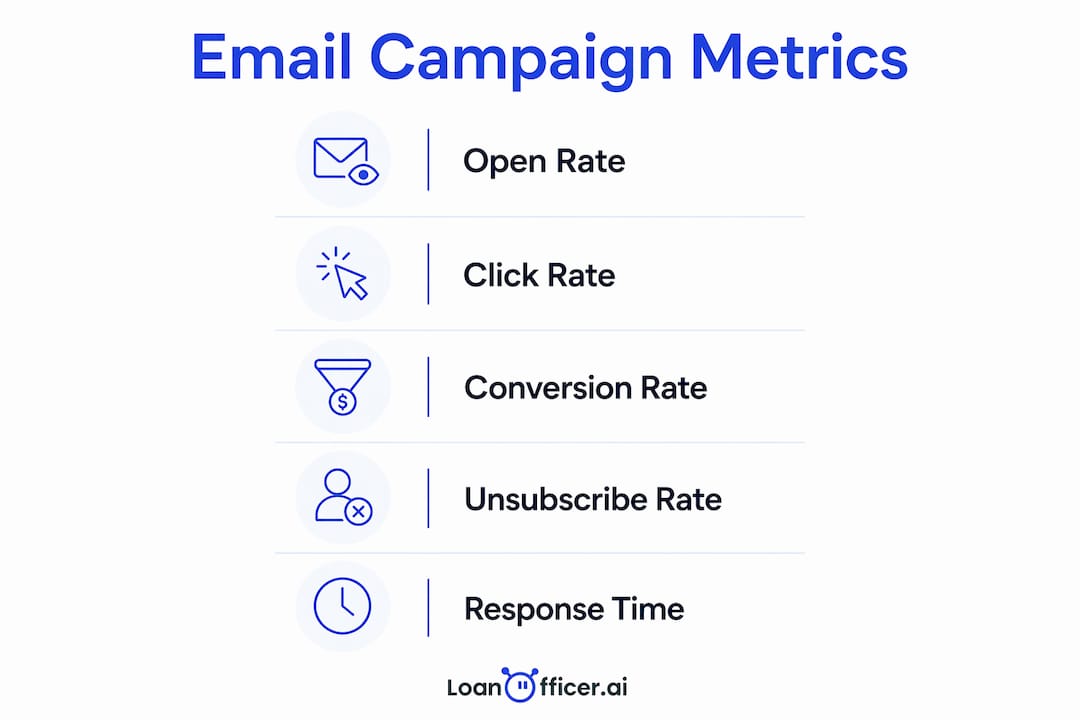
Three numbers matter most for mortgage email campaigns:
- Open rate tells you whether your subject lines are earning attention. A rate-drop alert with a specific dollar figure in the subject will outperform a generic newsletter subject consistently.
- Reply rate is more meaningful than click rate for mortgage emails, because a reply starts a conversation. Track it by template type to see which stages generate the most engagement.
- Conversion rate per sequence measures how many borrowers who entered a drip campaign moved to the next pipeline stage. This is the number that connects email activity to closed loans.
Review these monthly, not quarterly. A template that worked in a low-rate environment may underperform when rates shift, and catching that early saves pipeline.
How to personalize mortgage email templates for better engagement
Personalization beyond a first name is what separates a 20% open rate from a 40% one. Three levers move the needle:
Loan purpose context. A first-time buyer email should reference down payment assistance programs and credit score thresholds. A refinance email should reference the borrower’s original rate and current equity. Using the same template for both audiences signals that you did not read their file.
Local market data. Mentioning median days on market in a specific city, or inventory changes in a borrower’s ZIP code, makes a rate update feel like advice rather than advertising. Loan officers who build realtor partnerships can pull this data from their MLS feed and drop it into partner emails automatically.
Timing to life events. An annual mortgage checkup email sent on the anniversary of a borrower’s close date feels personal. The same email sent randomly feels like a newsletter. CRM triggers make the difference between the two.
Loan Officer AI is built for exactly this workflow
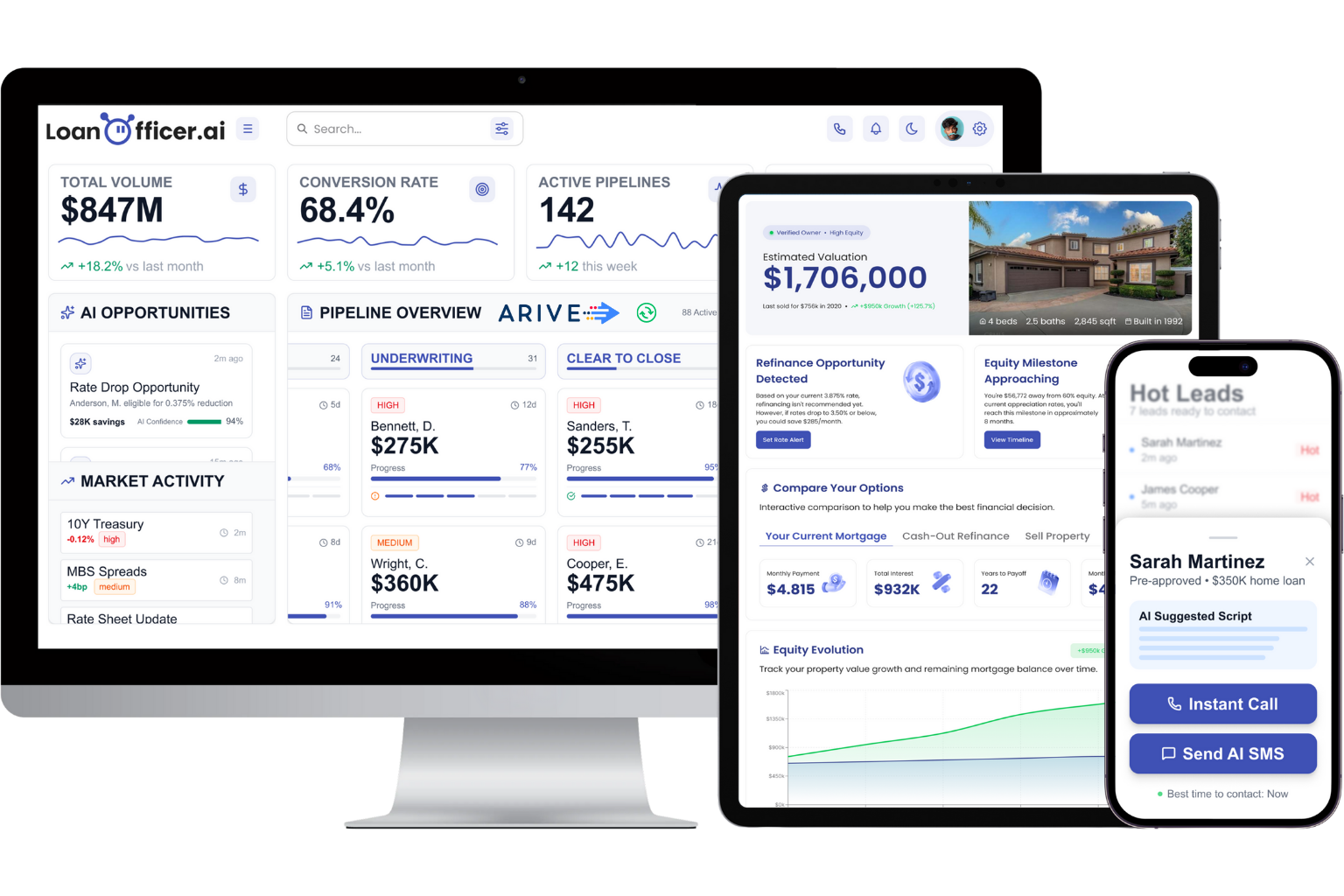
Most loan officers know what they should send. The problem is finding time to send it, personalize it, and track whether it worked. Loan Officer AI handles all three automatically, without requiring a Salesforce administrator or a marketing team.
The platform deploys AI-powered follow-up across your full pipeline, identifies refinance candidates from your existing database using live equity data, and keeps every outgoing message compliant with built-in disclosure management. For brokerages and independent loan officers who want consistent borrower communication without the manual overhead, it is a direct alternative to building that system yourself. Start with a free trial to see how the automation maps to your current pipeline.
Key Takeaways
The most effective mortgage email strategy pairs stage-specific templates with CRM automation and built-in compliance, so every message is timely, personal, and legally sound.
| Point | Details |
|---|---|
| Templates by pipeline stage | Use distinct templates for inquiry, pre-approval, rate updates, refinance, and post-close to match borrower context. |
| Compliance is non-negotiable | Every email needs a valid address, NMLS ID, unsubscribe link, and TILA disclosures when rates are mentioned. |
| Speed drives contact rates | Responding within 5 minutes can increase contact success over 8 times compared to delayed replies. |
| CRM automation removes manual load | Trigger-based drip campaigns fire the right email at the right stage without manual intervention. |
| Loan Officer AI for AI-driven outreach | Loan Officer AI automates lead response, refinance detection, and compliance tracking with a reported 93% partner retention rate. |
