Prove Consent in 5 Minutes: Ringless Voicemail Rules for U.S. Lenders
Ringless voicemail is legal in the United States, but only when you treat it the way federal regulators do: as a call. The FCC has ruled that ringless voicemail delivered to wireless numbers falls under the TCPA, which means marketing messages need prior express written consent, scrubbed lists, and documented proof you followed the rules. Skip any of that, and you’re exposed to statutory damages and class-action risk, not just a warning letter.
TL;DR:
- Using ringless voicemail for marketing requires documented, signed consent tied to the exact phone number, brand, and timestamp, especially for product pitches.
- Businesses must scrub against the National Do Not Call Registry before each campaign and respect local calling window restrictions, which can be narrower than federal limits.
- Violations can lead to statutory damages exceeding a thousand dollars per violation, multiplied by the number of unwanted messages, with poor recordkeeping greatly increasing legal risk.
- Building a unified, auditable consent and opt-out system across all communication channels reduces legal exposure and supports confident, scalable outreach.
- Stay compliant by understanding the FCC’s ruling directly, keeping logs secure and timestamped, and enforcing revocations across all platforms immediately.
Table of Contents
- Is Ringless Voicemail Legal Under the TCPA?
- What Consent Do You Need for Marketing Voicemail Drops?
- How Do You Stay Compliant With DNC and Opt-Out Rules?
- Do State Laws Add Extra Ringless Voicemail Regulations?
- What Are the Penalties for TCPA Violations?
- How Can Mortgage and Marketing Teams Reduce TCPA Risk?
- Why Compliance Is a Competitive Edge, Not Just a Legal Shield
- A Compliance-First Way to Manage Mortgage Outreach
- Where to Verify These Rules Yourself
- Sources
Is Ringless Voicemail Legal Under the TCPA?
The short answer is yes, but with conditions. The FCC’s November 2022 declaratory ruling settled a debate the industry had been having for years: does dropping a voicemail directly into someone’s inbox, without their phone ever ringing, count as a “call” under the Telephone Consumer Protection Act? The Commission said it does.
The reasoning matters more than the ruling itself. The FCC focused on functional equivalence and consumer intrusion rather than the delivery mechanism. A ringless voicemail still occupies storage space on someone’s phone, still interrupts their day, and still arrives without an audible ring the recipient could use to screen it. Consumer advocates at the National Consumer Law Center had pushed for this exact interpretation, arguing that regulation should follow the experience of the person receiving the message, not the technical trick used to deliver it.
The full text lives in the Federal Register’s publication of the ruling, which lays out the Commission’s administrative findings in detail. The practical takeaway for any business: treat ringless voicemail exactly like a prerecorded or artificial-voice robocall, because that’s precisely how the law now sees it.
What Consent Do You Need for Marketing Voicemail Drops?
Marketing-related ringless voicemail requires prior express written consent, not just a phone number on a lead form. The FCC’s ruling specifies that consent must be verifiable and documented, naming the seller or brand the consumer agreed to hear from, with a timestamp showing when that agreement happened.

Oral consent doesn’t clear this bar for marketing content. A recorded “yes” on a sales call won’t hold up the way a signed, dated, written opt-in will. There’s a narrower carve-out for purely informational messages, things like appointment reminders or account servicing notices, which fall under different, looser standards. But if the message pitches a product, a rate, or a refinance offer, it’s marketing, and marketing needs the written standard.
A defensible consent record should include:
- The exact phone number the consumer authorized
- The specific brand or company named in the disclosure
- A timestamp of when consent was given
- The source (web form, in-person signature, app checkbox)
- The exact language the consumer agreed to
Mortgage teams using automated outreach often pair this with TCPA-compliant texting practices, since the same consent logic applies across channels.
How Do You Stay Compliant With DNC and Opt-Out Rules?
Getting consent is step one. Staying compliant after that consent expires, gets revoked, or never existed for a particular number is where most businesses actually get sued. The operational side of TCPA compliance comes down to four habits, and none of them are optional.
- Scrub against the National DNC Registry frequently.Cross-checking your list before every campaign, not just once a quarter, catches numbers that opted out since your last scrub.
- Respect calling windows. The federal baseline runs 8:00 AM to 9:00 PM in the recipient’s local time zone, but some states impose narrower windows, so build to the strictest one you touch.
- Offer immediate, working opt-outs. A “reply STOP” that doesn’t actually stop anything is worse than no opt-out at all in a courtroom.
- Use accurate caller ID. Spoofed or mismatched caller ID numbers are a separate violation on top of any consent issue.
- Log everything. Delivery timestamps, consent records, and opt-out confirmations are your primary defense if a complaint turns into a lawsuit.
Pro Tip:Treat every opt-out as universal the moment it happens, not channel-specific. If someone texts “STOP,” that revocation should suppress them from voicemail drops and email too, automatically, without a manual update three systems behind.
Do State Laws Add Extra Ringless Voicemail Regulations?
Federal law sets the floor, not the ceiling. Several states run their own “mini-TCPAs” with private rights of action that let individual consumers sue without waiting on federal enforcement, and Florida’s telemarketing statute is the one most compliance teams flag first because its damages and standing rules are notably plaintiff-friendly.
Key state-level variables to watch:
- Stricter calling windows than the federal 8 AM to 9 PM baseline
- Lower frequency caps on how often you can contact the same number
- Longer required retention periods for opt-out records
- Broader definitions of what counts as an automated call
If you run campaigns across multiple states, the safest move is building your program to the strictest state standard you touch, rather than maintaining fifty different rule sets.
What Are the Penalties for TCPA Violations?
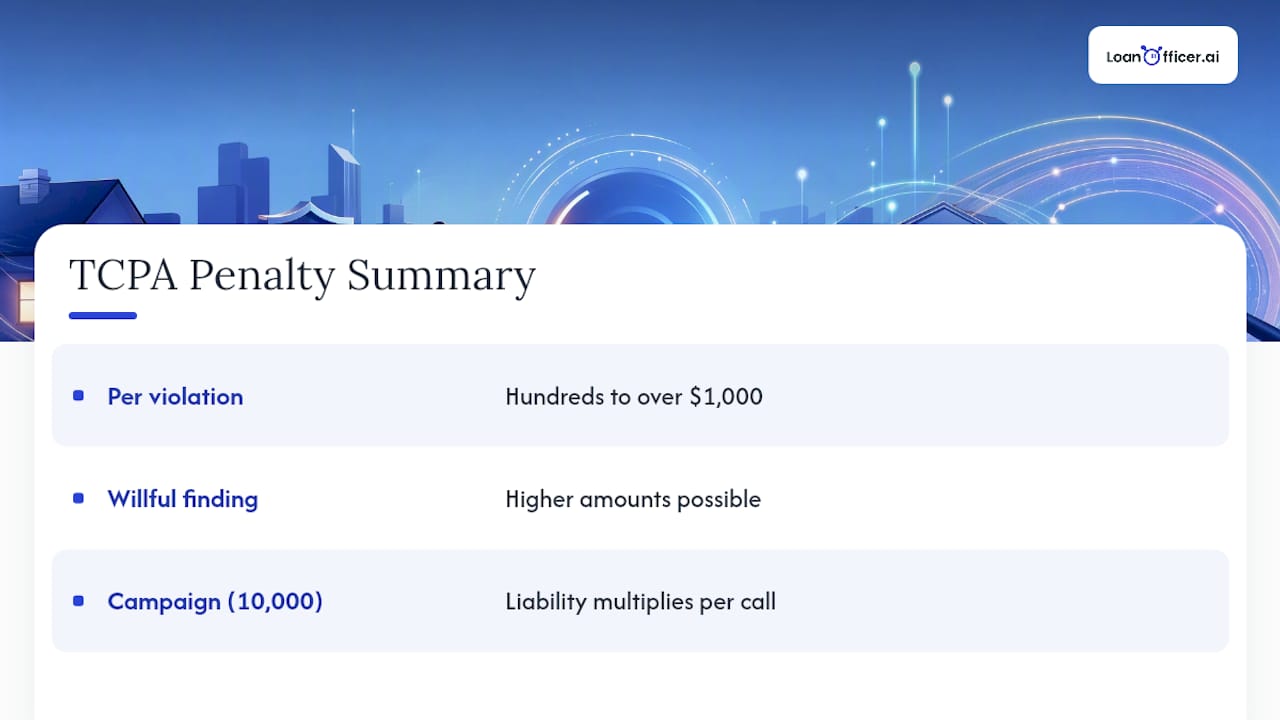
Statutory damages run from hundreds to over a thousand dollars per violation, with higher amounts possible when a court finds the violation willful, and each unwanted voicemail can count as a separate violation. Run a campaign to 10,000 numbers without proper consent, and the math turns ugly fast. Plaintiffs’ attorneys specifically look for missing consent documentation and repeated opt-out failures because those are the easiest patterns to prove in court. A modest local campaign with sloppy records can generate liability that dwarfs the marketing budget behind it.
How Can Mortgage and Marketing Teams Reduce TCPA Risk?
Reducing exposure isn’t about avoiding ringless voicemail entirely. It’s about building a system that can prove compliance on demand, because “we thought we had consent” is not a defense that holds up once a plaintiff’s attorney starts asking for documentation.
- Verify consent before every send, not just at intake. Numbers change hands, get reassigned, or get ported, so a consent record from eighteen months ago may not match today’s owner.
- Centralize suppression lists so a revocation on one channel, voice, text, or email, blocks all three instantly rather than depending on someone remembering to update a spreadsheet.
- Audit vendor contracts. If a third-party dialer or voicemail-drop platform handles delivery, require proof of their scrubbing procedures and contractual indemnities, since platform promises alone rarely hold up in litigation without an audit trail.
- Store logs in immutable, time-stamped systems. Courts want evidence, not recollection.
Pro Tip:Run a quarterly consent audit the same way you’d run a financial audit. Pull a random sample of active numbers and confirm you can produce a written, timestamped consent record for each one within five minutes.
Why Compliance Is a Competitive Edge, Not Just a Legal Shield
Most compliance guides stop at “here are the rules.” What gets missed is that the businesses treating consent records as a real system, not a checkbox, are the ones who can actually scale outreach without flinching every time a new lawsuit trend hits the news. Mortgage teams that pair TCPA-safe texting with centralized consent tracking aren’t just avoiding fines. They’re building a database they can market to confidently for years, because they know exactly who opted in and when.
The firms that get burned almost never had bad intentions. They had good intentions and no audit trail. That gap, between believing you’re compliant and being able to prove it in fifteen minutes to opposing counsel, is where the real risk lives.
— Jared Hart
A Compliance-First Way to Manage Mortgage Outreach
If you’re weighing risky, one-off voicemail drop vendors against something built for how mortgage teams actually work, the calculation should include more than message volume. Loan Officer AI centralizes consent capture, suppression lists, and opt-out processing across voice, text, and email in one place, so a revocation on any channel updates everywhere automatically instead of living in three disconnected systems.
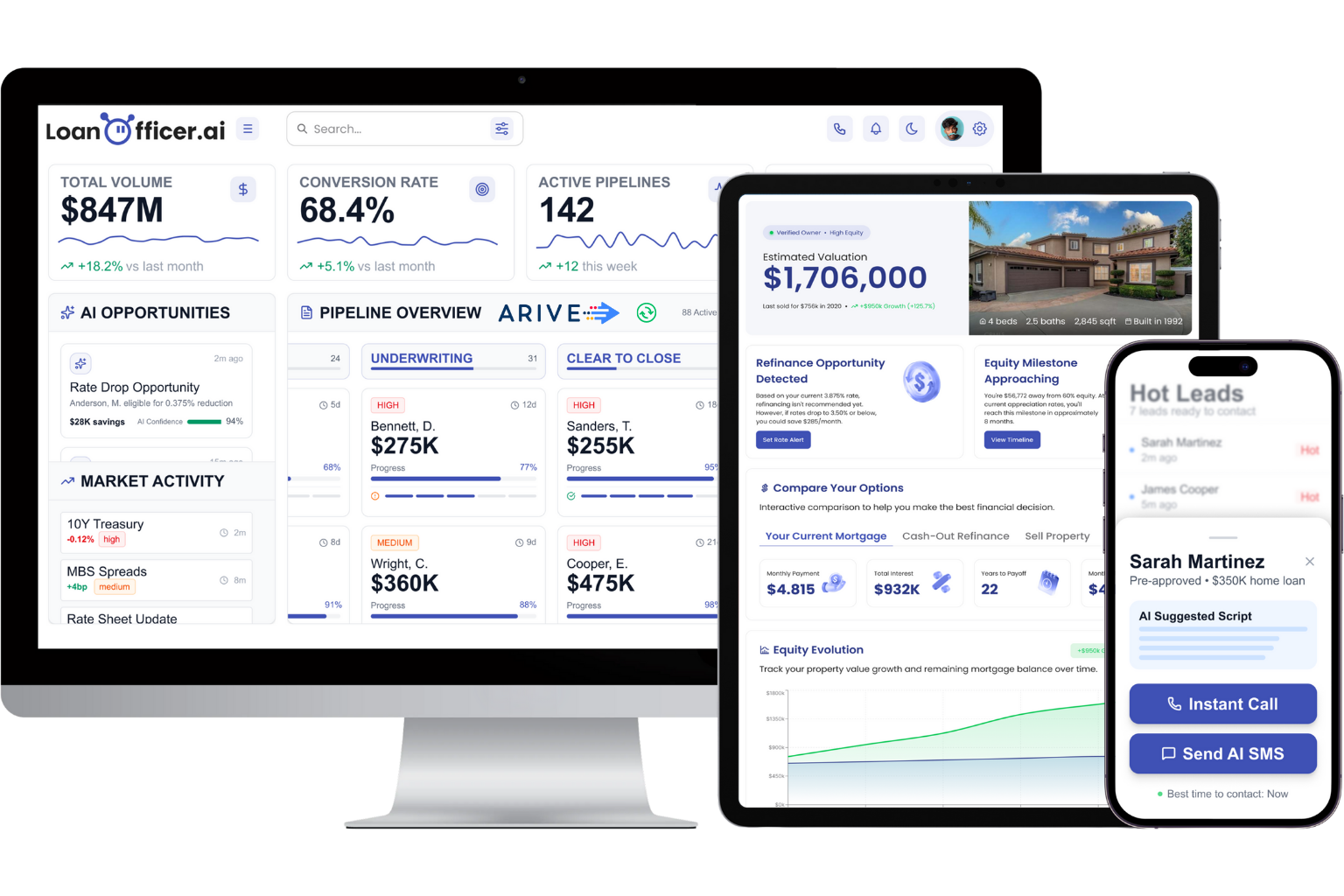
For teams juggling refinance campaigns, database mining, and realtor partnerships, that unified record is what actually holds up when a compliance question comes up months later. Loan officers and brokerage teams can explore the mortgage CRM for brokerages or check out how AI-driven marketing campaigns keep consent and delivery logs synced automatically. Pairing that with multi-touch strategies like the ones outlined in this mortgage touchpoint guide gives teams a way to stay in front of borrowers without gambling on unverified lists. Start a trial and see how consent tracking looks when it’s built into your pipeline instead of bolted on afterward.
Where to Verify These Rules Yourself
Don’t take secondhand summaries as the final word. Read the FCC’s original declaratory ruling and its Federal Register publication directly. Scrub numbers against the National Do Not Call Registry before every campaign, and keep the Wipfli compliance breakdown handy for a plain-language rundown of penalties and calling-window rules.
This article is general information, not a substitute for advice from a qualified financial advisor. Consult a qualified financial professional about your own circumstances before acting on anything here.
Sources
- FCC Finds That ‘Ringless Voicemails’ Are Subject to Robocalling Rules
- Telephone Consumer Protection Act of 1991; Petition for declaratory ruling (Federal Register)
- Ringless Voicemail Covered by Robocall Rules (NCLC)
- TCPA compliance requirements: rules and penalties (Wipfli)