Validate AI Lead Scoring in 30–60 Days for Mortgage Loan Officers

AI lead scoring is worth adopting for most mortgage teams: it ranks prospects by their probability of closing, so loan officers stop wasting call time on dead leads. Case data shows conversion rates jumping from 3% to 12% after implementation, though results vary by data quality. The right move isn’t a full rollout. Run a narrow pilot for 30 to 60 days, using a platform like Loan Officer AI, and measure before you scale.
TL;DR:
- AI lead scoring can significantly improve conversion rates, with one case showing an increase from 3% to 12%, though results depend heavily on data quality.
- High-performing models typically incorporate behavioral signals and contextual data, which are often under-captured or poorly integrated by mortgage teams.
- Running a narrow pilot for 30 to 60 days is recommended to gauge model effectiveness before expanding, with key metrics like conversion lift and response time.
- Scores should be integrated into CRM workflows for real-time routing, automated follow-up, and escalation, with clear SLAs for hot, warm, and cold leads.
- Data issues, market shifts, or biased inputs can cause model failure, so transparency and human review are essential to avoid fairness and compliance risks.
Table of Contents
- What Is AI Lead Scoring for Mortgage Teams?
- What Data Actually Drives an Accurate Mortgage Lead Score?
- How Much Lift Should You Actually Expect?
- How Should Scores Show Up in Your CRM Workflow?
- How Long Does It Take to See Results From a Pilot?
- Where Does AI Lead Scoring Go Wrong?
- How Does Loan Officer AI Put Scoring Into Practice?
- What Should You Prioritize When You Start?
- Ready to Pilot AI Lead Scoring? Here’s Where to Start
- Sources
What Is AI Lead Scoring for Mortgage Teams?
AI lead scoring assigns each mortgage lead a probability score, a number that estimates how likely that person is to close a loan within a given window. That’s fundamentally different from rules-based scoring, where someone manually decides “credit score above 700 plus income above $80,000 equals a hot lead.” Rules are static and rely on guesswork. Propensity models learn from thousands of labeled historical outcomes, actual leads that closed or died, and find the real patterns humans miss.
The model trains on past data: which leads converted, how fast, and what they had in common before anyone knew the outcome. It outputs a score, often 0 to 100, sorted into buckets:
- Hot (80 to 100): Contact within minutes, priority routing to a senior loan officer.
- Warm (50 to 79): Contact same day, standard nurture sequence with a human check-in.
- Cold (below 50): Automated drip campaign, no manual outreach until engagement rises.
A high-propensity pattern looks something like this: a borrower who visits your rate page three times in a week, uses your mortgage calculator with a specific loan amount, then opens two follow-up emails. Each behavior alone means little. Together, they’re a strong signal a rules-based system would likely miss entirely.
What Data Actually Drives an Accurate Mortgage Lead Score?
Three categories of signals feed a reliable model, and most mortgage teams only capture one of them well.
Borrower attributes form the baseline: declared income, requested loan amount, property location, and purchase timeline. These are static facts collected at the point of contact, useful but not predictive on their own.
Behavioral signals carry more weight. Rate page visits, calculator usage, frequency and recency of site activity, document uploads, and email or SMS engagement all indicate active intent versus passive browsing. A borrower who uploads a pay stub is behaving very differently from one who filled out a form and vanished.
Contextual data rounds it out: credit indicators, public records triggers (a new listing, a refinance inquiry elsewhere), property valuation changes, and employment shifts pulled from third-party data providers.
Industry analysis puts AI scoring accuracy at 75% to 85%, against roughly 25% to 30% for manual qualification, largely because models weigh combinations of these signals that a human reviewing a lead sheet would never catch.
To enrich weak fields:
- Redesign intake forms to capture timeline and loan purpose explicitly, not just contact info.
- Capture passive behavior through site tracking, since cookie consent frameworks govern what you can legally collect.
- Use vendor lookups to fill gaps in credit and property data before scoring runs.
How Much Lift Should You Actually Expect?
Set expectations with real KPIs, not vague optimism. Track conversion lift, contact velocity (how fast a hot lead gets a call), the qualified lead ratio, and closed loans per contact attempt. Those four numbers tell you whether scoring is actually changing behavior or just adding a dashboard nobody uses.
The ProPair case study reporting a jump from 3% to 12% conversion is a single-company result, not a guarantee. Treat it as a ceiling for what’s possible under strong data and disciplined follow-up, not a floor you’re entitled to on day one.
Payback on most CRM subscriptions arrives within one to two months at that volume.
Variability factors that swing your actual results:
- Sample size: fewer than a few hundred leads a month makes the model noisy and unreliable.
- Product mix: purchase and refinance leads behave differently and may need separate models.
- Data quality: garbage inputs produce a confidently wrong score, which is worse than no score at all.
How Should Scores Show Up in Your CRM Workflow?
Scores need a home in your CRM, and most platforms support either real-time scoring (updated the moment new behavior comes in) or batch scoring (recalculated nightly). Real-time works best for inbound web leads where speed to contact determines whether you get the deal. Batch scoring is fine for a purchased database you’re mining for refinance opportunities.
- Store the score as a CRM field, visible on the lead card, not buried in a report.
- Set routing rules by bucket: hot leads route to the first available loan officer with a five-minute SLA; warm leads get a same-day call queue; cold leads enter automated nurture.
- Build automated follow-up sequences for lower-score leads, email and SMS on a fixed cadence, so nobody falls through entirely.
- Define escalation rules: any lead that re-engages (opens three emails, revisits the calculator) gets bumped to human review regardless of original score.
- Assign role-based actions: producing loan officers work hot and warm buckets, while junior staff or a smart dialer handle cold outreach and re-engagement.
Pro Tip:Don’t let automated nurture run forever unchecked. Set a 90-day cap on cold-bucket sequences, then re-score or archive. A lead that’s been ignoring you for three months isn’t cold, it’s gone.
How Long Does It Take to See Results From a Pilot?
A pilot beats a full rollout every time, because it isolates variables you’d otherwise never untangle. Start narrow: pick one product type (purchase or refinance) or one lead channel, not your entire book.
- Weeks 1 to 4: Connect data sources, map fields, and let the model score leads without changing anyone’s workflow yet. This baseline period tells you if the score correlates with anything real.
- Days 30 to 60: First signals typically emerge here, according to practitioner reports covering propensity model timelines. Compare scored-lead outcomes against a holdout group that got no scoring at all.
- Months 3 to 6: Optimization window. Retrain on fresh outcomes, adjust bucket thresholds, and expand to a second channel if the holdout comparison holds up.
Watch completion rate, first-response time, and conversion weekly. If your sample is under a couple hundred leads, don’t trust small swings, wait for the trend to stabilize before deciding to scale.
Where Does AI Lead Scoring Go Wrong?
Three failure modes show up repeatedly: poor input data, imbalanced training outcomes (too few closed loans to learn from), and model drift, where the score quietly stops matching reality because the market or your lead mix changed.
Fair-lending exposure is the sharper risk. A model trained on biased historical outcomes can encode proxies for protected characteristics even without using them directly, zip code standing in for something it shouldn’t. That means feature audits and human review aren’t optional extras.
- Keep audit logs showing which inputs produced which score.
- Require explanation fields so a loan officer can see why a lead scored low, not just the number.
- Mask features that correlate too closely with protected classes.
- Build escalation rules so borderline or disputed scores always get human sign-off.
Pro Tip:If you can’t explain a score to a compliance officer in one sentence, don’t act on it yet. Explainability isn’t a nice-to-have here, it’s the difference between a defensible process and a lawsuit.
How Does Loan Officer AI Put Scoring Into Practice?
Loan Officer AI builds scoring directly into the CRM workflow rather than bolting it on as a separate tool. Leads get scored in real time, routed automatically, and paired with opportunity alerts when a borrower’s equity or rate situation shifts.
- Automated follow-up sequences trigger the moment a score changes, no manual queue management.
- LOS and CRM integrations pull loan status and outcome data back into the model for retraining.
- Database mining surfaces refinance and HELOC candidates that a manual review would take weeks to find.
- Independent loan officers, brokerages, and producing branch managers each get workflow views scaled to their team size.
What Should You Prioritize When You Start?
The teams that get real lift treat scoring as a discipline, not a feature toggle. Three things matter most: keep your pilot scope narrow, train staff on what a score bucket actually means before go-live, and review metrics on a fixed weekly rhythm rather than waiting for a quarterly report. Skip any one of those and you’ll end up with a dashboard nobody trusts.
— Jared Hart
Ready to Pilot AI Lead Scoring? Here’s Where to Start
You’ve seen the mechanics: real-time scores, bucketed routing, and a feedback loop that keeps the model honest. Loan Officer AI builds all of that into one CRM instead of asking you to stitch together a scoring vendor, a dialer, and a separate nurture tool.
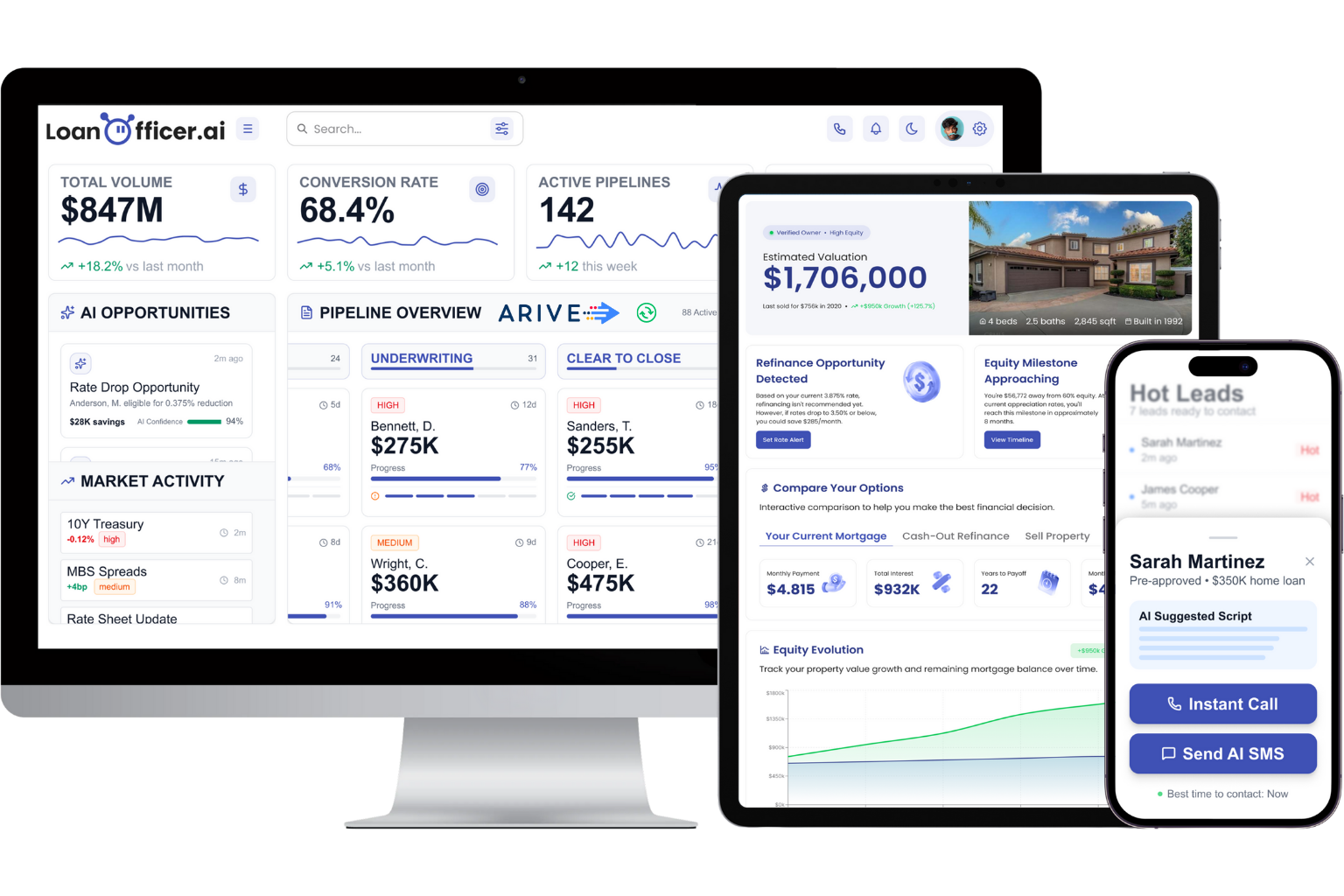
The advantage isn’t just the AI, it’s that scoring, routing, follow-up, and opportunity alerts live in the same system your team already works from every day. That means no export files, no manual score lookups, and no gap between when a lead heats up and when someone calls them.
A practical pilot checklist to run this month:
- Pick one lead channel (refinance database or a single web source) to score first.
- Connect your existing LOS so outcome data feeds back into the model.
- Set a five-minute SLA for hot-bucket leads and assign it to a specific person.
- Track conversion and response time weekly for 60 days before expanding.
If you want to see how the scoring and routing system works with your own lead flow, request a trial and run it against a real segment of your pipeline before committing to anything wider.