Co-Branded Mortgage Marketing: A Compliance Playbook
Co-branded mortgage marketing is a joint campaign between a loan officer and a referral partner, usually a real estate agent, builder, or title company, where both names appear on the same marketing asset. The bottom line: any payment you make or receive for that campaign has to buy real marketing services at fair market value, and it can never be tied to the volume or value of referrals. Get that one rule wrong and everything else about the campaign is irrelevant.
Before you design a single flyer, do three things:
- Document the scope of work and who’s paying for what, in writing, before the campaign launches.
- Price each service at what it would actually cost on the open market, not a number backed into after the fact.
- Disclose the arrangement clearly on every piece of shared marketing, labeled as an advertisement.
Everything below expands on how to do those three things without triggering a RESPA problem.
Key Takeaways
Compliant co-branded mortgage marketing depends on paying fair market value for real, documented marketing services rather than for referrals.
| Point | Details |
|---|---|
| Payment must match performed services | Every dollar paid under an MSA needs to correspond to a documented, fair-market-value deliverable, not a referral outcome. |
| Documentation is the real defense | Invoices, ad reports, signed scopes of work, and disclosure copies are what an examiner reviews under the CFPB’s fact-specific standard. |
| TILA applies independently of RESPA | Any rate or payment figure on a co-branded asset triggers separate Truth in Lending disclosure requirements. |
| Segment shared lead data by partner | Consent language and CRM tagging by partner prevent privacy conflicts and duplicate outreach on shared leads. |
| Automate proof-of-performance capture | Tools like Loan Officer AI tag leads by co-branding partner and export campaign reports to support fair-market-value invoicing. |
Table of Contents
- What RESPA Section 8 and CFPB Guidance Require for Co-Marketing
- How Do You Set Up a Compliant Co-Branded Campaign?
- What Co-Branded Assets Actually Move the Needle?
- How Do You Measure a Co-Branded Campaign’s Results?
- A Workflow That Builds Compliance Into the Campaign
- Does the Truth in Lending Act Apply to Co-Branded Materials?
- Who Owns the Lead’s Data in a Co-Branded Campaign?
- How Should You Co-Brand Email and PPC Campaigns?
- How Do You Align Branding With a Real Estate Partner?
- When Co-Branding Is Worth the Effort, and When It Isn’t
- A Practical Alternative to Manual Compliance Tracking
- Sources
What RESPA Section 8 and CFPB Guidance Require for Co-Marketing
Section 8 of the Real Estate Settlement Procedures Act bans giving or accepting any “thing of value” in exchange for referring settlement service business. That phrase is broader than most loan officers assume. The Consumer Financial Protection Bureau’s RESPA FAQs make clear that even a small gift can count as a prohibited thing of value if it’s tied to a referral. There’s no dollar threshold that makes a kickback acceptable. The size of the payment isn’t the test; the reason for the payment is.
Marketing services agreements, or MSAs, live in a gray zone that the CFPB has clarified over time. After rescinding its 2015 compliance bulletin, the agency shifted to what it calls a “facts and circumstances” approach, meaning there’s no simple checklist that guarantees safety. Instead, the CFPB’s own guidance points to a handful of questions examiners actually ask:
- Were the services in the agreement actually performed, or did money change hands for something that never happened?
- Was the price fair market value, or does it look inflated relative to what the service would cost from an unrelated vendor?
- Is payment tied to completed deliverables, or does it fluctuate with how many loans or referrals came through?
- Is there documentation, invoices, ad reports, signed contracts, proving the services were real?
That shift toward a fact-specific review raises the stakes on paperwork. An MSA that would have survived on a handshake a decade ago now needs a file that can answer an examiner’s questions on its own.
Enforcement history gives you the red flags to avoid. The CFPB’s Compliance Bulletin 2015-05 documented consent orders where MSAs were used to disguise referral fees as marketing payments. The tells were consistent: fees that scaled with referral volume, services described in vague terms with no proof they happened, and pricing nobody could justify against a real market rate. Keep invoices, ad performance reports, signed scopes of work, non-exclusivity clauses, and copies of the consumer-facing disclosures. If you can’t produce that file on demand, the agreement probably wasn’t structured well enough to survive scrutiny.
How Do You Set Up a Compliant Co-Branded Campaign?
Treat every co-branded campaign like a vendor contract, not a favor between friends. Here’s the sequence that keeps you defensible from day one:
- Write the scope of work first. Name the specific deliverables, a set number of social posts, a printed flyer run, a webinar with a defined attendee target, before anyone spends a dollar. Vague language like “ongoing marketing support” is exactly what examiners flag.
- Price it at fair market value. Get a quote from an independent vendor for comparable design or ad-buy work, then use that number (or something close to it) as your benchmark. If a printer would charge $400 for a flyer run, don’t let your partner pay $1,200 for the same job.
- Split costs proportionally. If you’re splitting a $2,000 digital ad buy 50/50 based on estimated audience overlap, write down how you arrived at that split, not just the final number.
- Structure payment around deliverables, not deals closed. Payment triggers when the webinar happens or the ad campaign report comes in, never when a referral converts to a closed loan.
- Collect proof before you invoice. Screenshot the ad report, save the vendor receipt, log the webinar attendee count. Attach all of it to the invoice, not just a lump-sum bill.
Pro Tip:Build a one-page MSA template with fields for scope, cost split, and deliverable proof built in. Filling in a template every time beats drafting a new agreement from scratch, and it keeps your documentation habits consistent across partners.
Add one disclosure line to every asset: “This is an advertisement. [Loan officer] and [partner] have a marketing services agreement.” Simple, visible, and it removes any ambiguity for the consumer.

What Co-Branded Assets Actually Move the Needle?
Some formats consistently outperform others because they give both partners something to promote to their own audience, not just a shared logo.
- Co-branded open house flyers: Include both names and license numbers, a QR code to a shared landing page, and the advertisement disclosure in the footer.
- Neighborhood market guides: A one-page PDF covering local listings and financing basics works well as lead magnets for both partners’ email lists.
- Joint webinars: A 30-minute session on “buying in this market” splits naturally between the agent’s listings and the loan officer’s financing angle.
- Social ad pairs: Run matching creative on each partner’s own account rather than one shared post, since that respects each party’s audience and ad spend.
- Co-branded direct mail: Works well for geographic farming campaigns where both partners already share a target ZIP code.
For production costs, split design and printing based on actual usage, if 70% of the flyer promotes the agent’s listing and 30% covers your rate quote. That’s a defensible cost-split ratio, not a coin flip. Media buys should be tracked separately from production so each line item has its own fair-market-value justification. Some lenders and mortgage insurers, like Arch MI’s co-brand marketing library, publish editable templates specifically built for this kind of split, which saves you from designing every asset from zero.
Pro Tip:Lead with your partner’s branding on the first asset in any new relationship. A flyer that spotlights the agent’s listing with your financing info in a smaller footer signals you’re building their business, not just harvesting theirs.
A one-line prompt for your next flyer: “Feature [agent name]'s new listing at [address], list three financing options I offer, and include a QR code to our shared open house RSVP page.” Use the same structure for a webinar invite or a social ad, just swap the call to action.
How Do You Measure a Co-Branded Campaign’s Results?
Every deliverable in your MSA should map to a metric you can actually pull and attach to an invoice. Reach and impressions come from the ad platform’s own reporting dashboard. Landing page visits and form completions come from a shared page with UTM tracking baked in. Leads and conversions get logged in your CRM and tagged by campaign and partner.
- Reach/impressions: exported directly from the ad platform (Meta Ads Manager, Google Ads).
- Landing page visits: tracked via UTM parameters on every shared link.
- Leads captured: tagged by source and partner inside your CRM.
- Webinar attendance: registration and attendance logs from your webinar platform.
| Metric | How to Capture It | Ties to Deliverable |
|---|---|---|
| Ad impressions/reach | Platform export (Meta, Google) | Media buy line item |
| Landing page visits | UTM-tagged shared URL | Web/design line item |
| Leads generated | CRM tag by campaign/partner | Lead-gen deliverable |
| Webinar attendance | Registration platform export | Event deliverable |
Once the campaign ends, reconcile every deliverable against the invoice before payment goes out. Pull the ad report, the UTM data, and the CRM tags into one file, attach them to the signed scope of work, and store the whole package together. That file is your answer if anyone ever asks why the payment was made.
A Workflow That Builds Compliance Into the Campaign
The cleanest way to avoid a paperwork scramble after the fact is to build proof-of-performance into the campaign itself, rather than reconstructing it after the invoice is due.
- A shared landing page collects the lead and captures the co-branding partner as the source.
- A paid social or search ad drives traffic to that page with a UTM tag specific to the campaign.
- The CRM logs the lead, tags it to the partner automatically, and starts a follow-up sequence.
- At campaign close, an exported report shows impressions, visits, and leads tied to that exact campaign and partner tag.
That sequence does the documentation work automatically instead of leaving it to memory. Platforms built for mortgage professionals, including features inside Loan Officer AI’s campaign tracking tools, can tag leads by referral partner and export campaign reports in one file, which is precisely the kind of time-stamped record the CFPB’s fact-specific review rewards.
Pro Tip:Set your CRM to auto-tag every lead from a co-branded campaign with the partner’s name and the campaign date. When it’s time to invoice, that tag alone gives you a defensible lead count without digging through spreadsheets.
Does the Truth in Lending Act Apply to Co-Branded Materials?
Yes, and it’s a separate obligation from RESPA. TILA and its implementing rule, Regulation Z, govern how you can talk about loan terms in any advertisement, co-branded or not. If a co-branded flyer mentions a specific rate, payment amount, or loan term, it triggers TILA’s “trigger term” disclosure rules, meaning you now have to include additional terms like APR, and in some cases a full Schumer box, depending on the format.
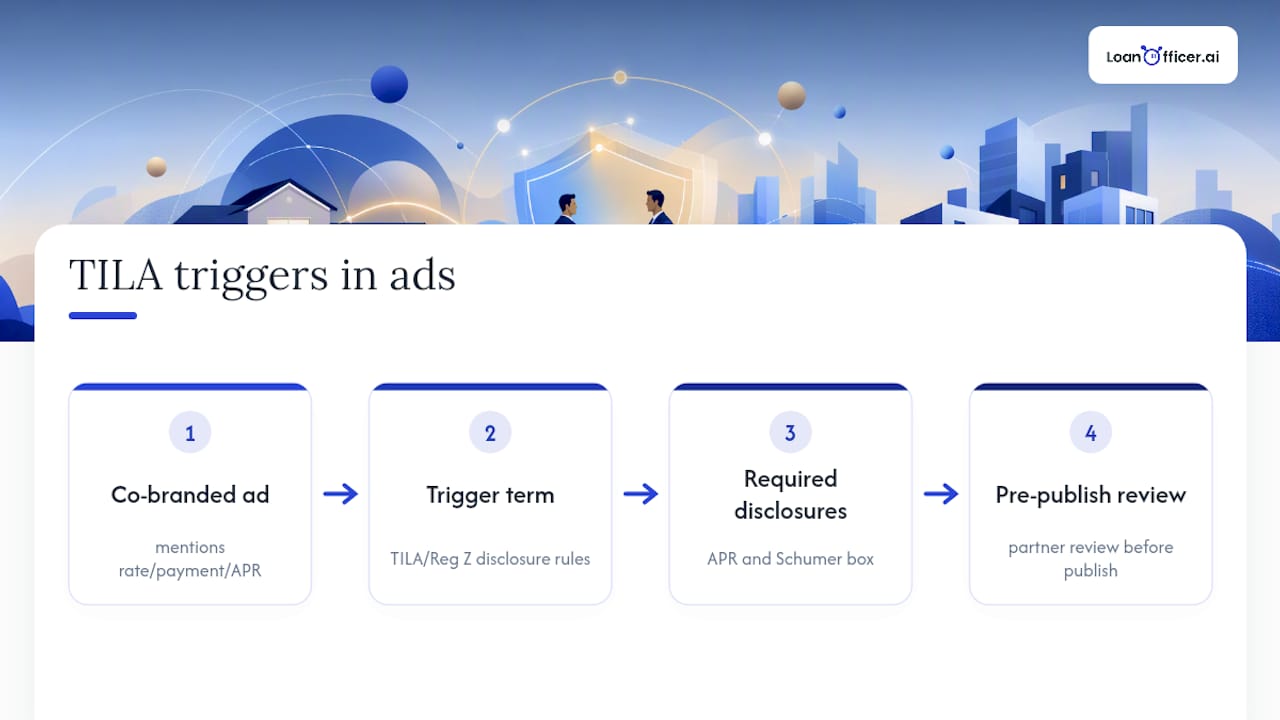
The practical trap in co-branded materials is that a real estate partner, focused on the property, might add a line like “financing available at 5.99%” without realizing that single number now obligates a set of federally mandated disclosures. Before any co-branded asset goes to print or goes live as a paid ad, review it specifically for loan terms, not just for the RESPA disclosure. A flyer can be perfectly compliant on the referral-fee side and still violate TILA because someone dropped a rate quote into the corner without the required context.
Set a rule with every partner: no specific rates, payments, or APR figures appear on shared marketing without your review first. It’s a five-minute check that prevents a much bigger cleanup later, and it belongs in the same scope-of-work document that governs the rest of the campaign.
Who Owns the Lead’s Data in a Co-Branded Campaign?
Every co-branded landing page or shared form is also a data-sharing arrangement, and that needs its own set of ground rules. When a consumer fills out a form on a joint landing page, both partners can see that person’s contact information, and possibly financial details, unless you build the intake to separate that data by intent.
Start with consent language on the form itself: tell the consumer explicitly that their information may be shared with both the loan officer and the real estate partner named on the page. Vague privacy language, or none at all, puts both partners at risk under state privacy laws and erodes consumer trust in the arrangement.
Decide up front who owns the lead record and how it gets split. A common structure: the partner whose ad or listing generated the click owns first contact rights, while the other partner receives a tagged copy inside their own CRM for follow-up on their specific service. That avoids both partners independently calling the same consumer within an hour of each other, which happens more often than either side wants to admit.
Keep the data segmented by partner and by campaign inside your CRM rather than dumping every co-branded lead into one shared list. That segmentation matters if a consumer later asks to opt out or requests their data be deleted, since you need to be able to identify and update every place that record lives, not just the master database.

How Should You Co-Brand Email and PPC Campaigns?
Social ads get most of the attention in co-branding conversations, but email and pay-per-click campaigns carry the same rules with different mechanics.
For co-branded email, keep the sending domain and list ownership clear. If you’re emailing your own database on behalf of a joint promotion, disclose the partnership in the email body, not just in a footer nobody reads. Segment your list so the co-branded message only reaches contacts who’d plausibly care about that specific partner, rather than blasting your entire database with every agent relationship you have.
PPC campaigns need the fair-market-value logic applied to ad spend the same way it applies to flyer printing. If you and a partner split a $1,500 Google Ads budget, document how that split was calculated, by estimated click volume, by geographic overlap, by whatever logic you actually used, and keep the platform’s spend report as backup. Landing pages tied to PPC ads need the same advertisement disclosure as a printed flyer; a shared microsite promoting both a listing and a mortgage pre-approval offer is still co-branded marketing, even if it never touches social media.
One habit that keeps email and PPC compliant: run every campaign through the same MSA and disclosure checklist you’d use for a printed asset. The channel changes; the RESPA and TILA obligations don’t.
How Do You Align Branding With a Real Estate Partner?
The best co-branded materials read as one coherent piece, not two logos stapled together. Start by agreeing on which partner leads visually for a given asset. A listing flyer should lead with the agent’s brand and photography, with your financing information as a clear, secondary block. A rate-education webinar should flip that balance, with your name and credentials up front and the agent’s listings featured as the practical application.
Color and tone matter more than loan officers usually credit. If your materials use a sharp, modern palette and your partner’s brand leans traditional and warm, a mismatched flyer looks like two separate campaigns forced together, which undercuts the credibility both of you are trying to build. Agree on a shared template early, one that pulls a neutral color scheme both brands can live with, rather than negotiating it asset by asset.
Consistency in messaging matters too. If your talking points about affordability or rate trends contradict what the agent tells buyers at an open house, that mismatch erodes trust in both parties fast. A quick pre-campaign call to align on the market narrative you’re both telling saves you from that kind of self-inflicted confusion later.
When Co-Branding Is Worth the Effort, and When It Isn’t
Co-branded marketing pays off fastest with partners who already share your ideal client, an agent working the same price point and neighborhoods you lend in, not a random referral source you’ve met twice. Audience overlap matters more than relationship warmth. A partner you genuinely like but who works a completely different buyer segment will produce flyers nobody in either audience cares about.
The most common operational mistake isn’t malicious, it’s laziness. Loan officers verbally agree to split an ad budget, run the campaign, and never write anything down. That handshake approach is precisely the pattern regulators flag, even when nobody intended a kickback. The paperwork isn’t bureaucratic overhead; it’s the only thing that separates a legitimate MSA from an informal referral arrangement in an examiner’s eyes.
Start with one asset, document the agreement before you spend a dollar, and have someone review the MSA who isn’t emotionally invested in the partnership. That third read catches the vague scope language and inflated pricing you’ll miss on your own.
— Jared Hart
A Practical Alternative to Manual Compliance Tracking
Chasing down ad reports, tagging leads by partner, and reconciling invoices by hand is where most co-branded campaigns quietly fall apart, not because the marketing failed, but because nobody kept the file. Loan Officer AI was built to close that gap: campaign tracking that tags every lead by referral partner automatically, and exportable reports that give you the time-stamped proof-of-performance an MSA needs without a spreadsheet marathon.
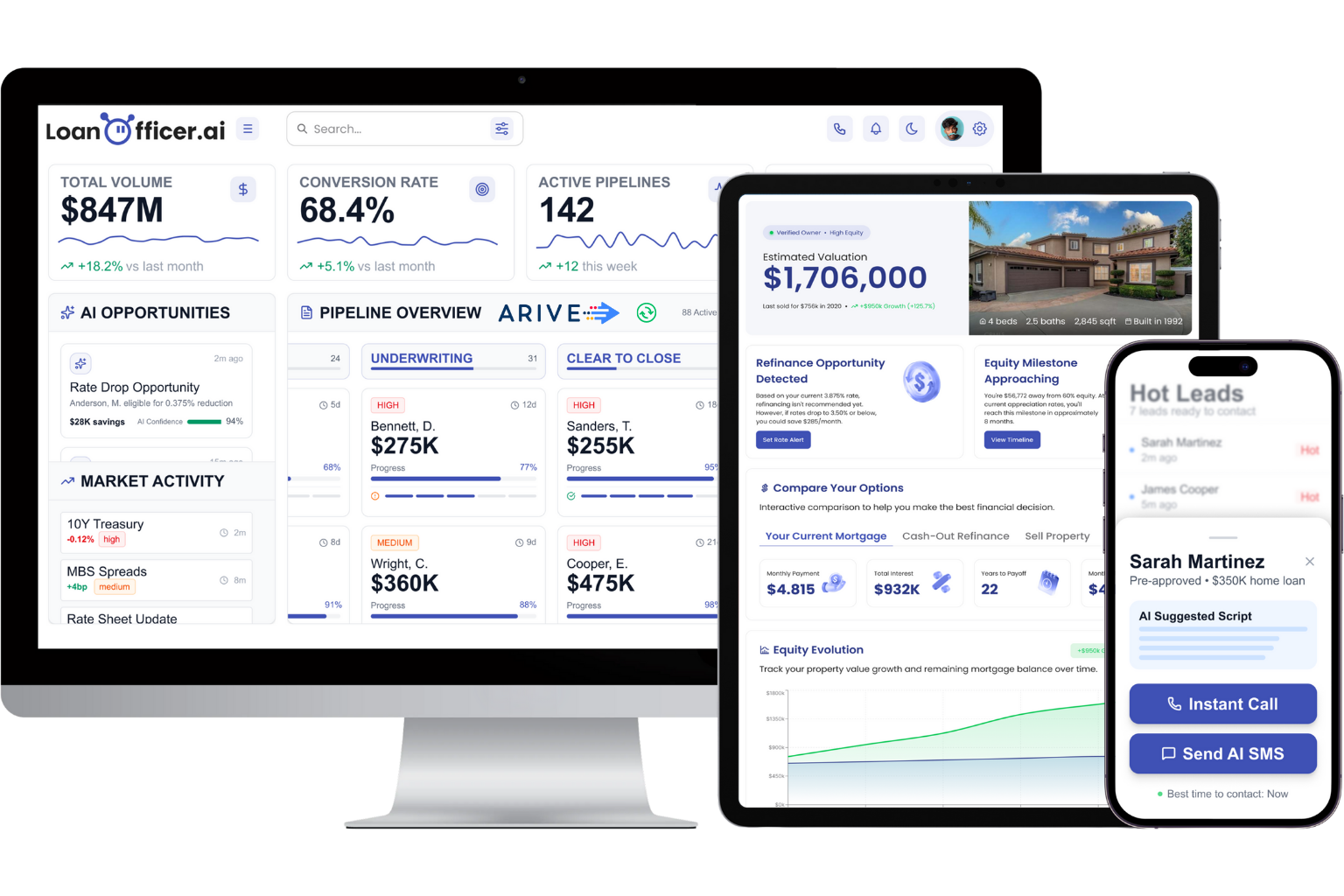
The platform’s borrower engagement automation keeps co-branded nurture sequences running in the background while flagging refinance and equity opportunities inside your existing database, work that would otherwise eat hours you don’t have during a live campaign. Independent loan officers running multiple realtor relationships get the most out of this, since every partner’s leads stay segmented instead of blending into one messy list. Loan Officer AI reports a 93% partner retention rate among users, a signal that the automation holds up under real campaign volume, not just in a demo. If you’re running or planning a co-branded campaign this quarter, start a trial and set up your first partner-tagged campaign before your next flyer goes to print.
Sources
- Real Estate Settlement Procedures Act (RESPA) FAQs — Consumer Financial Protection Bureau
- CFPB Compliance Bulletin 2015-05: RESPA compliance and marketing services agreements
- Co-Brand Marketing Materials — Arch MI