Win the First 5 Minutes: Instant Lead Response for Mortgage Teams

Contact new web leads within seconds through automated intake, then get a live human on the line inside five minutes whenever possible. That two-step sequence, not a slicker ad or a better rate sheet, is the single highest-leverage fix in most loan officers’ pipelines. Miss the first five minutes and you’re competing for a borrower who’s already talking to someone else.
TL;DR:
- Contact new mortgage leads within five seconds with automated acknowledgment and prioritize live transfer within five minutes to significantly increase qualification rates.
- Calling a lead at one minute yields a 391% higher contact rate than at two minutes, making immediate response crucial for conversion.
- Implementing a hybrid response system with AI intake, automated routing, and follow-up sequences can maximize efficiency and lead engagement outside of standard office hours.
- Measuring success relies on reducing first-touch median to under 60 seconds, increasing contact and qualified lead rates, and tracking actual appointment conversion improvements.
- Using AI-powered CRM platforms that integrate with loan origination systems ensures automatic, rapid lead routing and follow-up, reducing manual effort and missed opportunities.
Table of Contents
- What is instant lead response in mortgage lending?
- The two-touch rapid-response playbook
- Which technology actually closes the speed-to-lead gap?
- How do you build an always-on rapid-response system?
- How do you measure ROI on faster lead response?
- Real-world example: protecting the first five minutes with an AI-enabled CRM
- What high-performing loan officers actually focus on
- How Loan Officer AI helps you deliver instant lead response
- Sources
What is instant lead response in mortgage lending?
Instant lead response means contacting a new mortgage inquiry within seconds of submission, then converting that contact into a live conversation within five minutes. The industry calls this discipline “speed-to-lead,” and the data behind it is blunt: leads contacted within five minutes are 21 times more likely to qualify than leads contacted after 30 minutes. That figure comes from the Harvard/MIT Lead Response Management Study, and it’s the number most mortgage-technology vendors now build their entire product around.
The decay curve inside that window is steeper than most loan officers assume. Velocify/ICE mortgage data found calling a lead at the one-minute mark produced a 391% higher contact rate than calling at two minutes. Two minutes. Not thirty. That’s why sub-60-second automated acknowledgment has become the operational target, with five minutes as the outer limit before conversion odds collapse.
The five-minute rule, explained: Leads contacted within five minutes qualify 21x more often than those reached after 30 minutes. Leads called at one minute convert at rates 391% higher than leads called at two minutes.
Two forces make this harder than it sounds. First, a meaningful share of internet mortgage leads, often a significant portion of leads, arrive outside the standard 9 to 5. A borrower filling out a rate quote form at 9:40pm on a Tuesday isn’t waiting for your office to open. Second, most loan officers are paid on commission or basis points, so slow response isn’t just a missed lead. It’s direct lost income. That financial reality is why speed-to-lead investment keeps climbing even among small independent shops.
The two-touch rapid-response playbook
Speed only matters if the sequence behind it is built correctly. The two-touch model separates acknowledgment from conversion, so no lead sits untouched while you’re on another call.
Touch 1 (seconds):
- Automated SMS confirming receipt and setting expectations (“Thanks for reaching out about your home loan. We’ll call you shortly.”).
- A short automated email with next steps and a scheduling link.
- Optional automated voice call that captures loan intent and confirms the best callback window.
Touch 2 (within five minutes):
- Live warm transfer to an available loan officer if the borrower is still engaged.
- If no one’s free, a scheduled callback confirmed by text within the same five-minute window.
- If the borrower doesn’t pick up, drop a voicemail and immediately trigger an SMS drip with a direct booking link.
- Keep the first SMS under 160 characters. Long messages get skimmed or ignored.
- Never let touch 2 depend on a human noticing a new lead in an inbox. Route it automatically.
- Build a three-attempt fallback: call, text, then a personalized email if the first two go unanswered.
Pro Tip:Test your own funnel. Submit a lead through your own website at 11pm on a Friday and time exactly how long it takes for the first response to hit your phone. Most loan officers are shocked by what they find.
Which technology actually closes the speed-to-lead gap?
Three categories of tools solve different pieces of this problem, and most high-performing teams end up running two or three together rather than picking just one.
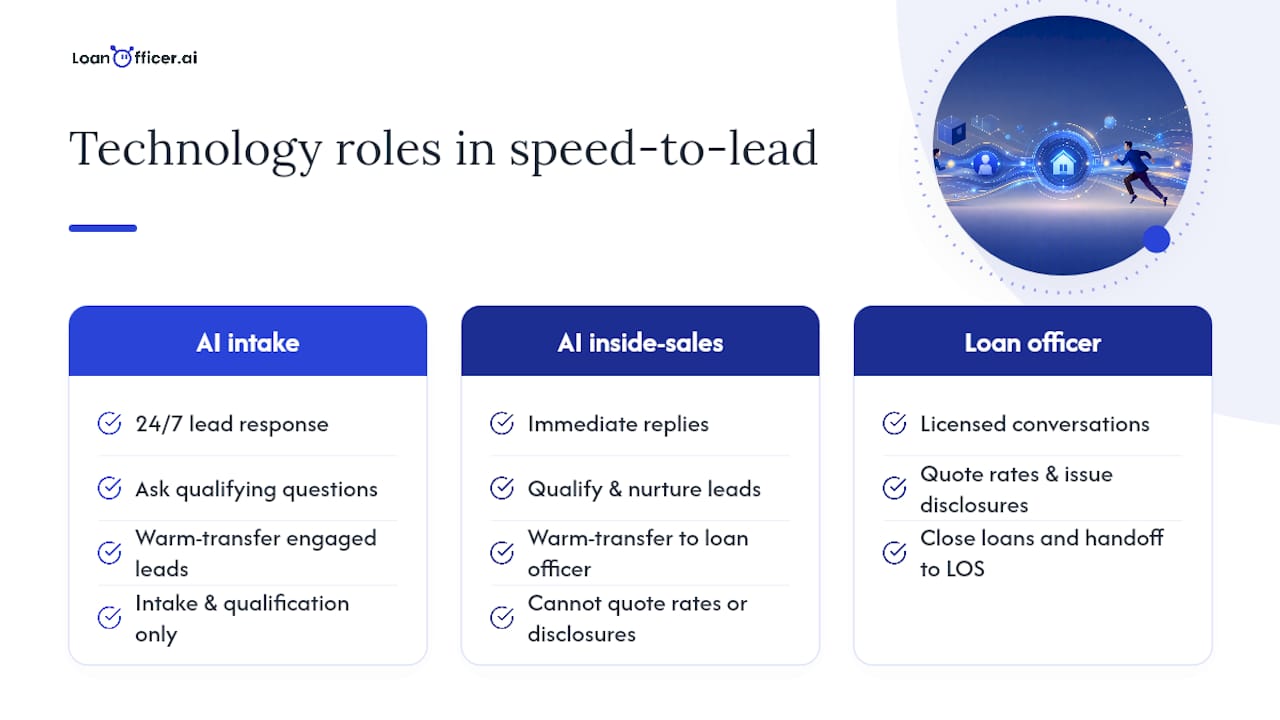
AI intake and AI inside-sales assistants run 24/7, replying to a new lead in seconds, asking qualifying questions, and warm-transferring engaged borrowers to a live loan officer. They cannot quote rates or issue disclosures. That work stays with a licensed loan officer.

CRM routing engines decide instantly who gets a lead based on availability, territory, or loan type, then fire the SMS and email sequence without a human touching a keyboard. A platform like Loan Officer AI’s pipeline management tools also flags refinance and HELOC opportunities inside your existing database, not just new inbound leads.
Smart dialers and SMS platforms handle the mechanical follow-through: auto-dialing a queue of fresh leads and logging every touch so nothing falls through after hour one. LOS integration ties the whole chain together so a qualified lead lands in loan processing without a manual re-entry step. Vendors across the industry are actively building toward this exact gap between lead capture and loan production.
AI intake should be treated as intake and qualification, not a replacement for licensed conversation. That framing keeps compliance intact while still winning the first five minutes.
For small broker teams, a hybrid model, AI intake covering nights and weekends paired with a lean inside-sales pod during peak hours, often produces the best return without the overhead of round-the-clock staffing.
How do you build an always-on rapid-response system?
Building this isn’t a one-week project, but it doesn’t need to be a quarter-long one either. Follow a defined sequence and measure before you scale.
- Set your SLA. Define first-touch median (target: under 60 seconds), contact rate, and qualified-rate benchmarks before you touch any software.
- Pick your intake method. Decide whether AI intake, a dedicated after-hours ISA, or a hybrid model fits your lead volume and budget.
- Build routing rules. Assign leads by loan type, territory, or officer availability so nothing sits in a shared inbox.
- Write minimal templates. Draft your SMS, email, and voicemail scripts once, then trigger them automatically from your landing form.
- Integrate your CRM and LOS. Confirm a qualified lead flows into processing without manual re-entry. Automating this handoff is where most teams lose the most time.
- Pilot with A/B testing. Run automated response against your current process for two to four weeks before a full rollout.
- Scale once proven. Expand the workflow to your full lead volume only after the pilot shows measurable lift.
| Implementation stage | What you’re measuring | Typical timeframe |
|---|---|---|
| SLA definition | First-touch median target | 1 week |
| Intake and routing setup | Rule accuracy, template coverage | 1 to 2 weeks |
| CRM/LOS integration test | Handoff accuracy, no manual re-entry | 1 week |
| Pilot (A/B) | Contact rate, qualified rate lift | 2 to 4 weeks |
| Full rollout | Sustained SLA performance | Ongoing |
How do you measure ROI on faster lead response?
Track five numbers, not fifty. First-response time distribution (median and 90th percentile), contact rate, qualified-lead rate, close rate, and cost-per-funded loan. Everything else is noise until those five are stable.
Run your A/B pilot by splitting incoming leads: half through your current process, half through the faster workflow, over an identical time window. Attribute lift by comparing contact and qualified rates between the two groups, not by eyeballing overall pipeline numbers, which get muddied by seasonality and lead-source mix.
| Metric | Baseline example | Target after speed-to-lead |
|---|---|---|
| First-touch median | 30+ minutes | Under 60 seconds |
| Contact rate | Low, inconsistent | Meaningfully higher |
| Qualified-lead rate | Baseline | Up to 21x on time-to-contact alone |
Fixing response time is consistently cited as the highest-leverage, most controllable lever in the mortgage funnel, because it compounds across contact, qualification, application, and pull-through simultaneously.
Even a conservative reading of the 21x qualification benchmark means a handful of previously-lost leads converting into funded loans covers the cost of most CRM or AI-intake tooling within a single quarter for a producing loan officer.
Real-world example: protecting the first five minutes with an AI-enabled CRM
Loan Officer AI’s platform runs AI-powered intake around the clock, routes qualified leads instantly, and flags refinance and HELOC opportunities inside a broker’s existing database, all integrated with LOS systems so nothing requires manual re-entry. The company reports 93% partner retention and meaningful time savings among mortgage teams using it. The software secures the intake and qualification work. Licensed loan officers still own every rate quote and disclosure, exactly as compliance requires.

What high-performing loan officers actually focus on
Most teams obsess over lead volume. The ones who win obsess over the clock instead: a short daily standup on first-touch metrics matters more than another lead source. Automation should own intake; humans should own the conversation that closes.
Three things to check every morning: median first-touch time from yesterday, how many leads went untouched past five minutes, and whether your after-hours coverage actually fired last night.
— Jared Hart
How Loan Officer AI helps you deliver instant lead response
Everything covered here, sub-60-second acknowledgment, warm transfers, after-hours coverage, opportunity detection inside your own database, is exactly what Loan Officer AI’s mortgage CRM was built to run without adding headcount.
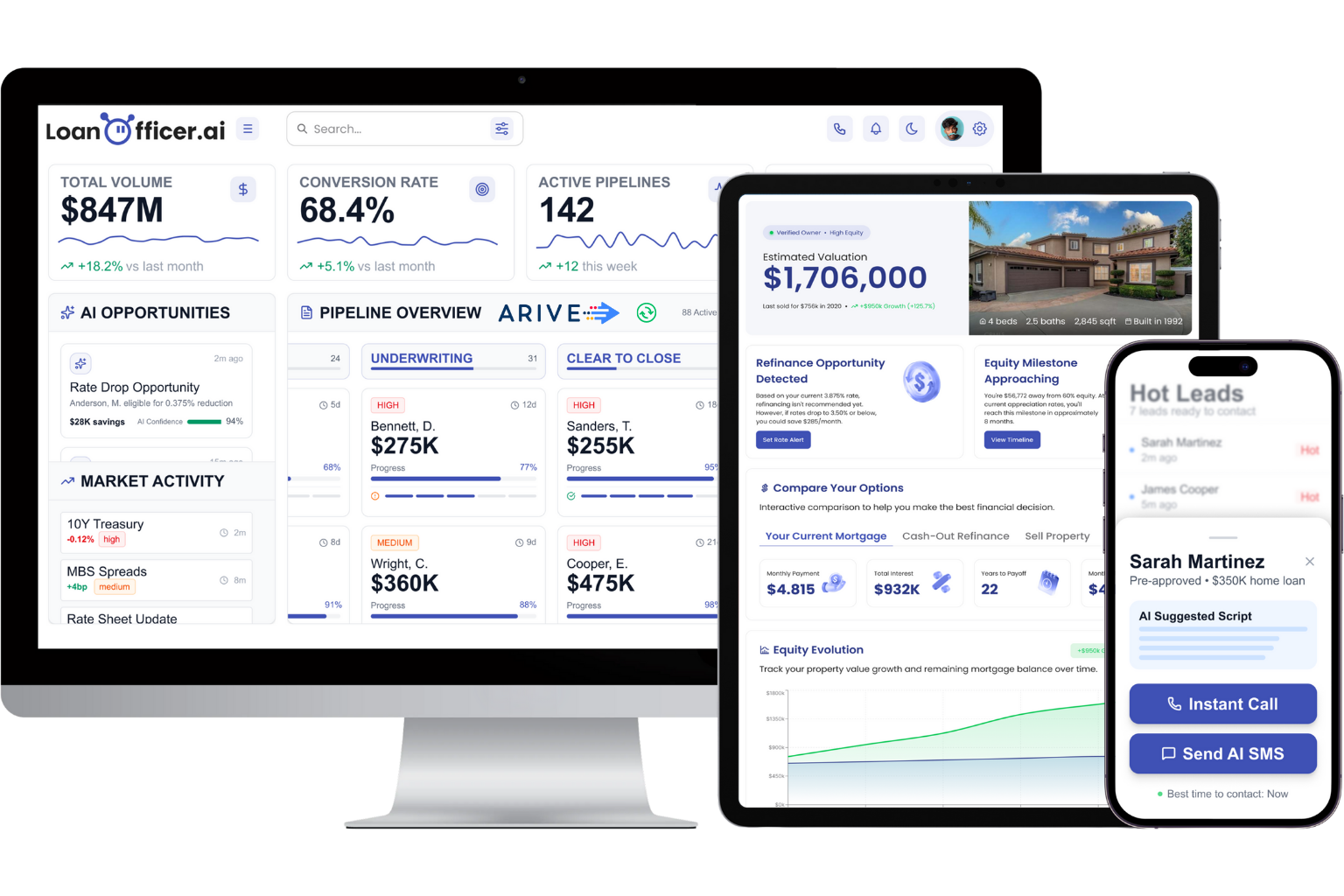
Instead of stitching together a texting app, a dialer, and a spreadsheet to track response times, you get AI intake, automatic routing, and LOS integration in one system built specifically for loan officers and brokers. It flags refinance and HELOC opportunities in your existing pipeline while it’s also catching every new web lead the moment it comes in, day or night. If you’re running a small team, the brokerage-focused workflows handle routing across multiple officers automatically, so no lead waits for someone to notice it.
Start a trial and run your own five-minute test against your current process. You’ll know within a week whether the math on faster response holds up for your pipeline.
Sources
- Mortgage Speed to Lead Statistics 2026: The Benchmarks That Matter
- Mortgage Lead Response Time Statistics (2026): Speed-to-Lead for LOs and Lenders
- Speed to Lead in Mortgage: What the Data Shows in 2026 - Structurely News
- Do Loan Officers Get Commission? How MLO Pay Works in 2026 | Aceable Mortgage