Compliance First 6–12 Month Mortgage Nurture for Loan Officers

A consistent, value-first nurture program that runs 6 to 12 months and blends email, text, calls, and human handoffs at the right trigger points reliably lifts conversion from early-stage leads and boosts lifetime value from past clients; learn more about lead nurturing explained for effective strategies. Compliance and measurement aren’t optional add-ons here. They’re the two things that determine whether the program survives an audit and whether you can prove it’s working.
TL;DR:
- Long-term nurture programs should run for six to twelve months to effectively engage leads over their decision-making process.
- Focus on key metrics such as engagement rates, reactivation counts, and 12-month conversion rates to measure success early.
- Segmentation by lead intent, content relevant to purchase, refinance, or past clients, and trigger-based escalation improve response and conversion.
- Use the right system architecture, including a CRM, automation, and direct LOS integration, to sustain automation without overwhelming the team.
- Compliance requires proper recordkeeping, honoring opt-outs within ten days, and avoiding prohibited messaging practices across email, text, and calls.
Table of Contents
- Why Mortgage Leads Need Long-Term Nurture
- Core Principles: The Framework for Effective Long-Term Nurture
- Segment-Specific Nurture: Purchase, Refinance, First-Time Buyers, and Past-Client Reactivation
- Channels, Automation, and System Architecture for Long-Term Nurture
- Compliance and Risk Checklist for Long-Term Outreach
- Measurement and Optimization: KPIs for Long Nurture Programs
- Sample 6-12 Month Nurture Playbook
- How an AI Mortgage CRM Operationalizes This Playbook
- Three Strategic Priorities That Actually Determine Success
- Put the Playbook on Autopilot With Loan Officer AI
- Sources
- FAQ
Why Mortgage Leads Need Long-Term Nurture
Most loan officers treat a lead as dead after 30 to 60 days of silence. That’s the wrong window. Home buying decisions, especially for first-timers, often unfold over 6 to 18 months, from browsing listings to actually applying. A lead who isn’t ready in March may be ready in October, but only if someone kept the relationship warm the whole time.
Lead decay is real, but it’s not universal. A lead who never replies to anything for a year probably won’t convert. A lead who opens your rate-update emails every month, even without replying, is still in the game. That distinction should drive your resource allocation.
Here’s what long nurture actually buys you:
- Higher conversion from the 70 to 80% of leads who aren’t ready to transact in their first 90 days
- Lower cost per funded loan, since a nurtured database lead is cheaper than a fresh paid lead
- Meaningfully better lifetime value from past clients who refinance or refer, rather than shopping a competitor next time
The compounding math: a database of 500 dormant contacts nurtured consistently for a year will generate more closed loans than 500 fresh leads chased hard for 60 days and abandoned. Patience, applied systematically, outperforms intensity applied briefly.
Track three numbers monthly: engagement rate (opens, clicks, replies), reactivation count (dormant contacts who re-engage), and 12-month conversion rate by lead source. Those three tell you whether the program is working long before a single loan closes.

Core Principles: The Framework for Effective Long-Term Nurture
A durable nurture program rests on four pillars, and skipping any one of them is why most programs quietly die around month four.
- Value before ask. Every touch should teach, update, or clarify something the recipient cares about, rate movement, equity change, a market shift, not just remind them you exist.
- Segment by intent, not just by lead source. A refinance-curious homeowner and a first-time buyer six months from a lease renewal need entirely different content, even if both came from the same landing page.
- Set cadence to the calendar, not to your mood. Weekly touches for the first month, then tapering to biweekly or monthly, keeps you present without becoming noise.
- Build human escalation rules into the automation. When someone clicks a rate alert twice in a week or replies to a text, that’s not a job for another automated email. That’s a phone call.
Underneath all four sits data hygiene. If your CRM doesn’t reliably tag lead source, consent status, and last human touch, your segmentation and your compliance both fall apart at the same time.
Pro Tip:Audit your database quarterly for contacts with no email or phone activity in 90 days and no valid consent record. Either re-permission them or move them to a passive, compliant list. A clean database beats a big one.
Mortgage nurturing strategies that skip escalation rules tend to produce great open rates and mediocre pipelines. Automation should surface the moment; a person still has to close it.

Segment-Specific Nurture: Purchase, Refinance, First-Time Buyers, and Past-Client Reactivation
Not every lead in your database wants the same thing from you, and treating them identically is the fastest way to get ignored. Segment-specific messaging is where mortgage nurturing strategies actually earn their keep.
- Purchase leads: Need affordability tools, neighborhood market updates, and pre-approval reminders. Trigger escalation when they engage with a home search tool or ask a rate question directly.
- Refinance prospects: Respond to rate-drop alerts and home equity milestones. A quarter-point rate move or a meaningful jump in home value should trigger an immediate, personalized outreach, not a generic monthly newsletter.
- First-time buyers: Need education more than urgency, down payment assistance programs, credit-building tips, what escrow actually means. Move them toward a “getting mortgage-ready” checklist rather than a hard pitch.
- Past clients (reactivation): Respond best to anniversary touches, life-event prompts (a new baby, a job change), and annual “here’s what your home is worth now” reports. Past client reactivation mortgage campaigns that lean on equity and rate data outperform generic “thinking of you” emails by a wide margin.
The trigger logic matters more than the content calendar. A purchase lead who suddenly starts opening every email about a specific ZIP code is telling you something concrete. A past client whose home value jumped $40,000 is a refinance or HELOC conversation waiting to happen. Build your sequences around those signals, not just around time elapsed since first contact.
Channels, Automation, and System Architecture for Long-Term Nurture
Sustaining a 6 to 12 month program without burning out your team requires the right stack, not just more effort. The essential components are a CRM built for mortgage workflows, marketing automation for email and content sequencing, direct LOS integration so pipeline status updates automatically, an SMS/text provider with documented consent tracking, and a smart dialer that prioritizes high-intent contacts for live calls.
Automation should handle a handful of specific patterns well:
- Lead aging rules that shift a contact’s cadence automatically as time passes without engagement
- Intent triggers based on rate movement, equity change, or content clicks
- Dynamic content blocks that swap messaging by segment without building five separate campaigns
- Requalification prompts that periodically ask dormant leads if their situation has changed
Personalization survives at scale through dynamic tokens (name, loan type, property address, rate scenario), clear owner-assignment so no lead falls through a handoff gap, and scheduled human touchpoints that automation simply cannot replace, like a call after a life event or a pre-approval expiration.
Pro Tip:Automate the reminder to call, never the call itself. The moment a system tries to replace a live conversation at a high-intent trigger point, conversion drops.
Reviewing automated mortgage lead follow-up workflows before building your own sequence can save weeks of trial and error.
Compliance and Risk Checklist for Long-Term Outreach
Long nurture programs run on repeated electronic outreach, which means compliance risk compounds right alongside engagement. Get the framework wrong and a 10-month program becomes a liability instead of an asset.
- CAN-SPAM: Every commercial email needs a clear, conspicuous opt-out mechanism, and you must honor opt-out requests within 10 business days. Don’t assume messages to existing customers are exempt as “transactional.” The FTC’s transactional category is narrow, and treating a rate update or a marketing newsletter as exempt when it doesn’t strictly qualify is a common, costly mistake.
- TCPA and consent revocation: The FCC has extended its waiver of the TCPA’s consent revocation rule until January 31, 2027, which delays the requirement to treat a revocation for one message type (say, texts) as a revocation for all types (calls, emails). That waiver could change with future rulemaking, so track it rather than assuming it’s permanent.
- ECOA and fair lending: Segmentation and messaging can’t vary by prohibited bases, and examiners expect your automated sequences to be auditable.
- Recordkeeping: Log consent state, message history, and the last human touch for every contact. CAN-SPAM violations can carry per-email civil penalties up to statutory limits, so sloppy records aren’t just a compliance headache. They’re a direct financial exposure.
Build quarterly reviews of your sequences and segmentation logic into the calendar, not just an annual check.
Measurement and Optimization: KPIs for Long Nurture Programs
You can’t manage what you don’t measure on the right timeline, and a 30-day dashboard will tell you almost nothing useful about a 12-month program.
Track these as your primary KPIs:
- 12-month conversion rate by lead source and by segment
- Engagement rate (opens, clicks, replies, call answers) trending over time, not just a snapshot
- Reactivation lift among past clients and dormant leads
- Time-to-contact once a high-intent trigger fires
Attribution across a long window is genuinely harder than a 30-day funnel. Multi-touch attribution, crediting the email that educated, the text that reminded, and the call that closed, gives a far more honest picture than last-touch models that hand all the credit to whichever channel happened to touch the lead right before conversion.
Run A/B tests on subject lines and cadence continuously, but evaluate cohorts quarterly rather than weekly. A 12-month program needs 12-month patience in its reporting cadence, or you’ll make reactive changes based on noise instead of signal.
Sample 6-12 Month Nurture Playbook
Here’s a concise sequence built for an early-stage purchase lead. Adapt the cadence and content type, but keep the trigger logic intact.
- Month 1: Weekly touches, welcome email, affordability calculator, first rate check-in. Trigger: any click escalates to a personal text from the loan officer.
- Months 2 to 3: Biweekly. Neighborhood market updates, pre-approval reminder, credit tips. Trigger: home search tool engagement triggers a call.
- Months 4 to 6: Monthly. Rate movement alerts, buyer education content, seasonal market notes. Trigger: two consecutive opens without clicks trigger a requalification text.
- Months 7 to 9: Monthly, lighter touch. Success stories, refinance-adjacent content if rates shift, anniversary of first contact. Trigger: any reply routes directly to the assigned loan officer.
- Months 10 to 12: Monthly. Direct check-in call attempt, updated affordability snapshot based on current rates. Trigger: no engagement in 60 days moves the contact to a passive quarterly list.
Swap purchase-specific tokens for refinance or reactivation content and the same skeleton works for past client reactivation mortgage campaigns, just anchor the triggers to equity and rate changes instead of home search behavior. The mortgage lead nurturing playbook covers additional variations by lead type.
How an AI Mortgage CRM Operationalizes This Playbook
The gap between a nurture plan on paper and one that actually runs for a full year is usually execution, not strategy. Loan Officer AI was built to close that gap by automating the pieces that break down first: follow-up timing, opportunity detection, and pipeline visibility.
Loan Officer AI centralizes automated follow-ups, real-time opportunity alerts tied to rate and equity changes, and pipeline management in a single system built specifically for loan officers, rather than a generic sales CRM retrofitted for mortgage work.
When evaluating any AI CRM for a long-term nurture program, check three things: whether it integrates directly with your LOS, whether opportunity alerts are based on real equity and rate data rather than generic scoring, and whether escalation to a human is built into the automation logic rather than bolted on afterward.
Three Strategic Priorities That Actually Determine Success
The mortgage professionals who win long-term nurture don’t out-hustle everyone else. They treat their pipeline as a long-life asset worth budgeting for, the same way they’d budget for marketing spend or licensing renewals, instead of an inbox to be cleared out.
Second, compliance and measurement need to be operational from the start, not retrofitted after a complaint or a slow quarter forces the issue. Third, automation exists to scale predictable human moments, the call after a life event, the check-in after a rate drop, not to replace them. Programs that get this backwards produce great metrics and empty pipelines.
— Jared Hart
Put the Playbook on Autopilot With Loan Officer AI
Building the sequences, triggers, and compliance logging described in this guide by hand across a spreadsheet and three disconnected tools is exactly the kind of work that quietly falls apart by month four. Loan Officer AI replaces that patchwork with one system: automated follow-ups that respect your cadence rules, opportunity alerts that fire on real rate and equity data, and pipeline management that shows you exactly where every long-nurture contact stands.
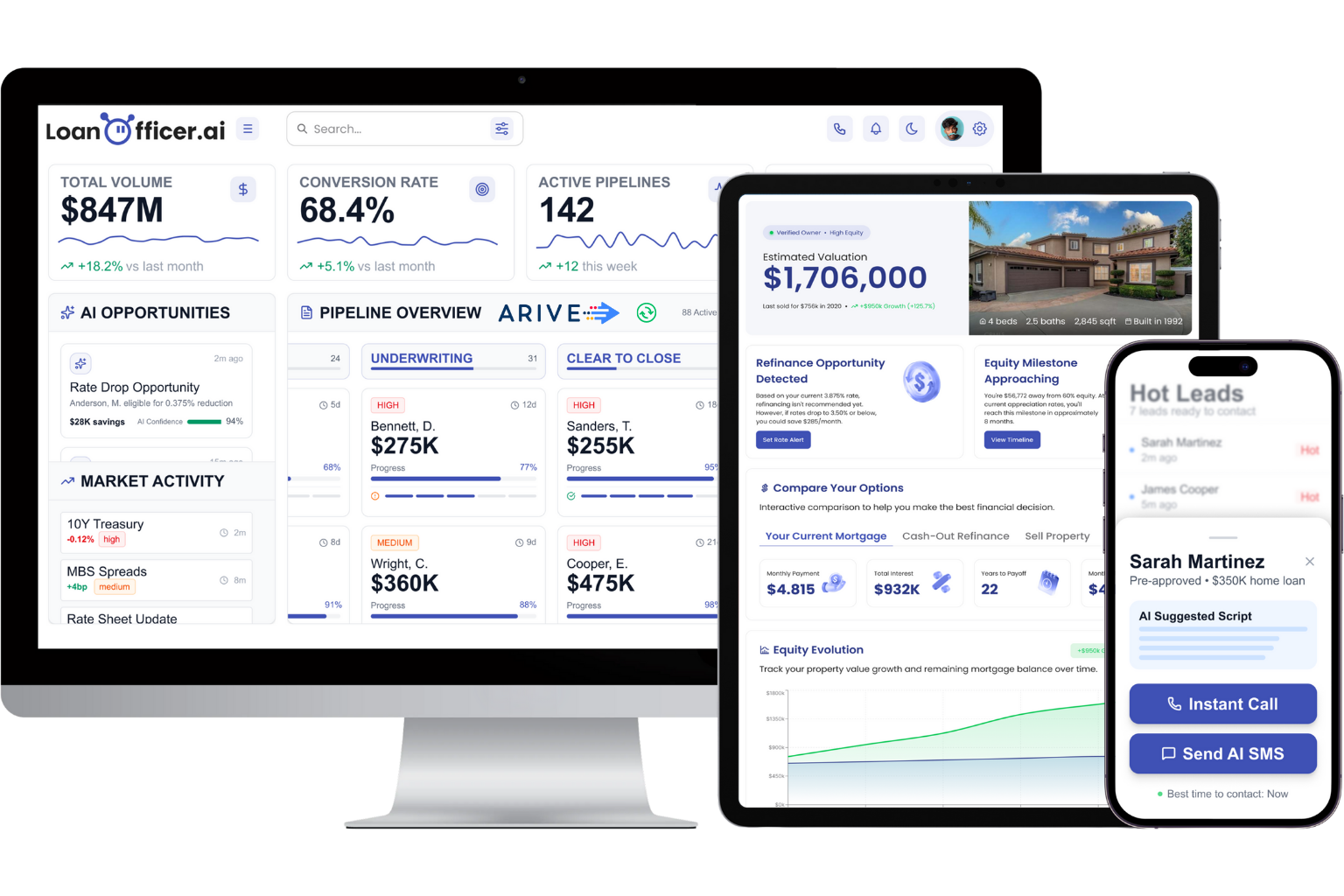
Plans start with Starter at $197 per month, scaling up through Team and Brokerage tiers as your database and team grow, with a one-time $299 onboarding fee to get your sequences and data migrated correctly the first time. If you’re running refinance-heavy reactivation campaigns, the refinance specialist tools are built around exactly the equity-triggered outreach this guide describes. Start a trial of Loan Officer AI and see how much of the 12-month playbook you can put on autopilot this week.
Sources
This guide draws on the FTC’s CAN-SPAM compliance guide, the FCC’s TCPA consent revocation waiver order, the CFPB’s Regulation B guidance, and Regulation X servicing rules. Review each directly before finalizing your own compliance procedures.
This article is general information, not a substitute for advice from a qualified financial advisor. Consult a qualified financial professional about your own circumstances before acting on anything here.
- CAN-SPAM Act: A Compliance Guide for Business | Federal Trade Commission
- FCC: CGB extends effective date for TCPA’s consent revocation rule
- Regulation B (Equal Credit Opportunity Act) | CFPB
FAQ
How much commission do loan officers make on a $500,000 loan?
Commission structures vary widely by lender, loan program, and whether the officer is paid a flat basis-point split or a tiered structure, so there’s no single universal figure. Most loan officers are paid a percentage of the loan amount, commonly in the range lenders set internally, and a long-term nurture strategy matters here because reactivated past clients and referrals typically cost far less to acquire than paid leads, improving effective margin per deal.
Can a 70-year-old get a 20-year mortgage?
Yes. Age alone cannot be used to deny or limit mortgage terms under fair lending rules, and lenders evaluate applicants based on income, assets, credit, and ability to repay, not age.
What should you not tell a mortgage lender?
Avoid volunteering vague or inconsistent statements about income, employment plans, or large deposits you can’t document, since inconsistencies slow underwriting and can trigger additional scrutiny. Never misrepresent your intent to occupy the property or the source of your down payment, as both are verified and materially affect loan terms.
How much income do you need to qualify for a $250,000 mortgage?
Required income depends on your debt-to-income ratio, credit profile, down payment, and the loan program, but many conventional guidelines target a total DTI around 43% or lower. A rough starting point many lenders use is roughly $60,000 to $70,000 in annual household income for a $250,000 loan, assuming minimal other debt and a standard down payment, though your specific number will vary with rate and loan type.
How long should a mortgage nurture campaign run before I give up on a lead?
Most mortgage nurturing strategies should run a full 6 to 12 months before moving a contact to a passive, low-frequency list, since decision timelines for buyers and refinance candidates routinely extend well past 90 days. Leads showing zero engagement across that entire window, no opens, clicks, or replies, are the ones worth deprioritizing, not leads who are simply quiet for a month or two.
