Assign One Owner: Mortgage CRM Adoption That Sticks for Loan Officers
Yes, adopt a mortgage CRM. Lenders using milestone tracking see roughly a 33% lift in application-to-close conversion, and the single action that determines whether you actually capture that gain is naming one person as the CRM owner before you sign anything. Skip that step and even the best software becomes an expensive contact list.
TL;DR:
- Assigning a single, dedicated owner is crucial, as shared ownership often leads to failed mortgage CRM adoption and inconsistent usage.
- Continuous micro-training and habit-forming routines help sustain high adoption rates beyond initial implementation, avoiding decay after the first few months.
- Proper data cleanup, standardization, and sequencing of integration steps significantly reduce migration delays and prevent duplicate or outdated contact records from contaminating the system.
- Phased rollouts targeting specific roles with tailored training and champions improve adoption success and minimize operational disruptions.
- Most ROI benefits, such as a 33% lift in application-to-close rate, become measurable within one to two quarters after milestone tracking is fully operational.
Table of Contents
- Why Mortgage CRM Adoption Pays Off
- Why Mortgage CRM Rollouts Stall (And How to Fix Them)
- How Do You Roll Out a Mortgage CRM Without Disrupting Production?
- Mortgage CRM Data Migration and Integration Checklist
- What KPIs Actually Prove Mortgage CRM Adoption Is Working?
- Why Ownership, Not Technology, Decides Whether Adoption Sticks
- How LoanOfficer.ai Fits This Adoption Playbook
- Sources
- FAQ
Why Mortgage CRM Adoption Pays Off
The math on mortgage CRM adoption isn’t subtle. Lenders with milestone tracking report 25% to 40% faster loan processing and that 33% application-to-close lift, and adoption itself has become the norm rather than the exception. A significant portion of lenders globally use a CRM, with higher adoption rates among federally regulated U.S. lenders.
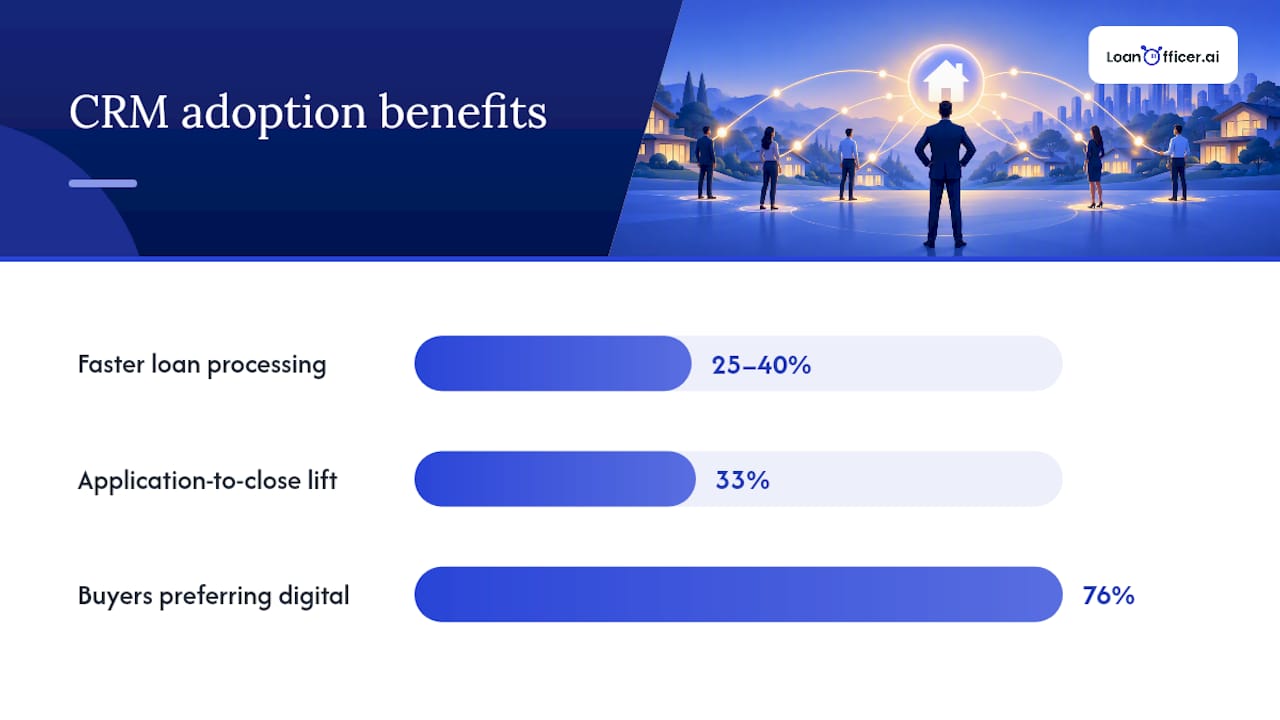
Borrowers are pushing this trend as much as operations teams are. 76% of surveyed homebuyers now say they prefer lenders who offer integrated digital experiences, like scheduling appraisals or closings online. A CRM isn’t just internal plumbing anymore. It’s the borrower’s first impression of whether your operation feels current or dated.
The uplift shows up in a few consistent places:
- Faster follow-up on new leads, which correlates directly with contact-to-application rates
- Fewer dropped handoffs between origination, processing, and closing
- Higher referral and repeat-borrower rates when past clients get proactive outreach
Statistic to remember: teams that connect CRM milestones to their pipeline see application-to-close conversion rise significantly, according to Sure Send’s benchmark analysis. That single number usually covers the software’s cost within the first quarter for a mid-sized team.
Why Mortgage CRM Rollouts Stall (And How to Fix Them)
Most failed rollouts don’t fail because the software is bad. They fail because nobody owns the outcome. Here’s what actually breaks, in order of frequency.
- No clear owner. When the CRM belongs to “everyone,” it belongs to no one. Assign a named owner (often an ops manager or a senior loan officer) who reports adoption metrics monthly.
- One-and-done training. A single onboarding session doesn’t build habits. Treating adoption like a marketing program, with monthly micro-training and recognition for power users, works far better than a launch-day webinar.
- Dirty data at the start. Migrating stale contacts, duplicate records, and inconsistent naming conventions poisons the system before anyone logs in. Audit and standardize naming rules before migration, not after.
- Fragmented tech stack. Nearly 74% of lenders cite stack fragmentation as a top inefficiency driver, adding an average $412 per loan in redundant work. Inventory every vendor contract and renewal date before you commit to a new platform.
Pro Tip:Pull every vendor contract’s renewal clause into a single spreadsheet before you evaluate a new CRM. A tool that looks cheaper on paper can lock you into overlapping subscriptions for another 18 months if you don’t check the fine print first.
How Do You Roll Out a Mortgage CRM Without Disrupting Production?
Rushing a mortgage CRM implementation is the fastest way to get the failure modes above. A phased rollout, timed correctly, avoids most of them.
Phase 1: Readiness audit (Week 1 to 2) Before touching new software, inventory what you already have.
- List every current vendor, contract end date, and renewal notice period
- Pull a sample of existing contact and loan records to gauge data quality
- Identify who currently “owns” client follow-up informally, since that person becomes your champion
Phase 2: Pilot (Weeks 3 to 8) Run the CRM with a single team or branch before a full rollout. Mid-market implementations that include data cleanup and integration work typically take four to eight weeks, and it’s smart to budget 20% to 30% longer than the vendor’s estimate. Set pilot success metrics up front:
- Percentage of new leads logged within 24 hours
- Percentage of active pipeline records updated weekly
- At least one measurable improvement in contact-to-application speed
Phase 3: Staged expansion (Months 2 to 4) Roll out by role, not all at once. Loan officers need lead-response training first; processors need milestone-tracking training second; branch managers need dashboard training last, once there’s real data to review. Each group needs its own champion, not a single company-wide trainer.
Phase 4: Advanced features (Month 4 onward) Only turn on automated multi-channel campaigns, smart dialer workflows, and predictive equity or refinance alerts once the team is comfortable with daily basics. Enterprise-wide deployments with full integration can run three to six months end to end. Trying to activate every automation on day one is how teams end up ignoring all of them.
Mortgage CRM Data Migration and Integration Checklist
Migration is where most mortgage CRM implementation timelines slip. Get the sequencing wrong and you’ll be running two systems in parallel far longer than planned.
Export and map these datasets first, in this order:
- Active contact records with current loan stage
- Loan milestone history (application, underwriting, closing dates)
- Communication logs (calls, texts, emails) tied to each contact
- Referral source and realtor partnership data
Integration order matters just as much as the data itself. Connect your loan origination system first, since it drives milestone accuracy. Point-of-sale integration comes next, followed by e-signature platforms, then marketing attribution tools last. If your workflows involve borrower-facing digital submissions, review how the CFPB evaluates servicer platform workflows for compliance treatment before launch.
| Migration Step | Typical Timing | Key Risk If Skipped |
|---|---|---|
| Data audit and cleanup | Before pilot | Duplicate or dead contacts pollute new system |
| LOS integration | Pilot phase | Milestone tracking becomes manually re-entered |
| Parallel run (old + new system) | 2 to 4 weeks | Leads dropped between systems |
| Full cutover | After pilot success | Team reverts to old habits under pressure |
mortgage CRM installs](https://suresend.ai/l/mortgage-crm-statistics), makes this migration considerably easier since mobile access doesn’t require a separate rollout phase. That mobility also drives a real productivity gain, with remote loan officers reporting notable output increases once they’re not tied to a desktop system.
What KPIs Actually Prove Mortgage CRM Adoption Is Working?
Adoption metrics and business metrics are different things, and mixing them up is a common mistake. Track both, but report them separately.
Operational adoption health:
- Daily and weekly active logins per user
- Percentage of contacts with complete, standardized data fields
- Feature usage rate for core tools (follow-up sequences, pipeline stages)
Pipeline and conversion impact:
- Contact-to-application rate
- Application-to-close rate, benchmarked against the 33% lift figure tied to milestone tracking
- Cost per funded loan and referral percentage, reviewed monthly
One gap worth closing early: many teams capture where a lead entered the funnel but never connect that to the full multi-touch marketing path that actually produced it. Without that link, you’re measuring activity, not return on marketing spend.
Why Ownership, Not Technology, Decides Whether Adoption Sticks
The technology rarely fails. The habit does. Every stalled rollout traces back to the same root cause: nobody was accountable for making the CRM part of daily behavior, so it quietly became optional.

Naming an owner isn’t a formality. It’s a multiplier that supports a marketing automation checklist for SMBs to build habits and ensure adoption success. That person tracks the adoption KPIs, runs monthly micro-training instead of a single kickoff, and publicly recognizes the loan officers who log every call. Teams that treat adoption like an ongoing habit-building program, not a launch event, keep their usage rates high a year later instead of watching them decay after month three.
If your organization is weighing whether adoption is worth the disruption, the disruption is smaller than the cost of staying fragmented. The real risk isn’t picking the wrong software. It’s picking the right software and never assigning anyone to make it stick.
— Jared Hart
How LoanOfficer.ai Fits This Adoption Playbook
This CRM platform is built around the exact checklist above rather than a generic contact database bolted onto a mortgage workflow.

Onboarding starts with the same readiness audit outlined in the roadmap above, and the platform’s LOS integrations follow the same sequencing recommended for any migration. Loan Officer AI reports 93% partner retention, a signal that the habit-building side of adoption, not just the software, gets support after launch.
If you’re ready to see whether the fit works for your pipeline, start a trial run or review current plans and pricing, which start at $197 per month for the Starter tier. Teams weighing a fuller rollout can also compare the Team and Brokerage tiers before committing.
Sources
For deeper detail on rollout mechanics, the step-by-step implementation playbook and migration guide expand on the phases above. Regulatory context on borrower-facing platforms comes from the CFPB’s No-Action Letter template.
- MBA Premier Member Editorial: Lenders, take note: the technology buyers want to see
- CFPB No-Action Letter template (Brace Software example)
- Mortgage CRM Statistics: Trends, ROI, and Key Benchmarks | Sure Send Blog
- MBA Premier Member Editorial: The hidden cost of a fragmented tech stack—and how to fix it
FAQ
How long does mortgage CRM implementation take?
Simple, out-of-the-box setups can launch in about two weeks, while mid-market rollouts with data cleanup and integrations typically take four to eight weeks. Enterprise deployments with full integration can run three to six months, so budget somewhat longer than the vendor’s initial estimate.
What is a realistic ROI timeline for mortgage CRM adoption?
Most teams see measurable pipeline gains within one to two quarters once milestone tracking is fully adopted, since that tracking is tied to a roughly 33% application-to-close lift. The exact payback period depends on lead volume and how quickly the team builds daily logging habits.
Who should own mortgage CRM adoption inside a brokerage?
Ownership works best with a single named person, usually an ops manager or senior loan officer, who tracks usage KPIs and runs monthly reinforcement training. Diffuse ownership across a whole team is the most common reason rollouts stall.
Does Loan Officer AI integrate with existing loan origination systems?
Yes, Loan Officer AI is built with LOS integrations and pipeline management designed specifically for mortgage workflows rather than generic sales pipelines. Current plans and integration details are listed on the pricing page.
What causes most mortgage CRM adoption failures?
The most common causes are missing ownership, one-time training instead of ongoing reinforcement, poor data hygiene during migration, and a fragmented tech stack. Stack fragmentation alone adds an average $412 in redundant cost per loan for affected lenders.
