60-Day Compliant Pilot for Mortgage Realtor Partnerships

Build partnerships that create measurable borrower value and document any paid services, never payments tied to referrals. The central legal constraint is RESPA Section 8, which bars fees or kickbacks for sending settlement service business. The immediate next step: agree with one potential partner on a documented, non-volume-based co-marketing pilot with a defined service, a fair price, and a 60-day review.
TL;DR:
- Partnerships must produce a useful service for borrowers before any fees are exchanged to comply with RESPA Section 8.
- Activities like joint educational sessions or program stacking are compliant, while paying realtors for referrals without documentation is not.
- Written agreements should detail specific services, fair-market pricing, non-exclusivity, consumer disclosures, and proof of service delivery.
- During transactions, clear communication, defined handoff points, and KPI tracking ensure operational reliability and partnership growth.
- Relying on structured documentation and operational consistency is more important than charm or volume, and leveraging technology can support scaling.
Table of Contents
- What compliant, high-value partnerships actually do
- RESPA and practical compliance checklist for partnerships
- Step-by-step playbook to start and run a partnership pilot
- Transaction-day workflow and communication templates to avoid delays
- KPIs and a simple reporting cadence to grow partnerships
- Practitioner perspective and proofs
- Strategies for initiating and building trust in mortgage realtor partnerships
- Legal considerations beyond RESPA such as state-specific laws and licensing requirements
- Templates or examples of compliant partnership agreements and marketing materials
- Effective communication practices and conflict resolution between partners
- Timing and timeline considerations for partnership development and transaction flow
- Why most partnership advice misses the point
- Scaling partnerships with a mortgage CRM
- Sources
- FAQ
What compliant, high-value partnerships actually do
The partnerships that hold up under scrutiny and actually move deals forward share one trait: they produce something a borrower can use before any money changes hands. A loan officer and a realtor teaching a joint first-time buyer class is useful and defensible. A loan officer paying a realtor $500 per closed referral is not, regardless of how either party labels the arrangement.
A few examples of activities that tend to pass the smell test and the regulatory test:
- Joint educational sessions on financing options, local market conditions, or the buying timeline, open to any consumer rather than a referred list.
- Program stacking, where a lender and agent coordinate so a buyer can combine down payment assistance with a renovation or energy-efficiency program, the kind of pairing Freddie Mac recommends to help buyers qualify while managing out-of-pocket costs.
- Co-branded checklists or pre-approval guides that explain process, not promote either party’s volume.
None of these require an exclusive arrangement, and none tie compensation to how many deals get referred. That is the dividing line that matters most.
RESPA and practical compliance checklist for partnerships
Section 8 of RESPA prohibits giving or accepting a fee, kickback, or anything of value in exchange for referring settlement service business on a federally related mortgage loan. That covers cash, discounted marketing, free staffing, and anything else of value, not just checks.
When one party has an ownership stake in the other’s business, an Affiliated Business Arrangement disclosure is required. CFPB examination guidance describes an exemption that applies only when written disclosure is provided at the time of referral or application, listing the ownership interest and the typical range of charges.
Marketing services agreements have drawn significant CFPB enforcement attention when payments appeared tied to referral volume rather than actual services, according to NAR’s RESPA guidance. A lawful MSA reflects fair-market-value work, stays non-exclusive, and includes consumer disclosures.
A short checklist before signing anything:
- Write down the exact service being paid for, and who performs it.
- Price that service at what it would cost from an unrelated vendor, not a round number that feels fair.
- Confirm the agreement is non-exclusive and doesn’t require minimum referral volume.
- Add the consumer disclosure language your compliance counsel approves.
- Keep invoices and proof of service delivery on file, not just the signed agreement.
Step-by-step playbook to start and run a partnership pilot
Start by mapping potential partners against two filters: client overlap and complementary strengths. A realtor who sells to first-time buyers in your typical price range is a better fit than one who works mostly with cash investors, even if the second one closes more volume.
- Pick one partner and agree on a single measurable goal, such as cutting days-to-close or lifting referral-to-application conversion.
- Set a 30 to 90 day pilot window with a fixed end date and a review meeting already on the calendar.
- Draft a short written memo covering the service each party provides, who pays for what, and any required consumer disclosure.
- Define handoff points: who sends the pre-approval, who collects which documents, and how often status updates happen.
- Review results against the original goal, then decide whether to continue, adjust, or end the pilot.
The memo doesn’t need to be long. A one-page document naming the service, the price, the timeline, and the disclosure requirement covers most of what a compliance review will ask for.
Pro Tip:Keep the pilot non-exclusive from day one. An exclusivity clause is one of the fastest ways to turn a legitimate co-marketing arrangement into something that looks like a referral-for-volume deal.
Transaction-day workflow and communication templates to avoid delays
Most partnership friction shows up during the transaction, not during the sales pitch. A clear sequence of touchpoints fixes most of it.
- Pre-offer: confirm pre-approval status, use a shared intake form so both sides see the same borrower information, and set expectations on response time.
- Under contract: run a joint underwriting checklist, flag appraisal triggers early, and agree on a documentation timeline so nobody is chasing paperwork the week before closing.
- Closing: coordinate the final walk-through date, confirm who sends which documents to the title company, and settle on a single point of contact for last-minute questions.
- Status updates: a short template such as “Loan status: [stage]. Next step: [action]. Expected by: [date].” keeps both sides informed without extra calls.
When something stalls, escalate by phone, not email, and loop in both the loan officer and the agent on the same call so the fix doesn’t take three separate conversations.
KPIs and a simple reporting cadence to grow partnerships
Partnerships that aren’t measured tend to drift. A short list of KPIs, reviewed quarterly, keeps the arrangement honest about what’s working.
| KPI | What it tells you |
|---|---|
| Referral-to-application rate | Whether introductions are converting to actual loan applications |
| Conversion-to-close rate | How many applications turn into funded loans |
| Days-to-close | Whether the handoff process is adding delay |
| Partner retention | Whether the relationship is lasting beyond one or two deals |
| Referred-borrower satisfaction | Whether the borrower experience matches what both partners promise |
A quarterly review meeting, thirty minutes, with these five numbers in front of both parties, is enough to decide whether to expand the partnership, fix a specific bottleneck, or end it.
Practitioner perspective and proofs
The partnerships that last aren’t the ones with the best pitch. They’re the ones where both sides can point to a specific, documented service and say exactly what it cost and what it delivered. That clarity protects everyone when a regulator or a compliance officer asks questions.
Some mortgage CRM platforms report high partner retention among loan officers using their tools to manage realtor relationships, reflecting improved follow-ups and handoffs that do not depend on memory.
— Jared Hart
Strategies for initiating and building trust in mortgage realtor partnerships
Trust between a loan officer and a realtor builds through repeated, predictable behavior, not a single good pitch meeting. The first conversation should focus on how each side handles a borrower, not on volume targets.
A practical opener: ask to shadow one transaction or review a recent closing timeline together. Seeing how someone actually communicates during a tight deadline tells you more than any introductory coffee meeting. Follow up with a small, low-stakes pilot, like a single co-hosted buyer seminar, before discussing any formal agreement.
Consistency matters more than enthusiasm. A loan officer who responds within the hour, every time, for three straight deals earns more trust than one who promises faster turnaround but delivers it inconsistently. Realtors remember who made their last closing harder and who made it easier, and they refer accordingly, informally and without any agreement in place.
Transparency about limitations also builds credibility. If a loan officer can’t serve a certain loan type or price range well, saying so upfront, and pointing the agent toward someone better suited, tends to earn more long-term referrals than overpromising and underdelivering on a deal that was a poor fit from the start.
Finally, treat the first few deals as a trial period for both sides. Ask directly: did this feel smooth, where did it stall, what would make the next one easier. That conversation, held honestly after closing, is often what turns an occasional introduction into a steady partnership.
Legal considerations beyond RESPA such as state-specific laws and licensing requirements
RESPA sets the federal floor, but it isn’t the only rule that applies. Most states regulate real estate licensees separately from mortgage loan originators, and a realtor who starts performing loan-related tasks, like collecting borrower financial documents on a lender’s behalf, can cross into activity that requires a mortgage license.
Legal commentary from Mayer Brown notes that payments must cover actual, necessary, and distinct services rather than functioning as a disguised referral fee, and that compensation set above fair market value risks being recharacterized as exactly that. This applies regardless of which state the partnership operates in, since it stems from the federal rule, but state real estate commissions often add their own disclosure or advertising requirements on top.
Many states also regulate how realtors and loan officers can jointly advertise, particularly around claims of guaranteed approval or specific rate promises. Before launching co-branded materials, check your state real estate commission’s advertising rules alongside RESPA, since a sentence that is fine under federal law can still violate a state-level consumer protection statute.
Licensing requirements for loan originators are also state-specific, and a loan officer operating across state lines needs the appropriate license in each state where the borrower’s property sits, not just where the loan officer is based. None of this replaces a conversation with compliance counsel, but knowing where state rules layer on top of RESPA keeps a partnership from running into a problem nobody flagged early.

Templates or examples of compliant partnership agreements and marketing materials
A compliant agreement doesn’t need to be complicated, but it needs a few elements every time: a description of the specific service provided, the fee tied to that service rather than to referral volume, a stated term with a renewal or termination clause, and the required consumer disclosure language.
For a basic co-marketing memo, structure it around four sections: the service each party delivers, the cost of that service and how it was benchmarked to market rate, the duration of the agreement, and a signature block confirming both parties reviewed the disclosure requirements. Keep a copy of any invoice or proof of work alongside the signed memo, since documentation after the fact is what regulators actually examine.
For marketing materials, co-branded flyers or digital content should focus on educational value, not joint promotion of referral volume. A flyer announcing a first-time buyer seminar, with both names and logos, reads very differently to a compliance reviewer than one that says “ask your realtor about financing with [loan officer],” which edges toward an implied referral relationship.
Our compliance playbook for co-branded mortgage marketing walks through specific structures that keep joint materials on the right side of the line, including language to avoid and disclosure placement.
Whatever template you use, have it reviewed once by compliance counsel before the first use, then reuse the same structure for future partners rather than drafting a new agreement from scratch each time.
Effective communication practices and conflict resolution between partners
Most partnership breakdowns trace back to a missed update, not a fundamental disagreement. Setting a communication cadence before problems arise, rather than after, prevents most of the friction.
Agree upfront on response time expectations, such as same-business-day replies during an active transaction, and put that expectation in writing as part of the partnership memo. When a deal stalls, a short phone call resolves more than a string of emails, since tone and urgency come through faster.
When conflict does happen, usually around a delay, a miscommunication about documentation, or a borrower caught between two sets of expectations, address it directly and specifically. Naming the exact point where the process broke down, rather than describing a general frustration, makes the conversation productive instead of defensive.
A simple rule helps: raise the issue within 24 hours of noticing it, directly with the partner, rather than letting it surface weeks later during a quarterly review when the details have faded. Partners who address friction quickly tend to stay partners longer than ones who let irritation build silently.
If a pattern of problems repeats across multiple deals, that’s a signal to revisit the original agreement rather than keep working around it informally. A quick recalibration conversation, using the KPIs from the quarterly review, keeps the relationship built on evidence rather than accumulated frustration.
Timing and timeline considerations for partnership development and transaction flow
Partnership building follows its own timeline, separate from any single transaction, and conflating the two causes problems. Expect the first few deals with a new partner to take longer than usual, simply because both sides are still learning each other’s process.
A reasonable timeline: spend the first 30 days on introductions and a single small joint activity, like a co-hosted seminar, before discussing any formal agreement. Run a 60 to 90 day pilot on one or two live transactions, tracking the KPIs covered earlier. Only after that pilot period produces a clear signal, good or bad, does it make sense to formalize a longer-term arrangement.

Within an individual transaction, timing matters just as much. Pre-approval should happen before a buyer starts touring homes seriously, not after an offer is already drafted. Appraisal and underwriting triggers need a documented timeline agreed on during the under-contract phase, so neither party is caught off guard by a tight closing date.
Freddie Mac’s lending resources note that continuous lender-realtor communication, maintained throughout the transaction rather than concentrated at the start and end, helps integrate financing programs into the buying strategy earlier, which tends to reduce last-minute surprises for buyers using nontraditional assistance programs.
Why most partnership advice misses the point
Most advice on this topic treats partnerships as a networking problem: meet more agents, attend more open houses, send more holiday cards. That’s not wrong, but it’s not what makes a partnership durable. The partnerships that survive past the first few deals are the ones built on operational reliability, not charisma.
The conventional wisdom overrates the first meeting and underrates the fifth transaction. Anyone can have a good coffee chat. Far fewer loan officers and realtors can run five closings in a row without a missed handoff or a documentation delay, and that track record is what actually earns steady referrals.
If there’s one thing to prioritize first, it’s documentation, not charm. Write down what the service is, what it costs, and what each party is responsible for before the first deal, not after a dispute. Compliance isn’t the obstacle to a good partnership. It’s the structure that lets a good partnership survive scrutiny and keep going.
Scaling partnerships with a mortgage CRM
Running a handful of partnerships on spreadsheets and memory works until it doesn’t. Loanofficer centralizes the tools covered above: automatic follow-ups so a referred borrower never waits on a reply, opportunity detection that flags refinance and equity activity worth sharing with a partner, and pipeline visibility that shows exactly where a joint transaction stands.
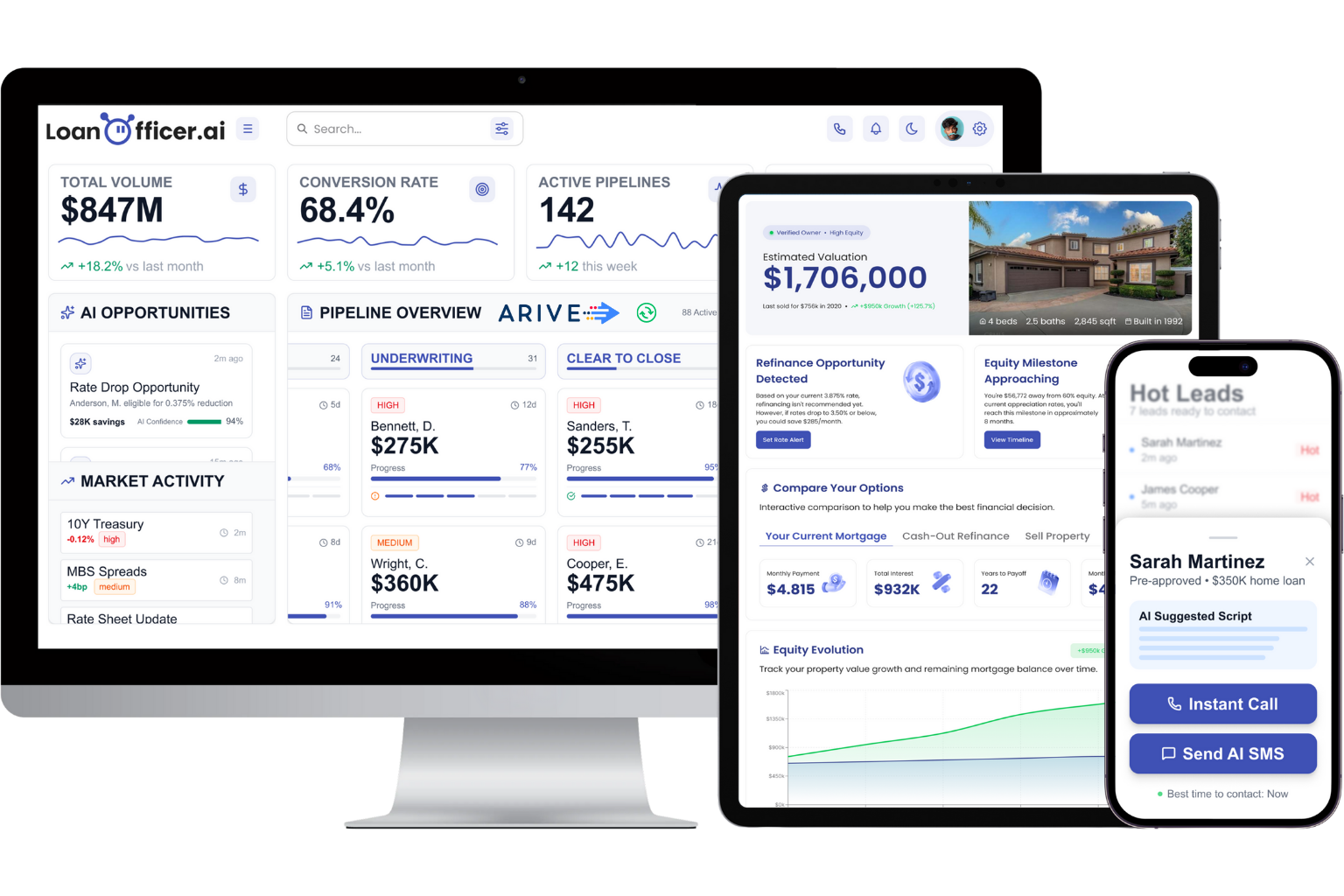
Loan officers using the platform to manage realtor relationships experience a high rate of partner retention, reflecting the benefits of operationally reliable partnerships where follow-ups and handoffs do not depend on memory. Plans start with Starter at $197 per month, with Team and Brokerage tiers available as partnership volume grows, detailed on the pricing page. Readers ready to see it in action can start a trial and connect their first partner pilot this week.
Sources
- 12 CFR 1024.14 (RESPA) — Section 8
- RESPA FAQ — National Association of REALTORS®
- Holly Bunting — Mayer Brown
- Freddie Mac homebuyer program resources
FAQ
Are referral payments between realtors and loan officers legal?
No. RESPA Section 8 prohibits giving or accepting a fee, kickback, or thing of value in exchange for referring settlement service business on a federally related mortgage loan. Payments are only permitted for actual, documented services priced at fair market value.
What co-marketing activities are allowed under RESPA?
Joint educational events, co-branded checklists, and shared buyer resources are generally permitted when they’re open to the public rather than tied to referral volume. NAR’s guidance recommends keeping any marketing services agreement non-exclusive and priced at fair market value, with consumer disclosures included.
What should a compliant partnership agreement include?
A written memo should name the specific service provided, its fair-market-value price, the agreement’s term, and any required consumer disclosure, particularly if either party has an ownership interest in the other’s business. Keep invoices and proof of service delivery on file alongside the signed agreement.
How do you measure whether a mortgage realtor partnership is working?
Track referral-to-application rate, conversion-to-close, days-to-close, and partner retention on a quarterly basis. A platform like Loanofficer can centralize that tracking so both partners see the same numbers during a review.
What are the main risks in a real estate and mortgage partnership?
The biggest risks are payments tied to referral volume, exclusivity requirements, and undisclosed ownership interests between the parties, all of which can trigger RESPA violations. Documenting services, pricing them at fair market value, and disclosing any affiliated business arrangement in writing addresses most of that exposure.
