AI Assisted 21 Day Mortgage Preapproval Nurturing for Loan Officers

Mortgage preapproval nurturing works best when a behavior-triggered CRM handles the fast, repetitive touches and a loan officer steps in the moment a lead shows real intent. Speed wins the first contact, a short branching sequence carries education through day 21, and automation routes anyone who clicks, replies, or opens a document straight to a human. Compliance rules and clear exit conditions tied to your loan origination system keep the whole system safe to run at scale.
TL;DR:
- Speed and behavior-triggered responses are essential, with initial contact made within minutes and automated education continuing for 21 days.
- Automated tasks handle instant acknowledgments, alerts for high-intent actions, and document reminders, while qualification and objection handling remain human duties.
- Strict compliance requires obtaining prior express written consent for texts and emails, logging consent records, and providing easy opt-out options.
- Reliable trigger points include form submissions, calculator interactions, document uploads, and LOS flags, with diligent data hygiene and testing needed before scaling.
- Monitoring key KPIs such as time-to-contact, open and click rates, and application conversion rates is crucial to optimize nurturing efficiency and response times.
Table of Contents
- What Does a Preapproval Nurturing Sequence Look Like From Day 0 to Day 21?
- AI Vs. Human: What To Automate, What To Keep Human
- What Compliance Rules Apply To Text And Email Nurture Campaigns?
- Which Integrations And Triggers Make The Sequence Reliable?
- What KPIs Should You Track For Preapproval Nurturing?
- How Do You Build And Pilot This Sequence Without Common Failures?
- Driving Adoption And Cultural Change In Mortgage Teams
- Why A Purpose-Built AI Mortgage CRM Gets You Here Faster
- Sources
- FAQ
What Does a Preapproval Nurturing Sequence Look Like From Day 0 to Day 21?
The first five minutes decide more than the next five weeks combined. Behavior-triggered follow-ups convert substantially better than time-based drips, and lead drop-off climbs fast once response time stretches into hours. Here’s a sequence structure you can adapt inside almost any mortgage CRM.
- Day 0 (minute one): An SMS and email go out from the loan officer by name, not a company alias, with one qualifying question (“Are you still looking in the same price range?”) and a booking link.
- Day 0 branch point: Any reply, calculator click, or booking click moves the lead into a human-ready queue for same-day contact. No response triggers the automated education track instead.
- Day 2: An educational message explains what preapproval actually verifies and what documents will be needed later, positioning the loan officer as the resource rather than a salesperson.
- Day 5: A short check-in text asks about timeline or property search progress, another branch opportunity if the lead engages.
- Day 7: A payment or affordability calculator link goes out with a direct call-to-action to run their own numbers, a high-intent action that should trigger immediate routing to a human.
- Day 10 to 12: Social proof or market-condition content addresses common hesitations without pushing for a call.
- Day 14: A document checklist arrives alongside a soft ask to start or finish the application, reducing friction at the exact point most leads stall.
- Day 18 to 21: A final direct outreach from the loan officer either re-engages a cold lead or, if the lead has completed key actions, formally exits the nurture sequence and moves into active loan origination system workflows.
Every branch point matters more than the content itself. A lead who opens the calculator on day 7 should never sit in an automated queue until day 10.
AI Vs. Human: What To Automate, What To Keep Human
Industry practice increasingly treats AI as a digital assistant that automates repetitive tasks so loan officers can spend more time on conversations that actually close loans. That framing should guide every automation decision you make.
Hand these tasks to automation:
- Instant acknowledgment texts and emails the moment a lead submits a form
- Webhook-driven alerts to the loan officer when a lead takes a high-intent action
- Document reminder sequences for missing paystubs, bank statements, or W-2s
- Low-risk data entry and tagging inside the CRM record
Keep these with a human:
- Qualification calls that assess credit nuance, income complexity, or down payment sourcing
- Objection handling around rate concerns or timeline anxiety
- Final application guidance once a lead is ready to move forward
Pro Tip:Run automation past your loan officers before launch, not after. A pilot with two or three volunteers who help write the message templates will surface tone problems automation alone never catches.
A platform built around centralizing follow-ups and opportunity detection makes this split easier to enforce because the routing logic lives in one system instead of scattered across spreadsheets and reminders.

What Compliance Rules Apply To Text And Email Nurture Campaigns?
The FCC’s Second Report and Order requires one-to-one prior express written consent for robocalls and robotexts. That means consent tied to your business specifically, not a shared checkbox covering a dozen advertisers on some third-party lead form.
CAN-SPAM adds separate obligations for commercial email: identify the actual sender, include a working opt-out link, and honor opt-out requests within the required window.
- Capture consent per lead source, and never assume a purchased list carries valid one-to-one consent.
- Log consent records with timestamps inside your CRM, since audits look for documentation, not memory.
- Review vendor contracts for how they collect and pass along consent data before you plug any lead source into an automated sequence.
- Build opt-out handling into every channel so a “STOP” text or unsubscribe click removes the lead everywhere, not just in one system.
A dedicated compliance guide for mortgage texting is worth bookmarking before you scale volume.
Which Integrations And Triggers Make The Sequence Reliable?
The minimum stack runs lead capture into a CRM, out to email and SMS providers, and back into your loan origination system, with each connection carrying event data both directions.
- Form submit: starts the day 0 sequence within minutes, not hours.
- Calculator engagement or portal click: triggers the human-ready queue automatically.
- Document upload: stops reminder messages for that specific item.
- LOS preapproval flag: exits the lead from nurture and moves the record into active processing.
Data hygiene matters as much as the triggers. Tag leads by source, flag consent status on every record, and dedupe aggressively so one person doesn’t get three versions of the same sequence from three different forms. Before launch, test every webhook manually, confirm handoffs actually reach the assigned loan officer, and verify exit conditions fire correctly when a loan moves forward.
What KPIs Should You Track For Preapproval Nurturing?
Time-to-contact is the single number that predicts more than any other. Behavior-triggered follow-up can increase reply rates significantly compared to scheduled drip campaigns, and that gap tends to widen the slower a team responds.
- Time-to-contact from lead capture to first human touch
- Open and click rates by message and day in sequence
- Contact-to-application conversion rate
- Document completion rate after checklist delivery
- Unsubscribe and opt-out rate by channel
Set up real-time alerts for high-intent actions, review sequence health weekly, and run a full conversion review monthly. Marketing automation adoption has been linked to a 28% increase in sales opportunities in industry ROI research, which gives you a benchmark worth testing against your own numbers through simple A/B tests on subject lines or send times.
How Do You Build And Pilot This Sequence Without Common Failures?
- Map every lead source feeding your CRM and confirm consent capture at each entry point.
- Build the trigger logic for day 0 through day 21, including every branch and exit condition.
- Write templates for each touchpoint, with the loan officer’s name and direct contact info on every message.
- Configure the loan origination system exit event so preapproved leads stop receiving nurture content automatically.
- Assign routing rules so high-intent leads land in a specific queue, not a general inbox nobody checks.
- Run a small-volume pilot with one lead source, watch the KPIs above weekly, and adjust timing or content based on real replies.
Pro Tip:The most common failure isn’t bad content, it’s missing exit conditions. A lead who keeps getting educational emails after they’ve already applied will unsubscribe from everything, including your loan officer’s future outreach.
Generic senders and unclear routing rules are the other two failure points worth testing for before you scale past your pilot group.
Driving Adoption And Cultural Change In Mortgage Teams
Loan officers adopt automation when they see time saved, not when they’re told to. Frame every rollout around what’s in it for them: fewer manual follow-ups, better conversations with leads who are already engaged. Pilot small, share early wins, and let frontline loan officers help write the templates they’ll actually use.
— Jared Hart
Why A Purpose-Built AI Mortgage CRM Gets You Here Faster
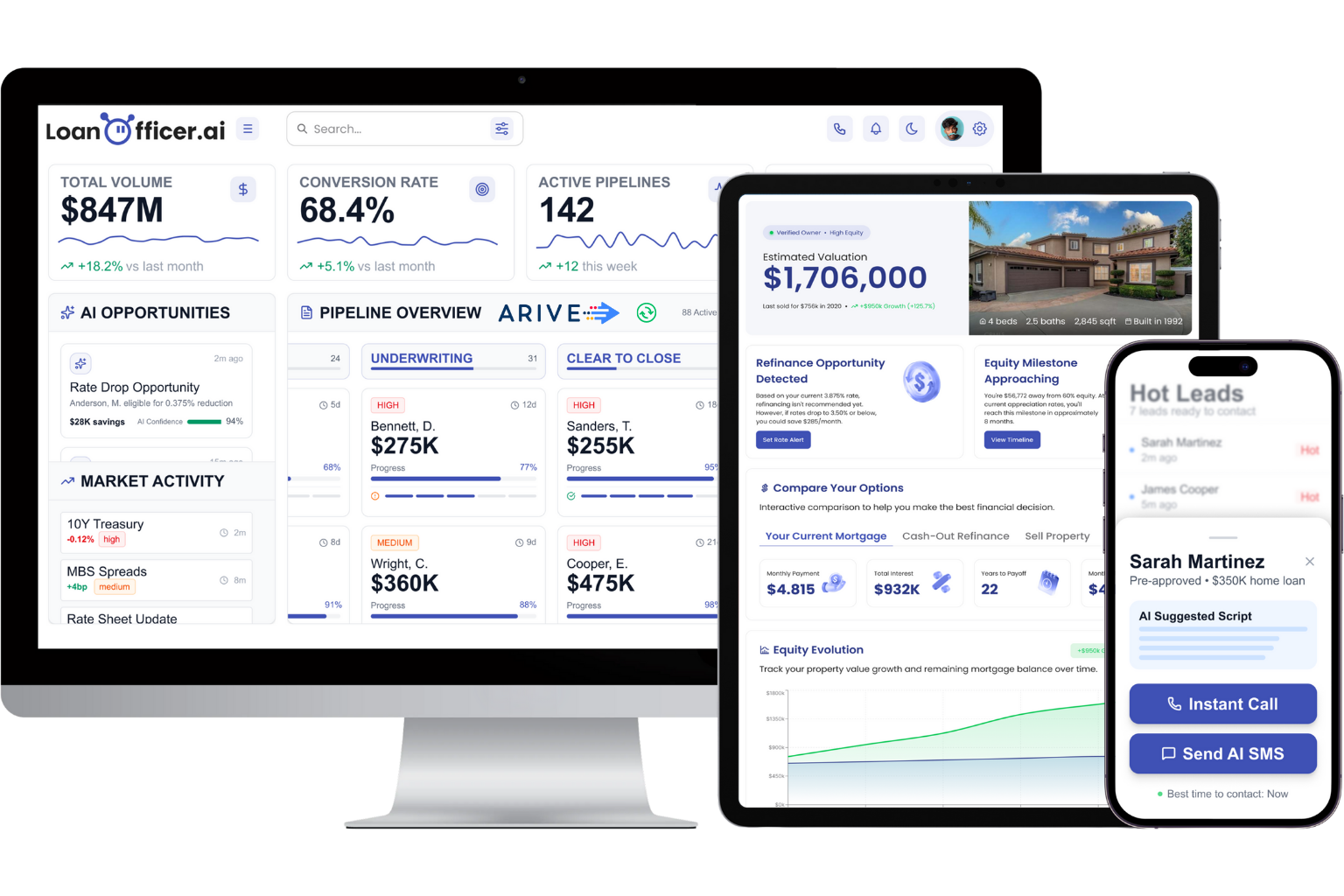
Building the sequence above from scratch means stitching together a CRM, an SMS provider, an email platform, and manual LOS updates, then hoping nothing breaks between them. Loan Officer AI centralizes those triggers, automated follow-ups, and opportunity detection in one system built specifically for mortgage teams, so the branching logic and LOS handoffs described above are configuration, not custom development.
Start by piloting one lead source, checking how your loan origination system integrates, and confirming consent logging works the way your compliance team expects. Loan officers, processors, and whoever owns your CRM should all sit in on the first walkthrough since routing rules touch every one of their workflows. Plans run from $197 a month for the Starter tier up to $697 for Brokerage, with a $299 one-time onboarding fee to get triggers and templates configured correctly from day one. You can also start a trial directly to see the sequence running against your own leads before committing.
Sources
Core sources behind this playbook include the FCC’s one-to-one consent rule, the FTC’s CAN-SPAM compliance guide, ICE Mortgage Technology’s borrower insights research, and MBA NewsLink’s coverage of AI adoption in lending.
- AI in residential lending: the agentic loan officer — MBA NewsLink
- Targeting and Eliminating Unlawful Text Messages — FCC (DA-24-910A1)
- CAN-SPAM Act compliance guide — FTC
- How to lead nurturing for mortgage brokers — USTech Automations
FAQ
What Is Mortgage Preapproval Nurturing?
It’s the process of automated and human follow-up that keeps preapproval-stage leads engaged until they complete a mortgage application. It typically combines CRM-triggered messages, educational content, and timed human check-ins over roughly three weeks.
How Fast Should A Loan Officer Respond To A New Preapproval Lead?
Contact within minutes, not hours, since behavior-triggered follow-up significantly outperforms delayed or scheduled outreach. A CRM with instant alerting handles the acknowledgment while the loan officer prepares for a same-day call.
What Consent Do I Need Before Texting A Mortgage Lead?
The FCC requires one-to-one prior express written consent captured specifically for your business, not a shared consent checkbox from a third-party form. Review the FCC’s consent rules before connecting any purchased lead source to automated texting.
Does Loan Officer AI Handle Compliance Logging For Texts And Emails?
Loan Officer AI centralizes consent tagging and follow-up history inside the CRM record, giving teams a documented trail for audits. Current plan details and pricing are listed on the Loan Officer AI pricing page.
How Much Does An AI Mortgage CRM Cost?
Loan Officer AI’s published plans start at $197 per month for Starter and go up to $697 per month for Brokerage, plus a $299 one-time onboarding fee. Enterprise pricing is available on request through the pricing page.
