Loan Officers: One Page KPI Packets for RESPA Safe Referral Reporting

The fastest, lowest risk way to report referral partner activity is to standardize partner attribution in your CRM, automate reconciliation to your loan origination system, and share a short, co-branded KPI packet every month. That packet should cover leads, applications, funded loans, conversion rate, and funded volume. Build it on documented referral intake and market value compensation under RESPA Section 8 and you remove most of the legal exposure before it starts.
TL;DR:
- Standardize partner attribution in your CRM and automate data reconciliation to reduce legal exposure under RESPA Section 8.
- Key metrics to track include leads received, qualified applications, funded loans, conversion rate, and funded volume, with consistent reporting for trend analysis.
- Use multiple attribution methods, such as CRM fields, digital tracking, and LOS matching, combined with confirmation emails to prevent disputes.
- Keep referral reports short, focused, and timely, with a single page featuring core KPIs and brief commentary, delivered monthly or quarterly.
- Automate the entire workflow through a CRM with built-in partner tracking, scheduled exports, and reconciliation to maintain accurate, trustworthy reporting.
Table of Contents
- What referral partner reporting actually does
- Core metrics every referral report must include
- How do you prove a partner sent the lead?
- Building partner reports partners actually read
- Automating reporting so the numbers stay trustworthy
- Compliance essentials: RESPA, MSAs, and what to avoid
- What a reporting system should automate for you
- Priority quick wins and what to fix first
- Turning this workflow into something you do not have to build yourself
- FAQ
- Sources
What referral partner reporting actually does
A referral report has one job: connect an outcome, a closed loan, a funded dollar amount, a declined file, back to the partner who sent it, and present that connection in a format a busy real estate agent or builder rep can scan in under a minute. Loan officers who treat reporting as an afterthought tend to lose partners not because their service is bad but because the partner has no clear evidence the relationship is working.
Several audiences read these reports, and each wants something different. Referring agents want proof their leads turn into closings so they can justify continuing to send business your way. Branch managers want a rollup across all partners to spot which relationships are worth more attention. Loan officers themselves want a reliable way to triage: which partners deserve a phone call this week, and which ones have gone quiet.
The best reports pair hard numbers with a few lines of plain commentary. A one-page KPI snapshot tells a partner where things stand; a short note explains why. A page of raw numbers with no context gets skimmed and forgotten. Two sentences of commentary, such as noting that three deals moved to clear to close or that a particular lead type is underperforming, make the data mean something.
The reporting habit also produces a byproduct most loan officers underuse: a forecasting tool. Once you track funded volume and conversion by partner over several months, you can project pipeline contribution by referral source and plan outreach around the partners who actually move the needle.
- Agents and referral partners want proof their leads convert, not just a thank you note.
- Branch managers want a cross-partner rollup to prioritize relationship management.
- Loan officers need a quick way to see which partners are active and which have stalled.
- Everyone benefits from a short narrative layer, not just a spreadsheet of numbers.
Core metrics every referral report must include
Partners do not need your entire pipeline. They need a handful of numbers that tell them whether sending you business is paying off, and those numbers should be consistent from one report to the next so trends are visible.
Leads received is the simplest count: how many referrals came in from that partner during the period. Qualified applications narrows that to leads who actually completed an application, which filters out tire kickers and shows the partner how many of their referrals were serious buyers. Funded loans is the number that matters most to most agents: how many of those applications actually closed. Conversion rate (funded loans divided by leads received) gives partners a single figure to track over time and compare period to period.
Time to fund, the average number of days from application to closing, helps partners set expectations with their own clients. Average loan size and total funded volume round out the picture, especially for partners who care about the dollar value of the relationship rather than just the loan count.
- Leads received: raw count of referrals logged for that partner in the period.
- Qualified applications: leads who submitted a complete application.
- Funded loans: applications that closed during the period.
- Conversion rate: funded loans divided by leads received, expressed as a percentage.
- Time to fund: average days from application to closing.
- Total funded volume: sum of funded loan amounts attributed to that partner.
Referrer attributed revenue is a figure some brokers choose to share informally with partners, usually expressed as funded volume multiplied by an internal basis point assumption, though this should stay a directional internal metric rather than a number shared externally, since compensation tied directly to referral volume raises the kind of red flag regulators look for under RESPA Section 8.
A note on quality signals: two partners can send the same number of leads and look identical on a bare KPI sheet, yet one sends borrowers who consistently qualify for better pricing. Adding light context, such as the general credit band mix or product type (purchase versus refinance), helps a partner understand why their conversion rate might differ from another referral source without exposing any individual borrower’s private financial details.
Funded volume and conversion rate together tell the real story. A partner who sends five leads a month with a high conversion rate may be worth more attention than one sending twenty leads that rarely qualify, and tracking both numbers side by side over a quarter is the clearest way to see which relationships deserve more time. For deeper detail on how to structure these figures across a full book of business, see this overview of mortgage KPIs for loan officers and brokers.
How do you prove a partner sent the lead?
Attribution is the part of referral reporting that breaks most often, usually because the referral source field gets left blank or overwritten somewhere between the first phone call and the closing table. A few methods, used together, close most of the gaps.
- CRM native partner fields. Require a partner ID, referral date, and contact source on every new lead record, and make the field mandatory rather than optional so it cannot be skipped under pressure.
- Digital tracking. Use UTM parameters on co-branded landing pages, unique referral codes on intake forms, and tracked phone numbers for partners who market jointly with you, which gives you a timestamped digital trail independent of memory or manual entry.
- LOS data matching. Match the CRM referral record to the loan origination system file number as soon as a lead becomes an application, creating a continuous audit trail from lead to app to file to closing.
- Hybrid or manual logging. For low volume or offline partners, such as a builder rep who calls rather than emails, log the referral manually at the moment of contact and send a same-day confirmation email so there is a timestamped record even without a digital form.
- Confirmation emails as a dispute reducer. Whichever method captures the lead, a brief automated or manual confirmation sent to the partner at intake (“thanks for the referral, we’ve logged this as of today”) creates a paper trail that resolves most disagreements before they start.
Each method has trade-offs. CRM fields are reliable but only as good as the discipline enforced around them. Digital tracking is airtight for leads that originate online but useless for a referral that starts with a handshake at an open house. LOS matching closes the loop at the file level but depends on the earlier steps being accurate. Manual logging is flexible but the most vulnerable to being forgotten during a busy week.
Pro Tip:Set the partner attribution field as a required entry in your CRM intake form so no lead can be saved without it.
The practical fix for most loan officers is layering these methods rather than picking one: digital tracking for partners who refer online, manual logging with same-day confirmation for everyone else, and LOS matching as the final check before any report goes out. Clean lead routing also reduces attribution disputes before they start, and a lead routing workflow built around clear provenance makes the rest of this process easier to automate later.
Building partner reports partners actually read
Cadence matters as much as content. A weekly internal pulse, reviewed only by you or your team, keeps pipeline movement visible without burdening partners with noise. A monthly partner summary is the one most referral sources expect and appreciate: enough time has passed for the numbers to mean something, but not so much that a partner forgets why a lead was slow to convert. A quarterly packet with full reconciliation gives both sides a chance to resolve any attribution questions before they accumulate.
The report itself works best as a single page. Partners do not read five page PDFs. A one-page snapshot showing the core KPIs from the prior section, a short list of top deals in progress, a view of where each referral sits in the pipeline, crediting status for anything in dispute, and a short “actions required” line covering anything you need from the partner, such as updated contact information for a stalled lead, covers everything without becoming a chore to produce or to read.
Format choice depends on the partner relationship. A co-branded PDF feels personal and works well for agents who want something to forward to their own team. A secure portal link scales better for high volume partners and avoids emailing sensitive loan data as an attachment. A CSV export suits data-minded partners, such as a builder’s internal sales operations team, who want to drop the numbers into their own tracking sheet. None of these is universally better; the right choice depends on how technical the partner is and how often they want to look at the data.
- Partner ID and lead ID for every record in the report.
- Date received and current pipeline stage for each referral.
- Expected or actual closing date and funded amount where applicable.
- A short notes field flagging anything unusual, such as a stalled file or missing documentation.
Research into what referral partners actually want to see in these packets points toward the same conclusion: short, consistent, and trustworthy beats long and occasional, a pattern covered in more depth in this realtor referral report.
Automating reporting so the numbers stay trustworthy
The workflow that keeps referral reporting accurate without consuming your week follows a simple pattern: capture the referral at intake, tag it with a partner ID, sync that record to your loan origination system as it progresses, and reconcile the final outcome at closing before anything goes out in a report.
- Capture. Every new lead enters the CRM with a mandatory partner field, whether it arrives through a digital form, a tracked phone call, or a manual entry.
- Tag. The partner ID travels with the record through every pipeline stage so it never has to be re-entered or guessed at later.
- Sync. As the lead becomes an application and then a file, the CRM record links to the loan origination system file number, keeping provenance intact end to end.
- Reconcile. At closing, someone on the team, typically the loan officer or a processing coordinator, confirms the final funded amount and partner credit match between the CRM and the LOS before the report is generated.
- Report. A saved filter or scheduled export pulls the reconciled data into the partner packet automatically, removing the need to rebuild the report by hand every period.
Useful automation features to look for include saved filters by partner, scheduled PDF or CSV exports that run without manual triggering, a partner facing dashboard that updates without you building a new report each time, and closing triggered reconciliation that flags any mismatch between CRM attribution and LOS data before a report ships.
Pro Tip:Run the reconciliation step before every scheduled report, not after, so a mismatch gets caught before a partner sees it rather than after they question it.
The most common failure points are stale partner fields that never get updated when a referral source changes mid-file, and manual edits made directly in a report template that never make it back into the CRM, which means the next report contradicts the last one. The fix for both is the same: treat the CRM as the single source of truth and generate every report directly from it rather than from a once-edited spreadsheet. A dashboard built for scheduled, auditable exports removes most of the manual editing that causes these mismatches in the first place. For partners who also track commission or payment timing, a payment gateway workflow can clarify how funds and fees move once a file reconciles, which is worth understanding even though loan officers are not the ones setting those terms.
Compliance essentials: RESPA, MSAs, and what to avoid
RESPA Section 8 prohibits paying or accepting a fee, kickback, or anything of value in exchange for referrals of settlement service business on federally related mortgage loans. The statute and its regulations define a referral broadly: any action that affirmatively influences a consumer’s choice of settlement provider can count, not just an explicit “send me your clients” arrangement.

Marketing services agreements sit at the center of most enforcement risk. An MSA is lawful only when the payments reflect services actually performed and reflect fair market value, documented with real invoices and real deliverables. The moment payment scales with referral volume rather than with the work done, it starts to look like a disguised referral fee. A CFPB compliance bulletin on RESPA and marketing services agreements describes how enforcement cases have repeatedly traced back to MSAs that masked referral compensation behind vague marketing language.
MSAs are frequently used to disguise referral payments, and regulators have brought enforcement actions where documentation did not match the services actually delivered, according to the CFPB’s compliance bulletin. That history is the reason documentation discipline matters more than good intentions.
Digital platforms carry their own version of this risk. The CFPB’s advisory opinion on online mortgage comparison platforms warns that a platform violates RESPA when it presents providers non-neutrally, such as through enhanced placement or ranked lists, in a way that steers consumers, if the operator receives payment tied to that steering. Any loan officer running a co-branded partner portal or referral landing page should keep presentation neutral and avoid anything that looks like a ranked endorsement tied to payment.
- Document every service an MSA covers with deliverables, not just a dollar figure.
- Keep market-value invoices on file that match the actual work performed.
- Provide clear disclosures to borrowers about any referral or marketing relationship.
- Preserve the full audit trail from referral intake through closing reconciliation.
Watch for the warning signs that an MSA has drifted into risky territory: payments that scale directly with the number of referrals rather than the marketing work performed, or an agreement with no real deliverables behind it. The MBA’s recent white paper on RESPA Section 8 reform argues that regulatory ambiguity around MSAs creates real compliance risk even for lenders acting in good faith, and calls for clearer supervisory guidance on how to distinguish legitimate marketing arrangements from disguised referral payments. Until that guidance arrives, the safest posture is to pause any arrangement that looks questionable, audit the paperwork against actual services delivered, and involve compliance counsel before resuming payments.
What a reporting system should automate for you
Most of the manual work in referral reporting disappears once a CRM handles attribution and export on its own. The features worth expecting from a mortgage specific platform include mandatory partner fields that cannot be skipped at intake, automatic source attribution that follows the lead through every stage, a direct sync to your loan origination system, scheduled partner exports that run without a manual trigger, a co-branded PDF or secure portal option for sharing results, and an audit log that shows exactly when a referral was logged and by whom.
- Mandatory partner ID and referral source fields at the point of intake.
- Automatic attribution that persists from lead through closing without manual re-entry.
- Scheduled, co-branded partner exports in PDF or portal format.
- An audit log timestamping every referral and every reconciliation step.
When evaluating any platform for this purpose, three questions separate a real solution from a dashboard with a referral label slapped on it. Ask how the system records partner provenance, whether it can generate a co-branded partner packet automatically rather than requiring manual assembly, and how reconciliation is handled at the moment of closing so attribution and funded amount always match between the CRM and the loan file.
Some CRM platforms build around these mechanics: automatic follow-ups, opportunity detection, and pipeline management alongside partner attribution and reporting tools designed for realtor and referral partner engagement.
Priority quick wins and what to fix first
Most loan officers do not need a full platform overhaul to see results. Start with three changes you can make this week: make the partner attribution field mandatory in your CRM so no lead slips through unlabeled, build a one-page monthly partner snapshot using the KPIs covered above, and require a same-day confirmation email at intake so every referral has a timestamp from the start.
The medium-term project worth scheduling in the next quarter is integrating your CRM with your loan origination system so closing reconciliation happens automatically instead of through a manual spreadsheet check.
None of this is really about compliance for its own sake. Partners keep sending referrals when they can see, clearly and consistently, that their leads are being tracked and credited fairly. The loan officers who lose referral relationships are rarely the ones who closed a lower percentage of leads. They are the ones whose partners stopped believing the numbers were being counted honestly.
— Jared Hart
Turning this workflow into something you do not have to build yourself
Everything described above, mandatory partner fields, automated attribution, scheduled co-branded exports, and loan origination system sync, can be handled by CRM platforms designed to manage this workflow without requiring manual assembly from spreadsheets and email reminders.
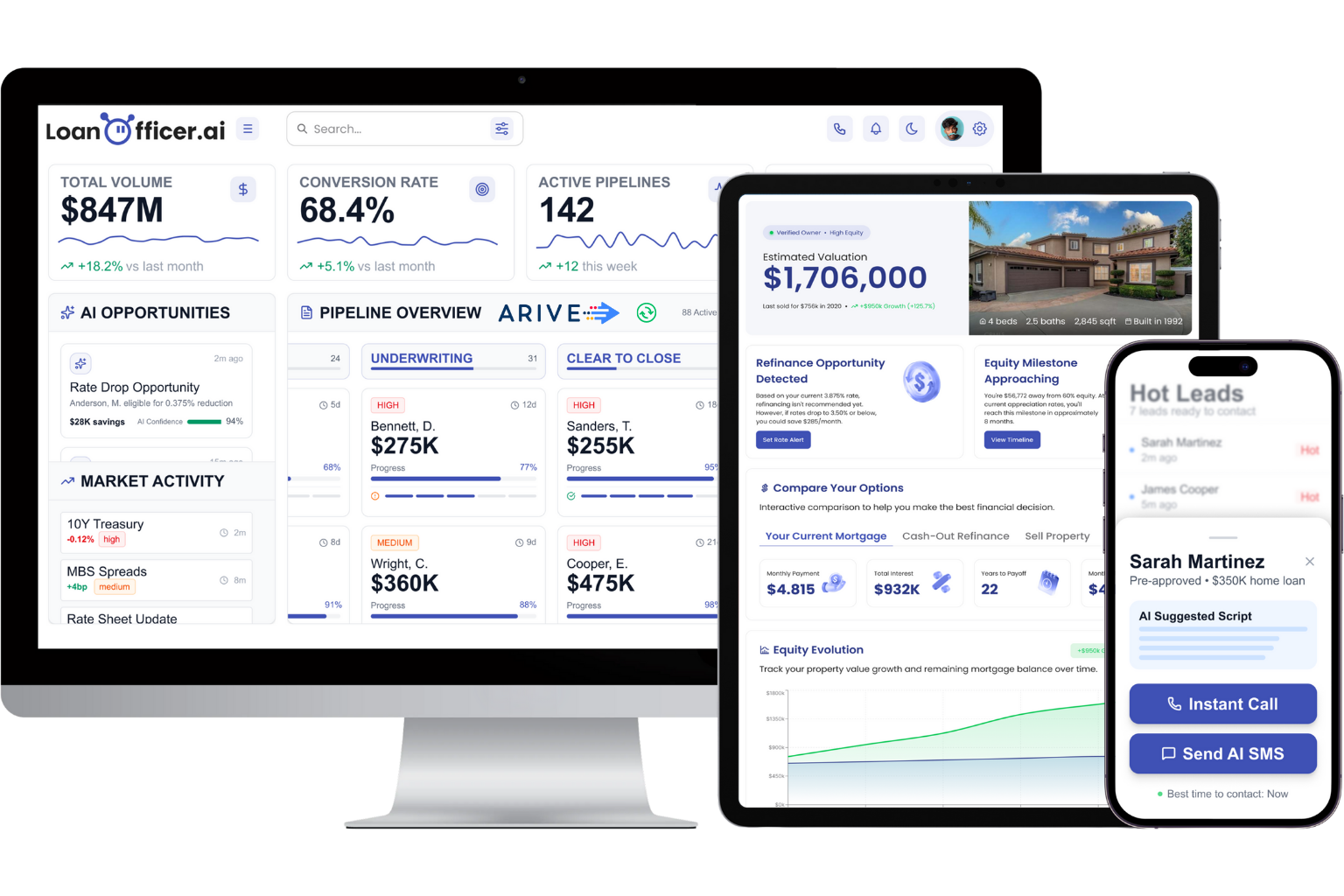
The platform centralizes partner engagement alongside pipeline management and opportunity detection, so the same system tracking referral partners can also surface refinance and equity opportunities in your existing book of business. Such a combination aims to support high partner retention by keeping reporting automatic and consistent.
Before choosing any CRM for this purpose, ask three questions: how does it record partner provenance at intake, can it generate a co-branded partner packet without manual assembly, and how does it reconcile credited referrals at closing. If the answers are vague, the reporting gap described throughout this piece will keep showing up in your partner relationships.
- Compare plans on the pricing page, which lists Starter, Team, Brokerage, and Enterprise tiers.
- Review the full feature set on the AI Mortgage CRM product page.
- Start a trial through the trial signup page to see partner reporting automation in your own pipeline.
FAQ
What does a referral partner do?
A referral partner, typically a real estate agent, builder, financial advisor, or past client, introduces potential borrowers to a loan officer in exchange for nothing more than a reliable, transparent relationship built on trust. Under RESPA, any compensation for that introduction must reflect actual services performed rather than payment for the referral itself, as outlined in RESPA Section 8.
What is the 3-7-3 rule for a mortgage?
The 3-7-3 rule refers to a historical Truth in Lending Act disclosure timeline tied to the now-discontinued Good Faith Estimate process rather than a current regulatory requirement for referral reporting. Current mortgage disclosure timing is governed by TILA-RESPA Integrated Disclosure rules, and loan officers should confirm specific timing requirements with compliance counsel or the CFPB’s RESPA FAQs rather than relying on the older rule of thumb.
How much does a mortgage broker make on a large loan?
Broker compensation varies by lender agreement, loan program, and state, and is not a fixed figure, so there is no single answer that applies to every transaction. Loan officers evaluating referral partner economics should calculate compensation using their own specific commission structure rather than an industry average, since no authoritative source publishes a universal rate.
Does RESPA prohibit referral fees?
Yes, RESPA Section 8 prohibits paying or accepting a fee, kickback, or anything of value in exchange for referrals of settlement service business on federally related mortgage loans. Marketing arrangements and co-branded materials remain lawful only when payment reflects real services performed at market value, not the referral itself, as clarified in the CFPB’s RESPA FAQs.
What should a monthly referral partner report include?
A monthly report works best as a single page showing leads received, qualified applications, funded loans, conversion rate, and total funded volume for that partner during the period. Adding a short narrative note, such as flagging a stalled file or a strong month, helps partners understand the numbers rather than just see them.
Sources
- § 1024.14 Prohibition against kickbacks and unearned fees. | Consumer Financial Protection Bureau
- CFPB compliance bulletin on RESPA compliance and marketing services agreements
- MBA white paper: Reforms needed to RESPA Section 8 to better serve consumers, mortgage market
