Gain Ten More Applications a Month With Click to Call Mortgage CRM
The winning configuration for mortgage teams is click-to-call paired with instant SMS and direct integration with your loan origination system, wired to route the right lead to the right originator in seconds. Teams running this setup see faster first contact and measurably higher lead-to-application conversion, because rate shoppers apply with whoever answers first. Loanofficer builds this exact stack into a single CRM, which makes it a natural starting point for teams that don’t want to duct-tape three vendors together.
TL;DR:
- Triggering a lead contact within 60 seconds significantly boosts the chances of qualifying, with some reports showing up to 21 times higher odds.
- A streamlined click-to-call system should include automatic call logging, parallel SMS, and LOS integration to maximize speed and data accuracy.
- During demos, verify vendors can initiate a call or text within 30 seconds of lead submission and ensure features like suppression rules and analytics are in place.
- Effective training emphasizes the importance of quick response times and routines like immediate follow-up texts and weekly call review sessions.
- Failure to foster a culture of prompt follow-up and proper feature use can lead to neglect of alerts, inaccurate reporting, and ineffective automation.
Table of Contents
- What Is Click-to-Call for Mortgage Loan Officers?
- Does Faster Response Actually Increase Mortgage Conversions?
- How Do You Score Click-to-Call Vendors During a Demo?
- Rolling Out Click-to-Call: A Practical Checklist and ROI Sketch
- What Compliance Rules Apply to Mortgage Click-to-Call Systems?
- How Do You Train Loan Officers to Use Click-to-Call Tools?
- What Goes Wrong When Mortgage Teams Deploy Click-to-Call?
- How Does Click-to-Call Change the Borrower’s Experience?
- Build Your Own Click-to-Call Stack or Buy a Packaged CRM?
- Sources
What Is Click-to-Call for Mortgage Loan Officers?
Click-to-call, in the CRM sense that matters here, means dialing a lead straight from their record, a smart-dialer queue, or a website widget, without punching digits into a phone. The originator sees the loan file, clicks once, and the system connects the call while logging everything automatically. This is different from a borrower clicking a “call us” link on a lender’s site to reach customer service. That’s a support function. This is a sales and speed-to-lead tool built for originators.
A functional click-to-call setup for mortgage work includes:
- A click-to-call button embedded in the lead record or pipeline view
- Smart dialer that queues leads and auto-dials the next one after a call ends
- Warm preview showing loan amount, credit tier, and property details before the call connects
- Mobile transfer so a call started on desktop can hand off to a cell phone
- Automatic call logging with duration, outcome, and notes tied to the loan file
- Parallel SMS touch that fires the moment a call goes unanswered
The workflow is simple: a lead comes in, the system alerts the originator, one click starts the call, and every action lands in the CRM without anyone typing a recap.
Does Faster Response Actually Increase Mortgage Conversions?
Yes, and the data on this is unusually consistent across the mortgage industry. Contacting a lead within five minutes makes that lead roughly 21 times more likely to qualify than waiting 30 minutes, a benchmark that traces back to the original Lead Response Management Study and gets cited constantly in mortgage lead-gen circles for good reason. Drop the window to under 60 seconds and the gains compound further, according to aggregated response-time research built on Velocify and ICE data.
The clearest real-world proof comes from a four-loan-officer brokerage that switched to a 90-second SMS response combined with a seven-day nurture sequence. Lead-to-application conversion rose from 18% to 31%, which on even a modest volume of leads translates into several additional closed loans a month, and real commission dollars nobody was capturing before.
| Metric | Slow response (30+ min) | Fast response (under 5 min) |
|---|---|---|
| Lead qualification odds | Baseline | Up to 21x higher |
| Conversion on 80 leads/month (case study) | 18% | 31% |
| Contact method | Single call attempt | Call + SMS + logged follow-up |
Pro Tip:Don’t just track “call attempted.” Track “conversation started.” A 90-second callback that hits voicemail isn’t a contact, and if your dashboard counts it as one, you’re grading yourself on the wrong curve.
Three numbers matter more than any others once you’re monitoring performance: time-to-first-dial, connected-call rate, and lead-to-application rate. Everything else is noise.
How Do You Score Click-to-Call Vendors During a Demo?
Not every “click-to-call” feature is built the same, and demos are where vendors hide the gaps. Score every platform against the same checklist so you’re comparing apples to apples instead of trusting a sales pitch.
- Sub-60-second trigger. Ask the vendor to show, live, how fast a new lead moves from form submission to an outbound call or text. If they can’t demo it in real time, assume it’s slower in production.
- Parallel SMS and call. The system should fire a text within seconds of an unanswered call, not wait for a human to remember.
- LOS writeback. Every call outcome should post back to your loan origination system automatically, not require manual entry.
- Human alert on reply. When a lead texts back or answers, a loan officer needs an immediate notification, not a queue they check hourly.
- Suppression rules. The system must stop outreach the moment a lead advances past a certain milestone, tied to pipeline status rather than a fixed time delay.
- AI voice agent or after-hours coverage (nice-to-have). Useful for catching leads that come in at 9 p.m.
- Skills-based routing (nice-to-have). Routes VA loans to VA specialists, jumbo to your top producer, and so on.
- Deep analytics and a mobile SDK (nice-to-have). Matters more for teams past five originators.
Beyond the feature list, ask three operational questions directly: What’s the SLA on handoff latency between lead capture and first dial? How granular is call logging, does it capture disposition codes or just “call made”? And is pricing per-seat, per-minute, or a hybrid, because per-minute models get expensive fast once volume climbs.
Rolling Out Click-to-Call: A Practical Checklist and ROI Sketch
Start small. Pick one lead source, wire click-to-call and instant SMS to it, and measure results for 30 days before expanding. A phased rollout looks like this: connect your LOS webhooks first (Encompass and Calyx both support events like loan.created and loan.milestone.updated), then configure suppression so active applicants stop getting sales texts, then turn on the smart dialer for new inbound leads only, then expand to the full pipeline once the numbers hold up.
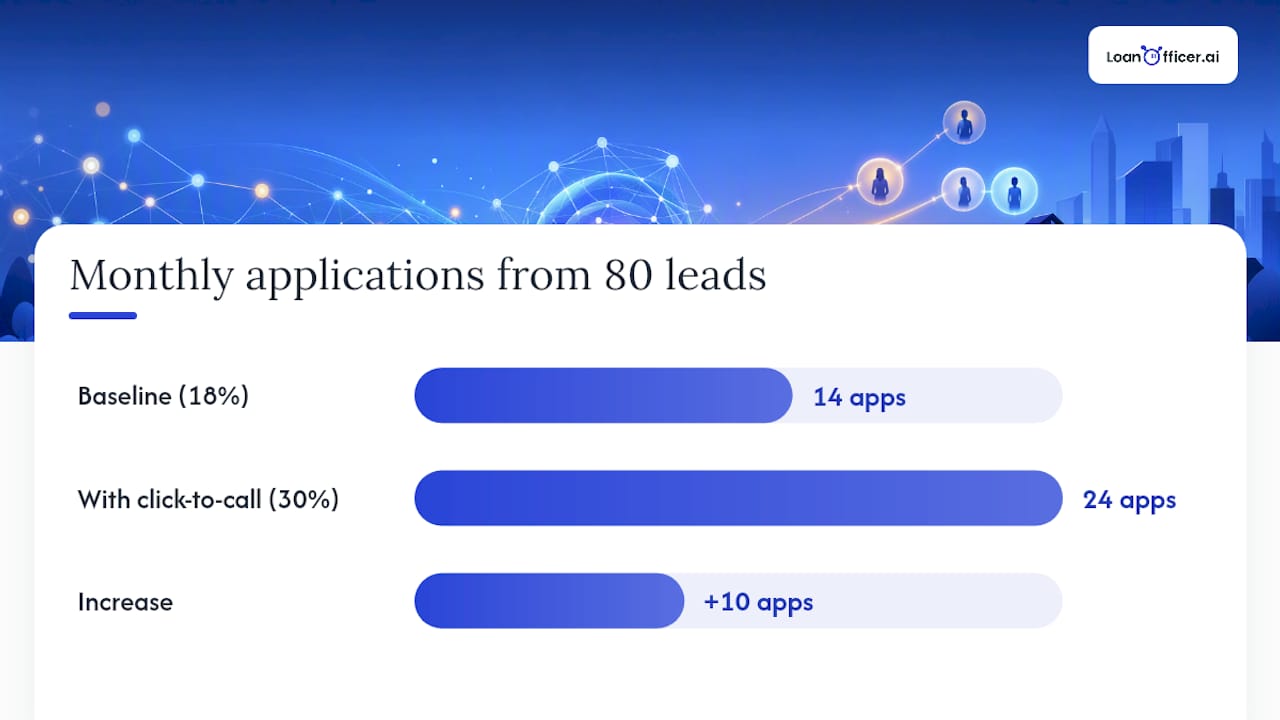
The ROI math is straightforward once you have a baseline. If your current lead-to-application rate sits around 18% on 80 leads a month, and instant response plus a structured nurture sequence pushes that toward 30%, you’re looking at roughly ten more applications a month from the same lead spend. At even a modest average commission per closed loan, that gap pays for a CRM subscription many times over within the first quarter.
A workflow-focused lead generation framework reinforces the same point from the service-business side: speed and structure convert better than volume alone. The mistake most teams make isn’t picking the wrong software, it’s rolling out every feature at once and having nobody trust the new alerts by week two. Sequence the rollout, and adoption follows.
What Compliance Rules Apply to Mortgage Click-to-Call Systems?
The Telephone Consumer Protection Act governs how you can call or text mortgage leads, and it’s not optional homework. TCPA requires prior express consent for automated calls and texts to cell phones, and that consent needs to be documented somewhere your CRM can produce on demand. A click-to-call system that fires SMS the instant a form is submitted needs a consent checkbox tied to that exact form, not a blanket assumption baked into your lead vendor’s terms.
Time-of-day restrictions matter too. Most states default to an 8 a.m. to 9 p.m. calling window based on the lead’s time zone, not yours, which trips up teams buying leads from other regions. Your dialer should enforce this automatically rather than relying on an originator to check a clock before every call.
If any part of your lead funnel touches European borrowers or you operate under GDPR-adjacent data rules, you also need clear opt-out mechanics and a defensible reason for storing call recordings and transcripts. Most US mortgage shops won’t hit this directly, but any CRM handling call logs and personal financial data should still treat consent and data retention as core features, not afterthoughts.
Suppression logic does double duty here. Wiring your outreach to stop the moment a lead advances in the LOS, rather than relying purely on time-based cooldowns, protects the borrower experience and functions as a genuine compliance safeguard against continuing to blast someone who already applied. Keep a written log of consent capture, opt-outs, and calling-hour enforcement. If a regulator or a plaintiff’s attorney ever asks, “prove it” is not a great answer to improvise in the moment.
How Do You Train Loan Officers to Use Click-to-Call Tools?
The tool is only as good as the habits around it. Most rollouts fail not because the software is weak but because originators keep working the way they always have, checking email once an hour instead of trusting the alert.
Start training with the “why,” not the “how.” Show your team the conversion math directly: a five-minute response window carries a dramatically higher qualification rate than waiting even half an hour. Once originators see that link between speed and their own commission, adoption gets a lot easier.
Then drill the actual click-to-call motion until it’s automatic. New leads should trigger a notification, a single click should start the call, and the originator should know the borrower’s loan details before saying hello. Run this as a live simulation in a team meeting, not a slide deck.
Set a team standard for what counts as a “real” contact attempt. If a call goes to voicemail, does the originator immediately send a follow-up text? Is there a script for that first 30 seconds when the borrower actually answers? Ambiguity here is where good tools die.
Finally, review call logs weekly as a group, not just individually. Compare who’s converting connected calls into applications and ask what they’re doing differently. The dialer and the CRM captured the data. Someone still has to read it out loud in a room and turn it into a coaching conversation.
What Goes Wrong When Mortgage Teams Deploy Click-to-Call?
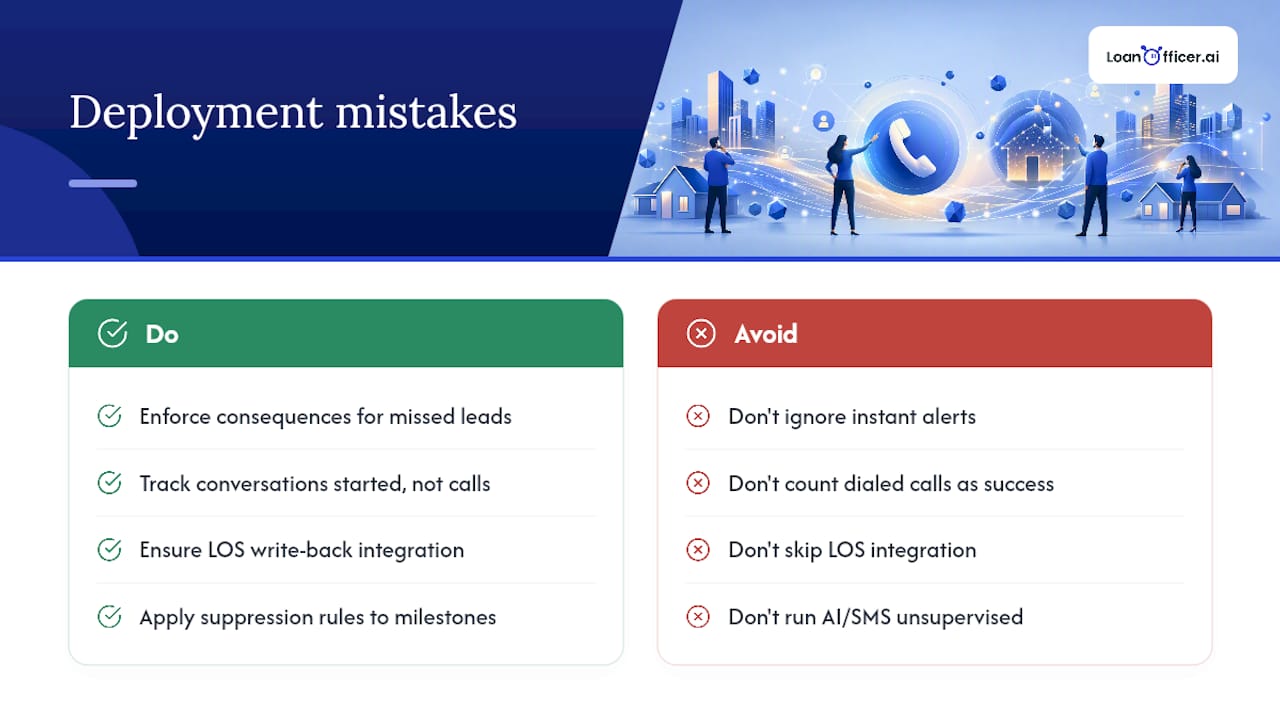
The most common failure isn’t technical, it’s behavioral: teams turn on instant alerts and then let them get ignored within two weeks because there’s no consequence for a missed lead. Speed-to-lead software doesn’t fix a culture problem. It just makes the problem visible faster.
A second recurring mistake is treating “call attempted” as success. If your dialer logs a call as completed the moment it dials out, regardless of whether anyone picked up, your dashboard will tell you response times are great while your actual conversion rate stays flat. Measure conversations started, not calls placed.
Integration gaps cause quieter damage. A click-to-call tool that doesn’t write back to your loan origination system creates two versions of the truth: what the dialer says happened and what the LOS says happened. Loan officers end up double-checking both, which defeats the entire purpose of automation.
Over-automation is the flip side. Teams that let AI voice agents or SMS sequences run unsupervised sometimes keep texting a borrower who already locked a rate elsewhere or already closed with a competitor, which damages the brand and occasionally invites a compliance complaint. Suppression rules tied to loan milestones exist specifically to prevent this, and skipping that step during setup is one of the most expensive shortcuts a team can take.
A smart dialer with skills-based routing sitting unconfigured is just an expensive phone. The fix is almost always simpler than the software: pick three features, use them fully, then expand.
How Does Click-to-Call Change the Borrower’s Experience?
Borrowers shopping for a mortgage are usually talking to three or four lenders at once, and whoever responds first tends to frame the entire conversation. A borrower who gets a call within a minute of submitting a rate quote request feels like a priority. A borrower who waits three hours has often already committed to someone else mentally, even if they haven’t signed anything.
Instant SMS running alongside the call attempt matters more than it seems on paper. A text that arrives while a borrower is still on the results page confirms the lead went through and someone is responding, which measurably increases the odds they answer when the phone actually rings a moment later. It’s a small psychological nudge, but it consistently improves connect rates.
The downstream effect shows up in engagement metrics beyond the first call: borrowers who get fast, logged, consistent follow-up tend to respond to document requests faster and ask fewer repetitive questions, because the originator already has context from every prior touch instead of asking the borrower to repeat their story. That consistency is hard to fake with sticky notes and a shared spreadsheet, and it’s exactly what a CRM built for loan officer teams is designed to standardize across an entire pipeline.
Build Your Own Click-to-Call Stack or Buy a Packaged CRM?
If you’re a solo originator or a two-person team with genuine engineering time on hand, a DIY Twilio-plus-webhook setup can work and costs less upfront. Once you’re managing five or more originators, multiple lead sources, and LOS suppression rules, the maintenance burden of a homegrown stack usually outweighs the savings. That’s the point where a packaged CRM earns its subscription.
Pro Tip:During any demo, ask the vendor to show a missed call turning into a text, then a reply turning into an alert on an originator’s phone, live. If they can’t do it in under 30 seconds, the handoff isn’t as tight as the pitch deck claims.
— Jared Hart
Sources
- Mortgage Speed to Lead Statistics 2026: The Benchmarks That Matter
- Mortgage Lead Response Time: Convert More Borrowers Faster
- Mortgage Leads Lost to Slow Follow-Up: Fix It in 2026
