Avoid FTC Risk: Compliant Mortgage Sales Leaderboards for Loan Officers

A mortgage sales leaderboard is an internal CRM dashboard that ranks loan officers or teams by validated originations, funded volume, conversion rate, and response time. It works only when the data behind it is accurate, access is role-based, and rankings feed coaching conversations rather than public comparison. Guidance from the FFIEC treats dashboards like this as risk tools that demand interpretability, and platforms like LoanOfficer.ai build these controls into the CRM itself.
TL;DR:
- Funded loan count and funded dollar volume are core metrics, but response time and pipeline velocity provide earlier indicators of an officer’s performance.
- Data sources such as the LOS, CRM, and lead vendors must be inventoried, reconciled weekly, and checked for duplicates to ensure leaderboard accuracy and compliance.
- Role-based access controls should restrict detailed rankings to authorized managers and log all data exports to maintain confidentiality and security.
- Using time-windowed views and drilldowns turns the leaderboard into a coaching tool, helping officers understand the reasons behind their rankings.
- Implementing a phased pilot with clear reconciliation and access procedures leads to a more reliable, interpretable, and compliant mortgage sales leaderboard.
Table of Contents
- Which metrics belong on a mortgage sales leaderboard
- Where leaderboard data comes from and how to validate it
- Setting access controls that keep leaderboards compliant
- Building leaderboards that coach instead of shame
- Implementation checklist: how to build and launch a compliant, accurate mortgage leaderboard
- Why interpretable, governed leaderboards win
- How LoanOfficer.ai supports compliant mortgage sales leaderboards
- Sources
- FAQ
Which metrics belong on a mortgage sales leaderboard
Start with numbers your loan officers can verify against their own pipeline, not numbers a manager has to explain. Each metric needs a clear numerator and denominator so nobody argues about how it was calculated.
- Funded loan count: closed and funded loans divided by total applications taken in the period, showing pull-through.
- Funded dollar volume: total principal funded in the window, useful for ranking by production size rather than deal count alone.
- Conversion rate: funded loans divided by qualified leads assigned, which separates strong closers from high-volume prospectors.
- Response time: median minutes from lead assignment to first contact, a leading indicator that predicts conversion before a loan ever funds.
- Pipeline velocity: average days from application to clear-to-close, which flags officers whose files stall in underwriting.
Secondary metrics like appointments set, pre-approvals issued, and referral partner activity belong on the board only when a team is early-stage or growth-focused, since they measure activity rather than results. If you combine metrics into a single composite score, publish the weighting formula next to the rank. An unexplained blended score invites distrust and hides which behavior actually drove the number.
Where leaderboard data comes from and how to validate it
A leaderboard is only as honest as its inputs, and mortgage teams pull from more systems than most CRMs admit. The loan origination system holds fund dates and loan status, the CRM holds activity and contact logs, lead vendors supply source and cost data, and consent or suppression flags determine what outreach can legally count.
- Inventory every data source feeding the board and assign an owner, a sensitivity level, and an update cadence to each.
- Reconcile CRM-logged events against LOS fund dates weekly, since manual entry drifts from system-of-record data fast.
- Run duplicate-detection checks on leads and borrowers so one file doesn’t inflate an officer’s count across two records.
- Flag stale or unsynced records automatically and exclude them from live rankings until refreshed.
- Keep internal leaderboard metrics separate from HMDA/Regulation C reporting unless the mapping between the two is explicitly governed and validated by compliance staff.
The FFIEC’s data analytics guidance calls for inventorying data sources and classifying them by risk before they feed any dashboard used for management decisions. Third-party writing on funnel tracking, such as Opptymizer’s piece on CRM integration, makes a similar point: reconciling marketing data with CRM records is what turns a vanity dashboard into a trustworthy one.
Pro Tip:Run your reconciliation report the same day payroll or commission statements go out, so any data conflict surfaces before it affects someone’s paycheck.

Setting access controls that keep leaderboards compliant
Role-based access control decides who sees whose numbers, and getting it wrong turns a coaching tool into a liability. Managers typically need team and individual views, while loan officers should see their own performance plus aggregated team benchmarks, not a colleague’s raw pipeline.
- Assign roles so exports and screen-sharing of leaderboard data are restricted to authorized managers and compliance staff.
- Log every export, print, or screenshot of ranked performance data with a timestamp and user ID.
- Filter suppressed, do-not-call, or unconsented leads out of activity metrics so the board never credits outreach that violates telemarketing rules.
- Mark each lead record with its consent status so response-time and conversion metrics only reflect contactable, compliant leads.
FFIEC’s security architecture guidance for its Central Data Repository describes authentication, authorization, and delegated administrator roles as the baseline for any system that grants tiered access to sensitive performance data, a model that translates directly to CRM dashboards.
Credit unions and banks should treat this as risk-based guidance rather than a checklist: document your access controls and reconciliation steps the way an examiner would expect to see them, especially since a 2024 FTC settlement shows regulators actively pursue lead generators whose data practices created downstream compliance exposure for the buyers of those leads.
Building leaderboards that coach instead of shame
A single overall rank tells an officer where they stand but nothing about why. Time-windowed views at 7, 30, and 90 days let a manager separate a slow week from a real trend, and drilldowns behind each rank turn the board into a coaching document instead of a scoreboard.
- Show the metrics behind every rank so an officer can see exactly which number moved their position.
- Exclude suppressed or unconsented leads from any reward calculation, crediting only qualified, contactable opportunities.
- Rotate the featured metric monthly (response time one month, conversion the next) so the board doesn’t just reward the same high-volume officers indefinitely.
- Add a private coaching tab visible only to the officer and their manager, separate from the public team view.
Pro Tip:Recognize team-level milestones alongside individual ranks. It keeps competitive officers engaged without turning the bottom of the board into a source of resentment.
Implementation checklist: how to build and launch a compliant, accurate mortgage leaderboard
Rolling out a leaderboard works better as a staged pilot than a company-wide flip of a switch.
- Define who sees what: a coaching view for managers and officers, and a separate executive summary for leadership.
- Assign a data owner for each source system (CRM, LOS, lead vendors) and document the update cadence for each.
- Build reconciliation rules that match CRM activity to LOS fund status before any number goes live on the board.
- Configure role-based access and turn on audit logging for exports and shared screens.
- Add consent and suppression filters so no metric rewards outreach to a suppressed or do-not-call contact.
- Pilot the board with one team for a full cycle, tracking both conversion lift and any compliance flags.
- Adjust weighting and metric selection based on pilot feedback, then extend to the rest of the organization.
Why interpretable, governed leaderboards win
The teams that get the most out of a leaderboard are rarely the ones with the flashiest dashboard. They’re the ones where a manager can point to a single number, explain exactly where it came from, and turn that into a specific coaching conversation instead of a vague ranking. That only works when the data underneath is validated and every officer can see the same math.
Leaderboards are management tools, not scoreboards, and the FFIEC’s framing of analytics as something that should prompt questions rather than replace review is worth holding onto. I write about mortgage CRM design at LoanOfficer.ai and see this pattern repeat across teams that adopt transparent metrics over opaque scores.
— Jared Hart
How LoanOfficer.ai supports compliant mortgage sales leaderboards
Most CRMs give you raw activity counts and leave the reconciliation, access controls, and consent tracking to you. LoanOfficer.ai builds those pieces into the platform, so the leaderboard reflects validated pipeline data rather than whatever got logged manually that week.
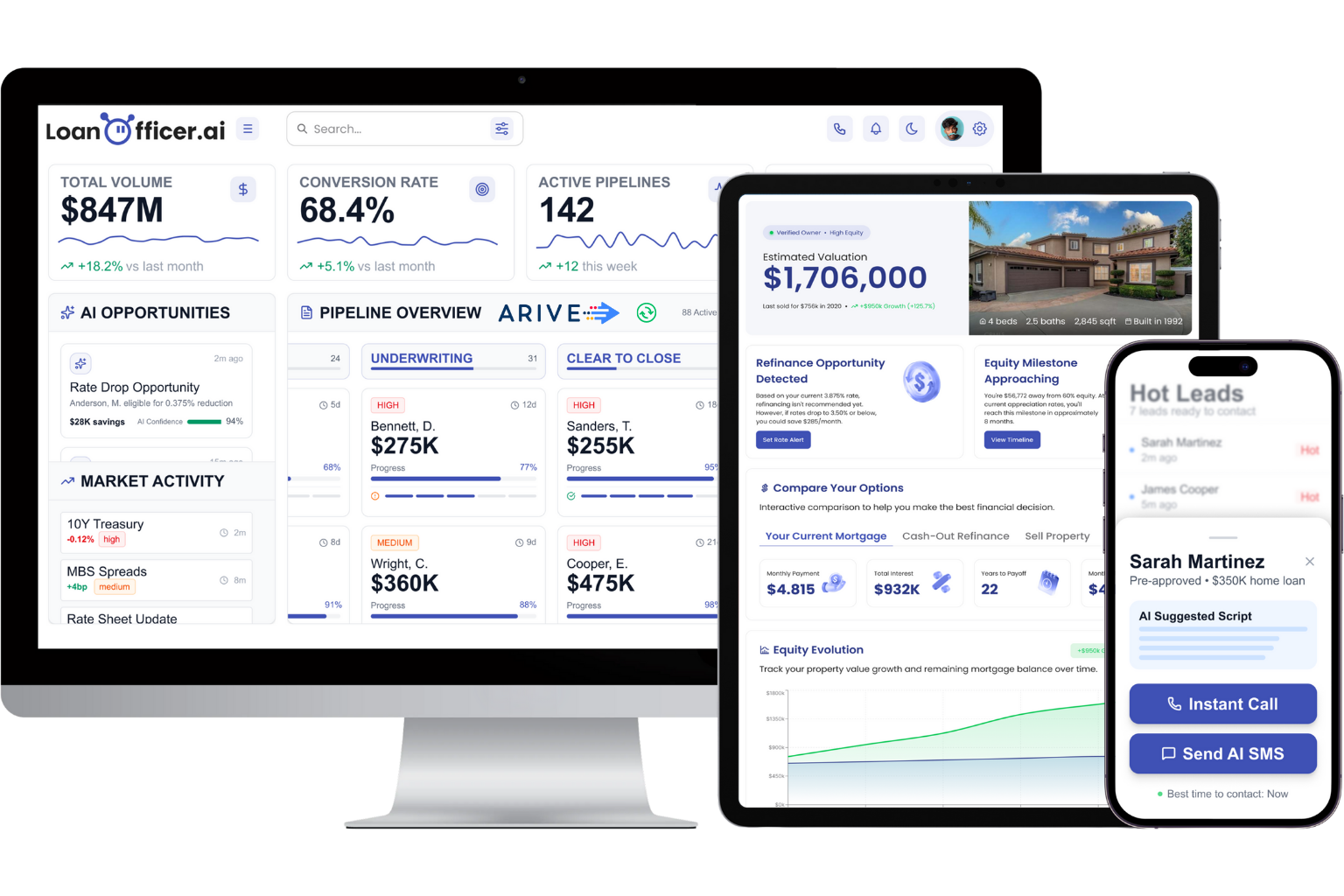
The platform centralizes AI-driven opportunity alerts, automated follow-up, and pipeline management so the metrics feeding a leaderboard come from the same system officers already work in daily, with role-based dashboards that give managers team views and loan officers their own performance data.
- Automated opportunity detection flags refinance and equity leads without manual data entry.
- Real-time LOS integration keeps funded volume and pipeline stage synced to the source of record.
- Role-based dashboards separate manager, team, and individual views out of the box.
- Automated follow-up sequences reduce response-time gaps that manual outreach tends to create.
The platform has been noted by mortgage teams for its ease of use and potential benefits. Plans start with Starter at $197 per month, with Team and Brokerage tiers available for larger teams; you can also start a trial to see how the CRM handles your own pipeline data before committing.
Sources
- FFIEC IT Examination Handbook InfoBase - III.A.4 Data Analytics
- Home Mortgage Disclosure Act (HMDA) | FFIEC
- California-based lead generator agrees to settlement banning it from making or assisting others in making telemarketing calls, including robocalls | Federal Trade Commission
- CDR security awareness training and RBAC description | FFIEC
FAQ
What metrics should a mortgage sales leaderboard track?
The core metrics are funded loan count, funded dollar volume, conversion rate, response time, and pipeline velocity, each defined with a clear numerator and denominator. Secondary activity metrics like appointments or pre-approvals can supplement these for newer officers, but they shouldn’t replace results-based numbers.
Should loan officers see each other’s individual rankings?
That depends on your access control setup: managers typically need full team visibility, while loan officers should see their own detailed data plus aggregated team benchmarks. Role-based access limits exports and detailed drilldowns to authorized managers, which reduces both privacy concerns and internal friction.
How is an internal leaderboard different from HMDA reporting?
An internal CRM leaderboard tracks operational performance metrics like conversion and response time, while HMDA reporting under Regulation C follows its own separate regulatory requirements. The two should stay distinct unless a team builds and validates a governed mapping between them.
Can a leaderboard reward outreach to any lead in the CRM?
No, leaderboards should exclude suppressed, do-not-call, or unconsented leads from any credited outreach metric. A 2024 FTC settlement against a lead generator shows why tracking consent status before crediting activity matters for legal exposure.
How often should leaderboard data refresh?
Most mortgage teams update leaderboards daily or in near real time, syncing CRM activity against LOS fund status to keep rankings accurate. Less frequent syncing risks showing stale numbers that no longer match an officer’s actual pipeline status.
