Cut More Than a Week From Mortgage Pipeline Velocity for Loan Officers

Pipeline velocity is how fast a loan moves from application to closing and how many files a team can move through that path without stalling. The single fastest way to raise it is making sure every application arrives with complete, accurate data so automated underwriting and your loan origination system can process it without manual rework. Regulatory rules still set a floor: once the Closing Disclosure goes out, the borrower must wait at least three business days before closing, so the real opportunity to gain speed lives before that document is issued.
TL;DR:
- Most delays are caused by incomplete data, underwriting exceptions, appraisal scheduling issues, or last-minute title coordination, which can often be fixed without new software.
- Implementing digital intake forms, automated underwriting, and pipeline automation can significantly reduce cycle times, especially if integrated with existing loan origination systems.
- Consistent measurement of application-to-close times and process stage durations helps identify bottlenecks and monitor improvement efforts effectively.
- Running a small, focused pilot that enforces mandatory data fields and automates early validation can improve velocity before scaling up team-wide changes.
- Loan officer platforms like LoanOfficer.ai support pipeline visibility and automated follow-up, enabling teams to catch stalled files early and track improvements over time.
Table of Contents
- Benchmarks: what application-to-close looks like now
- The recurring choke points that most loan teams can fix
- Practical tech and process levers that move the needle
- KPI dashboard: what to measure and how often
- 30/60/90-day sprint checklist to increase pipeline velocity
- A practitioner’s view on what actually moves the needle
- How LoanOfficer.ai fits into a velocity pilot
- Sources
- FAQ
Benchmarks: what application-to-close looks like now
The broker channel gives a useful baseline for judging your own pipeline. In the first quarter of 2025, average application-to-closing time in the broker wholesale and non-delegated correspondent channels ran 33.8 days, with the fastest 20% of lenders closing in 30.6 days or less and the slowest 20% taking 36.0 days or more.

The fastest and slowest lenders differ by roughly a week in cycle time, according to MBA’s Q1 2025 turn-time data. That gap usually comes down to how early and how completely a file gets built, not the loan program itself.
A few things shape how that clock behaves:
- The broker-channel clock generally starts once six data points arrive: name, income, Social Security number, property address, estimated value, and loan amount.
- Comparing your own numbers to industry averages only works if you’re measuring from the same starting point every time.
- Volume swings cause cycle times to stretch even when nothing else changes, since a sudden spike can clog processing and underwriting queues industry-wide.
The recurring choke points that most loan teams can fix
Most delays trace back to a small set of repeat offenders, and nearly all of them are fixable without new software.
- Incomplete or inconsistent Form 1003 data creates mismatches that stall Desktop Underwriter validation and send files back for correction.
- Underwriting exceptions move a stuck file forward today but often generate compliance questions and rework later in the file.
- Appraisal and valuation delays pile up when scheduling depends on a single vendor with no backup option.
- Title and closing coordination gaps surface late, when a missing document or fee discrepancy forces a scramble right before disclosure.
Pushing files through on exceptions feels productive in the moment, but it usually just moves the delay downstream instead of removing it.
Pro Tip:Run every file through automated underwriting validation before it ever reaches a human underwriter, not after.
Practical tech and process levers that move the needle
Speed comes from removing friction at the front of the pipeline, not from rushing the back end.
- Digital intake and validation that captures the six core data points up front and flags gaps before submission.
- LOS and automated underwriting integration, since clean inputs reduce the mismatches that trigger DU validation failures.
- Automated income and asset verification paired with e-document collection to cut the back-and-forth over paperwork.
- Digital valuation options that shorten appraisal turn times when the loan and property qualify.
- Pipeline automation that flags missing items and nudges the right person before a file goes idle.
On the process side, a few changes matter as much as any tool:
- Set clear service-level agreements between intake, processing, and underwriting, such as a two-business-day cap from complete file to submission.
- Standardize data entry so every loan officer captures the same fields the same way.
- Limit exceptions to genuine edge cases rather than a routine workaround for incomplete files.
A mortgage CRM with pipeline management features can automate much of the triage work, surfacing which files are stalled and why before they become a bottleneck.
Pro Tip:Treat DU validation as an early filter, not a final checkpoint. Resolve mismatches before the file leaves processing.
KPI dashboard: what to measure and how often
You can’t improve what you don’t track consistently, and the definitions matter as much as the numbers themselves.
- Application-to-close time, measured from the moment all six required data points arrive to the closing date.
- Time-in-stage, tracking how long a file sits in each phase: intake, processing, underwriting, and closing.
- Days-to-clear-for-underwriting, the gap between a complete file and formal submission.
- Pull-through rate, the share of applications that actually reach closing.
- Abandonment rate, tracking where and why files drop out of the pipeline.
Broker-channel benchmarks only compare fairly when everyone starts the clock at the same point, using MBA’s six-data-point definition. Review these numbers weekly at the team level and monthly at the leadership level, with one owner accountable for each metric.
30/60/90-day sprint checklist to increase pipeline velocity
Turning these ideas into practice works best as a staged sprint rather than an all-at-once overhaul.
- Days 1 to 30: Fix intake forms so all six core data points are mandatory before a file moves forward, publish a standard document checklist, and train front-end staff on both.
- Days 31 to 60: Connect automated underwriting and asset verification tools to the workflow, and set formal SLAs between processing and underwriting.
- Days 61 to 90: Formalize an appraisal vendor strategy with backup options, deploy pipeline automation for file triage, stand up a KPI dashboard, and measure results against your baseline.
Watch for two red flags along the way: teams that quietly skip compliance steps to hit a speed target, and teams that lean on manual exceptions as a permanent fix rather than a rare tool. Both trade a short-term win for a longer-term problem, and neither shows up as a real velocity gain once you measure pull-through and rework rates honestly.
A practitioner’s view on what actually moves the needle
The fixes that work aren’t glamorous. Tightening intake and enforcing SLAs beats chasing new software every quarter. One team I’ve seen cut cycle time by more than a week simply by making six data fields mandatory at intake and running automated underwriting checks before a file ever reached a human underwriter. Measure the result, and don’t mistake a busier pipeline for a faster one.
— Jared Hart
How LoanOfficer.ai fits into a velocity pilot
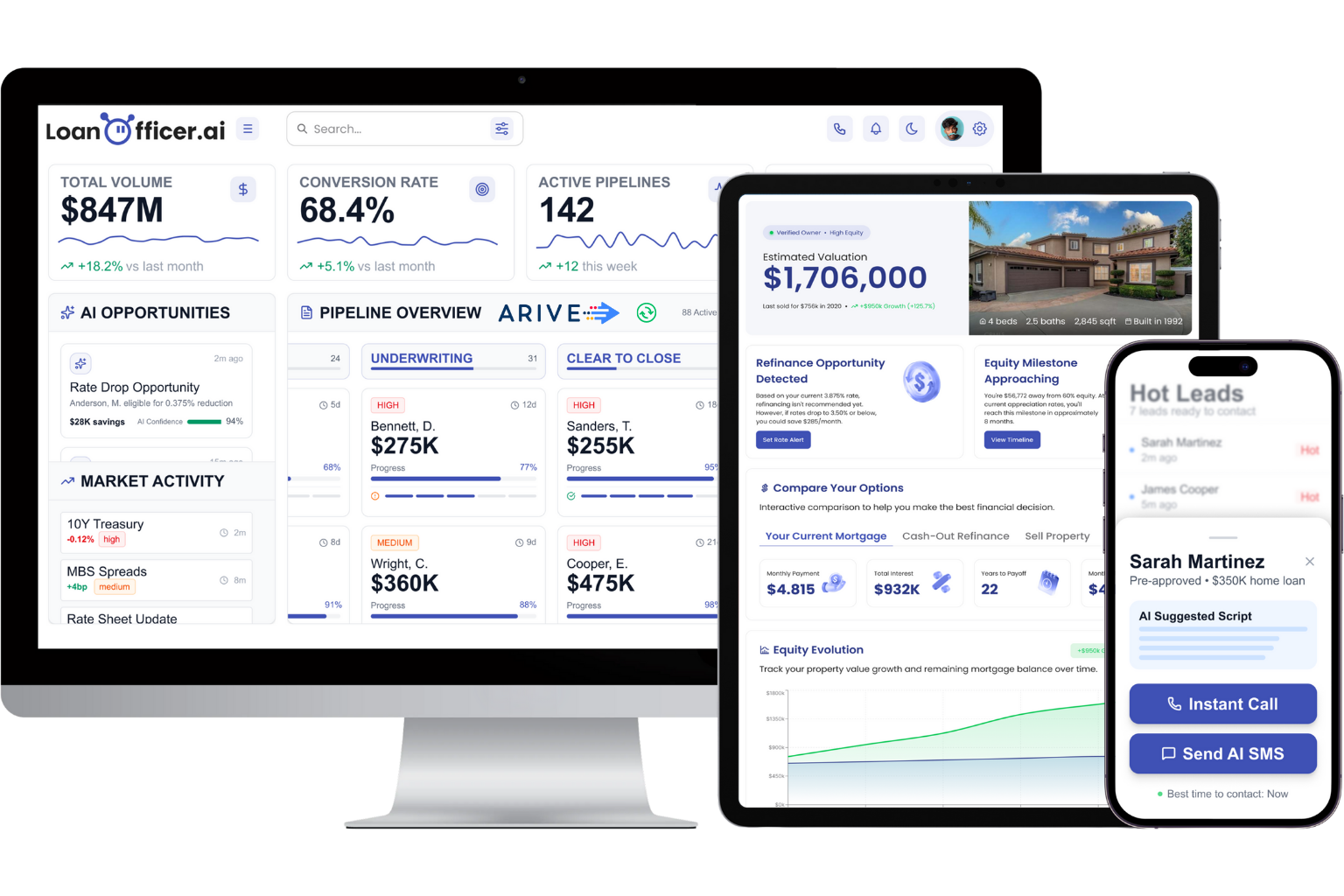
Most of the fixes above require someone to actually watch the pipeline and flag what’s stuck, which is where automation earns its place. The platform offers pipeline management, automated borrower follow-up, and real-time property and equity signals in one system instead of several disconnected tools.
For teams ready to test these levers, a pilot is the lowest-risk way to start:
- Run a small team pilot for one origination cycle, tracking application-to-close and time-in-stage against your current baseline.
- Use automated follow-up and pipeline management tools to catch stalled files before they cost you a week.
- Review the results, then decide whether to expand the pilot to the rest of the team.
Plans start with Starter at $197 per month, with Team and Brokerage tiers available as your pilot grows. Check current pricing and start a trial to see how the platform handles your own pipeline data.
Sources
- Chart of the Week: Average Turn Times for Broker Wholesale & Non-Delegated Correspondent Production Channels - MBA Newslink
- What documents should I receive before closing on a mortgage loan? | Consumer Financial Protection Bureau
- Desktop Underwriter validation service — Fannie Mae
FAQ
What is a mortgage pipeline?
A mortgage pipeline is the full set of loan files a broker or loan officer is currently moving through the process, from application through closing. Tracking it lets a team see where files are stuck and how many are likely to close in a given period.
What does pipeline velocity mean in mortgage lending?
Pipeline velocity refers to how quickly loans move from application to closing and how efficiently a team processes its full pipeline. Broker-channel data from MBA shows average cycle times of 33.8 days, with faster lenders closing in 30.6 days or less.
How can loan officers speed up their pipeline without cutting corners?
The most reliable approach is tightening front-end data collection so automated underwriting can run cleanly the first time, rather than skipping regulatory steps. Regulatory timelines like the three-day Closing Disclosure waiting period can’t be shortened, so the gains have to come from the stages before disclosure.
Does automated underwriting actually reduce delays?
Automated underwriting reduces delays mainly by catching data mismatches early, before a file reaches a human underwriter. Fannie Mae’s guidance notes that DU validation is sensitive to input accuracy, so clean intake data is what makes the automation effective.
What tools help manage pipeline efficiency for small mortgage teams?
Small teams typically benefit most from a CRM that automates follow-up and flags stalled files, paired with an LOS that integrates with automated underwriting. LoanOfficer.ai’s pipeline management features are built for this exact use case, combining automation with real-time file tracking.
