Recover Two More Closings: AI Mortgage Sales Roadmap for Loan Officers
Yes, AI genuinely increases a loan officer’s capacity when it works as an assistant, not a replacement. It automates lead response, follow-up, and pipeline mining, which frees hours for the calls that actually close deals. More than 300 mortgage professionals surveyed expect AI to drive most industry change over the next few years, while a large number of people still hold loan officer jobs today. The catch: human judgment still has to sign off on pricing and eligibility calls. Start with the use cases below to see where the payoff is fastest.
TL;DR:
- AI tools are most effective when automating repetitive tasks like lead triage, follow-up, and rate alerts, which yield quick, measurable improvements.
- Human review remains essential for pricing decisions, requiring clear checkpoints and fair-lending testing to avoid compliance risks.
- Starting with low-risk automation such as lead response and database mining can generate significant ROI before expanding into more complex functions.
- Proper integration with your loan origination system and setting specific success criteria are critical to ensure AI tools deliver real pipeline improvements.
- Reallocating saved hours into relationship-building activities maximizes AI’s value, emphasizing human involvement in pricing and client communication.
Table of Contents
- Where AI Mortgage Sales Tools Actually Move the Needle
- What Kind of Sales Lift Should You Actually Expect?
- The Compliance Line AI Mortgage Sales Tools Can’t Cross
- How to Roll Out AI Without Blowing Up Your Workflow
- How a Mortgage-Specific CRM Puts This Playbook Into Practice
- Three Things to Do This Week, Not Someday
- Try a Mortgage-Specific CRM Built Around This Exact Playbook
- Sources
Where AI Mortgage Sales Tools Actually Move the Needle
The mortgage professionals surveyed in that 2026 industry poll aren’t using AI to replace originators. They’re using it for research, marketing copy, and untangling investor guidelines, tasks that eat hours without ever touching a borrower relationship. That’s the pattern worth copying: point AI at the repetitive, low-judgment work first, and keep the borrower conversation in human hands.
Here’s where that split plays out in practice, ranked roughly by how fast each one pays off
Instant lead response with triage logic. A lead that sits untouched for even 10 minutes is dramatically less likely to convert than one contacted immediately. AI-driven mortgage lead generation tools now handle the first touch automatically, sorting a lead by loan type, credit signal, and urgency before routing it to the right originator or nurture sequence. The loan officer never sees a cold lead sitting in an inbox overnight.
AI sales assistants for follow-up and appointment qualification. Most originators lose deals not because they said the wrong thing, but because they said nothing for three weeks. Automated multi-channel campaigns, text, email, and voice, keep a prospect warm across the full decision window, and they can qualify intent before booking a slot on a human calendar. This is one of the more mature corners of artificial intelligence mortgage solutions right now, because the logic (if no response in 48 hours, try channel two) is simple enough for AI to execute without much risk of getting it wrong.
Rate-watch and refinance opportunity alerts. This is where database mining earns its keep. An AI system that watches a loan officer’s entire past-client book against live rate movement and home equity data can flag, the moment a refinance or HELOC opportunity opens up, who to call first. Homeowners are already doing their own version of this research; one industry note found that roughly a third of homebuyers now use AI tools to research their mortgage options before ever calling an originator. The loan officer who gets there first, with a specific number instead of a generic “rates dropped” email, wins that conversation and benefits from tailored mortgage planning for luxury buyers to protect legacy assets Mortgage planning for luxury buyers: Protecting legacy.
Document ingestion and condition triage. Pulling pay stubs, bank statements, and tax transcripts into a loan origination system (LOS) used to be an hour of manual data entry per file. AI-driven document processing can now read, classify, and flag missing conditions automatically, and industry reporting on agentic AI shows this is one of the categories seeing the steepest reduction in manual review time. That’s hours back per file, multiplied across a pipeline.
AI-assisted content for client communications and marketing. Drafting a rate update, a listing-agent co-marketing email, or a “why now” refinance explainer takes real time when written from scratch every time. AI tools for mortgage brokers can generate a first draft in seconds, leaving the loan officer to edit for tone and accuracy rather than start from a blank page.
A few things to keep straight about this list:
- Lead response and follow-up automation offer the fastest, lowest-risk return because they don’t touch pricing or eligibility.
- Document triage saves the most raw hours per file but requires tight LOS integration to avoid data errors.
- Rate-watch alerts convert existing relationships, which is cheaper than buying new leads.
- Content generation needs a human editor every time; treat AI drafts as a starting point, never a final send.
The order matters less than the discipline of starting with tasks that don’t require a license to perform. That’s the difference between automated mortgage sales that scale safely and automation that creates a compliance headache six months in.
What Kind of Sales Lift Should You Actually Expect?
Vendor case studies report big numbers, but the honest answer is: it depends heavily on your starting point, and you should measure your own baseline before trusting anyone else’s.
Pro Tip:Before you adopt anything, spend two weeks logging your current lead response time and follow-up cadence by hand. Without that baseline, you’ll have no way to know if a new tool actually improved anything or if your pipeline just had a good month.
The most-cited real-world figure comes from NEO Home Loans, which reported loans funded per loan officer grew as much as 91% within six months of adopting Better’s Tinman® AI platform. That’s a striking number, but it’s one partner’s reported result under a specific rollout, not a guaranteed outcome for every shop that flips a switch. Treat it as a ceiling to aim toward, not a floor to expect on day one.
By the numbers: A majority of mortgage professionals surveyed expect AI and automation to be the biggest driver of industry change in the coming years, yet current usage is concentrated in research and marketing tasks rather than core sales execution, according to the National Mortgage News survey. That gap between expectation and current use is exactly where the sales opportunity sits for loan officers willing to move first.
What should you actually track? Skip the vanity metrics and watch these:
- Lead response time — minutes from lead capture to first human or AI contact.
- Contact-to-application conversion rate — the percentage of engaged leads who actually start a file.
- Time-to-close — days from application to funding, before and after automation.
- Loans per originator per month — the production metric that ties directly to cost-to-originate.
- Refi/HELOC capture rate — how many flagged database opportunities actually convert to a new loan.
A rough ROI sketch: if automated follow-up recovers even two extra closings a month for an originator earning an average commission per loan, that’s real monthly revenue against a CRM subscription cost that’s a fraction of one commission check. The math works even at modest lift, which is why the vendor case studies, however dramatic, aren’t actually the point. The point is whether your own baseline numbers move.
The Compliance Line AI Mortgage Sales Tools Can’t Cross
AI can draft, sort, and flag. It cannot make a licensed pricing decision, and treating it like it can is where things go wrong fast.
The risk isn’t hypothetical. An automated system that learns from historical approval data can quietly bake in steering or disparate-impact patterns from that history, even when nobody intended it to discriminate. The Mortgage Bankers Association’s white paper on AI risk is blunt about this: any AI tool that performs originator-like tasks, quoting rates, recommending products, qualifying borrowers, needs the same fair-lending testing and documentation a human process would get. Skipping that step because “it’s just a chatbot” is how a lender ends up explaining a pattern to a regulator later.
A workable governance approach doesn’t need to be complicated. It needs three things:
- Classify every AI use by risk. A tool that drafts a marketing email is low risk. A tool that suggests a rate or a loan product to a specific borrower is high risk and needs human sign-off every time.
- Vet the vendor’s data and testing practices before rollout, not after a complaint. Ask directly how the model was trained and what fair-lending testing it has undergone.
- Set a testing cadence. Quarterly review of AI-driven recommendations against actual outcomes catches drift before it becomes a pattern.
The MBA’s guidance is direct on one more point worth repeating: require human checkpoints before any change to pricing or final product recommendations. A pilot that skips this step will look like it’s working right up until it produces a false positive that costs you a complaint or worse.
On the communication side, keep it simple: never let an AI-generated message promise a rate, term, or approval that hasn’t been verified by a licensed human. One line covers it: “This is a preliminary estimate, your actual rate depends on a full application review.” That sentence, sent every time an AI tool touches pricing language, is cheap insurance.
How to Roll Out AI Without Blowing Up Your Workflow
Don’t buy a platform and hope it fixes your pipeline. Audit first, pilot small, and expand only what’s proven.
- Audit your workflow for repetitive, high-frequency tasks. Track a week of your own activity. Anything you do the same way more than five times a day, initial lead texts, condition follow-ups, rate update emails, is a candidate for automation.
- Pilot the lowest-risk automations first. Lead triage, follow-up sequences, and rate-watch alerts don’t touch pricing decisions, which makes them the safest place to learn what a tool actually does before trusting it with anything sensitive.
- Integrate with your LOS and set human checkpoints. Any automation that touches loan conditions or product recommendations needs a defined point where a human reviews before it moves forward, not after.
- Plan staffing shifts, not just software. Processors and document-heavy roles face the highest near-term displacement, and industry analysis on AI’s effect on loan officer roles points toward retraining those staff as exception handlers and AI output auditors rather than assuming the roles simply disappear.
- Evaluate vendors against a short checklist before signing anything. Does it integrate natively with your LOS? Does it show its work on fair-lending testing? Can you set a pilot with a 60 or 90-day off-ramp if it underperforms?
Pro Tip:Define your pilot’s success criteria in writing before you start, not after you see the results. “20% faster lead response time” is a testable target. “Better efficiency” is not, and it’s how vendors end up grading their own homework.
Mapping out where documents flow between your LOS and your CRM is worth doing on paper before any mortgage workflow automation tool goes live. It’s tedious for an afternoon, and it saves weeks of untangling a broken handoff later.
How a Mortgage-Specific CRM Puts This Playbook Into Practice
Most of the playbook above assumes some kind of connective layer, one system that watches your pipeline, flags opportunities, and handles follow-up without you manually triggering each step. That’s the specific job a mortgage-focused AI CRM is built to do, and it’s worth knowing what to check before trusting one with your book of business.
A platform in this category typically automates:
- Follow-up sequencing across email, text, and calls based on where a lead sits in the funnel.
- Database mining that cross-references your closed-client list against live rate and equity data to surface refinance and HELOC candidates automatically.
- LOS synchronization so document status and condition updates sync without manual re-entry.
Before committing to any provider, including a dedicated AI follow-up feature, validate three things in a trial: does it actually integrate with your specific LOS, does the opportunity-alert logic surface leads you’d have otherwise missed, and does the human checkpoint sit exactly where you need it before anything touches pricing. Ask for a live demo using your own past-client data rather than a canned sample set. That’s the only way to know if the “opportunity detected” alert means something real for your pipeline.
Three Things to Do This Week, Not Someday
The mistake I see loan officers make isn’t skepticism about AI. It’s treating adoption as an all-or-nothing decision that requires a quarter of planning before touching anything. It doesn’t. Three moves, done in the next week, cover most of the real upside.
First, automate your first-response and follow-up sequences. This is the lowest-risk, highest-return move on the entire list, and most originators are still doing it manually or, worse, inconsistently.
Second, draw a hard line around pricing and approval conversations. AI drafts, humans decide, always. That line isn’t bureaucratic caution. It’s what keeps a good tool from becoming a fair-lending liability.
Third, and this is the part most guidance skips: reinvest the hours you save into actual relationship work, not more screen time. Industry analysis on borrower relationships makes the case plainly: the originators who win aren’t the ones who automate the most, they’re the ones who use the time automation buys them to have more real conversations with referral partners and past clients. AI that saves you three hours a day and gets spent on more inbox management wins nothing.
— Jared Hart
Try a Mortgage-Specific CRM Built Around This Exact Playbook
A mortgage-specific CRM is built around the workflow this article just walked through, not a generic sales CRM retrofitted with a chatbot. Such a CRM handles automated lead response, follow-up sequencing, and database mining for refinance and HELOC opportunities in one system, with real-time equity and rate data doing the flagging instead of you manually checking a spreadsheet.
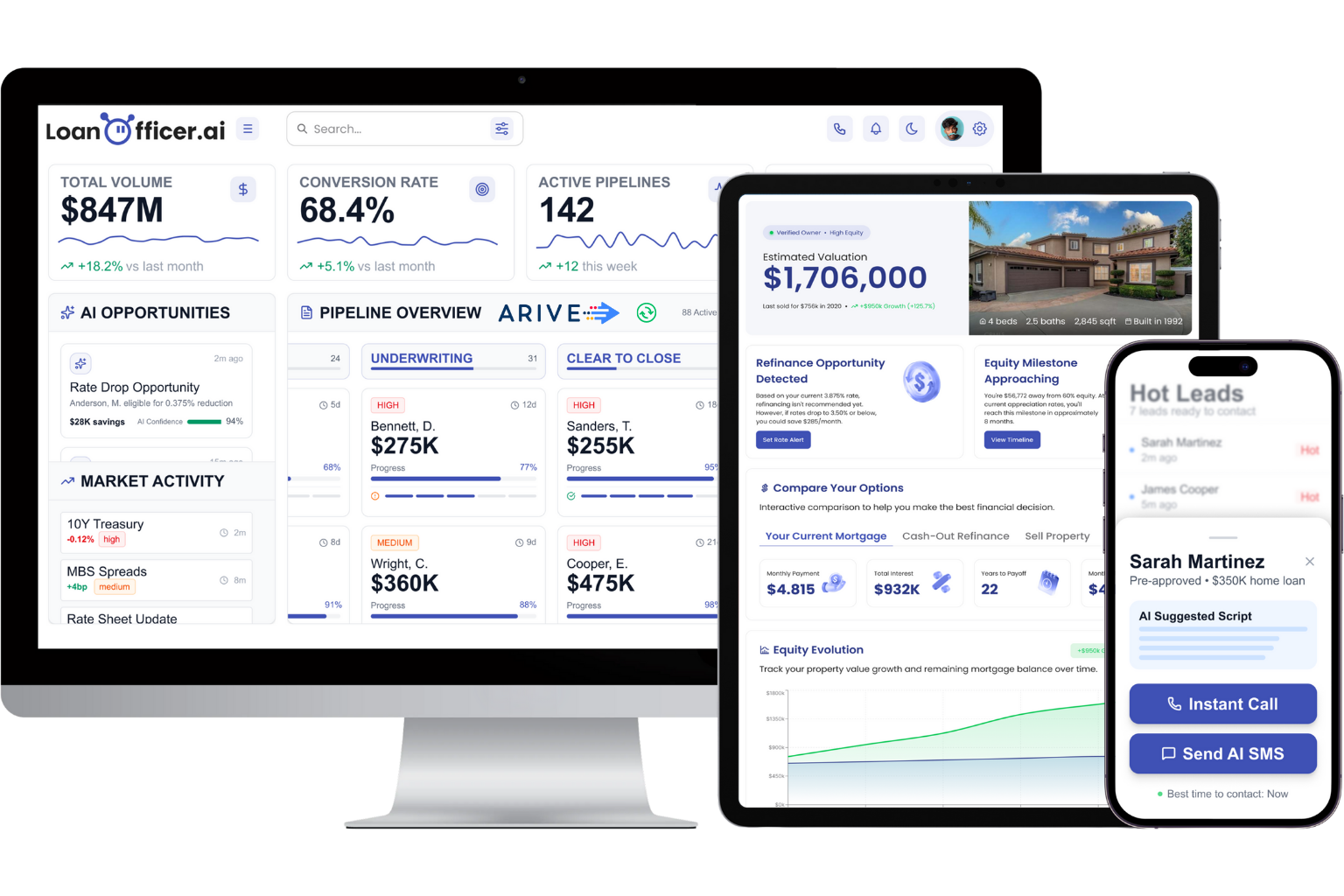
In a trial, focus on the same things this article told you to validate anywhere else: does the LOS sync actually work with your setup, does the opportunity-alert logic surface leads worth calling, and does the human checkpoint sit where you need it before anything touches pricing. Loan Officer AI reports 93% partner retention among the mortgage professionals already running this way. If the roadmap above made sense, the fastest way to test it against your own pipeline is to start a trial on the Loan Officer AI mortgage CRM and run your own numbers for 30 days before deciding anything.
Sources
- Survey: AI handles docs, LOs should own the relationship | National Mortgage News
- Policy: AI in the mortgage industry — Mortgage Bankers Association (MBA)
- Better marks one-year partnership with NEO Home Loans — Business Wire
