Hot Leads in a Day: Database First Equity Mining for Mortgage Teams
Equity mining is the CRM-driven process that turns your existing loan database and property feeds into refinance, HELOC, and cross-sell opportunities. That single query typically surfaces your first batch of qualified leads within a day, not weeks.
TL;DR:
- Most brokers already have access to the five core data inputs needed for equity mining but lack the systems to connect and score them effectively.
- Maintaining accurate and up-to-date property, lien, and credit data requires regular profiling, automated data pipelines, and validation to avoid dead-end leads.
- The most predictive equity triggers include loan-to-value ratios, vintage, lien status, property value gaps, and ownership length, which should be modeled with weighted scores.
- Outreach effectiveness depends on channel choice and timing, with personalized emails and fast follow-up calls for hot leads, while warm prospects benefit from multi-channel nurturing.
- Weekly monitoring of contact, lead-to-application, and closure rates, along with continuous data refreshes, are essential to determine program success and avoid stale or irrelevant leads.
Table of Contents
- What Is an Equity Mining Mortgage Strategy, Exactly?
- How Do You Get Your Mortgage Data Clean Enough to Trust?
- Which Equity Triggers Actually Predict a Refinance or HELOC Lead?
- What’s the Right Outreach Sequence for Equity Leads?
- How Do You Know if Your Equity Mining Program Is Actually Working?
- Running Your First Full Equity Mining Campaign Start to Finish
- What Software Actually Runs This Without a Full-Time Analyst?
- How Often Should You Refresh Your Loan Database for Mining?
- What Do You Say When a Borrower Pushes Back?
- Practitioner Quick Wins: What To Run This Week
- Put the Whole Workflow on Autopilot With Loan Officer AI
- Sources
What Is an Equity Mining Mortgage Strategy, Exactly?
Equity mining works because most loan officers are sitting on a goldmine they’ve never dug into. Every closed loan in your CRM carries a property address, an original loan amount, and a closing date. Cross that against current property values and you know, instantly, who has enough equity to refinance, open a HELOC, or qualify for a cash-out deal.
The workflow runs on five inputs: your CRM contact records, LOS loan fields, automated valuation model (AVM) data, lien records, and credit vintage. None of these are exotic. Most brokers already have access to all five. What’s missing is the connective tissue that links them together and scores the result.
The process itself breaks into four repeatable steps:
- Consolidate — pull loan and property data into one clean, queryable structure
- Score — rank every record by refinance or HELOC likelihood using equity, rate spread, and vintage
- Engage — run targeted outreach campaigns matched to each borrower’s opportunity type
- Measure — track contact rates, application rates, and close rates to refine the model
Run this correctly and you should expect three categories of leads: rate-and-term refinance candidates sitting on old high-rate loans, HELOC prospects with substantial untapped equity, and cross-sell opportunities like a second property purchase or a co-borrower who needs their own mortgage. Servicers have already figured out this math. Industry reporting shows servicers are prioritizing equity products specifically to retain customers they originated years ago, which means every day you wait, someone else is mining your old clients first.
How Do You Get Your Mortgage Data Clean Enough to Trust?
Bad data produces bad leads, and bad leads waste your team’s time on calls that go nowhere. Before you score a single record, you need to know how dirty your database actually is.
Start with profiling. Pull null rates on every field you plan to use for scoring: current property value, original loan amount, loan vintage, occupancy type. This mirrors what TCS’s white paper on data-driven decision-making in mortgage identifies as the core obstacle: siloed, unprofiled data that never gets turned into anything actionable.
Follow this sequence for a clean pipeline:
- Profile first. Check null rates and duplicate borrower entries before writing a single transformation rule.
- Build composite canonical IDs. Combine loan number, origination date, and a masked SSN or date of birth to catch duplicate borrower records that slipped in under slightly different names or addresses.
- Separate PII handling from business logic. Keep Social Security numbers and dates of birth in a locked-down layer, and run your scoring logic against masked or tokenized fields instead.
- Set up ETL or change-data-capture (CDC) pipelines so new LOS closings and updated AVM values flow in automatically instead of requiring a manual export every quarter.
- Log every transformation so you can prove, months later, exactly how a lead score was calculated. This matters for GLBA and FCRA audit trails as much as it matters for your own quality control.
Your integration priorities, in order: your LOS system, an AVM or MLS feed for current values, county recorder or title data for lien positions, a dedicated lien feed if you’re not getting one from title, and credit vintage data to flag stale versus fresh files.
Pro Tip:Profile your data for unique-value distributions and null rates before you write a single scoring rule. Skipping this step is the single most common reason equity mining programs produce lists full of dead ends.
Which Equity Triggers Actually Predict a Refinance or HELOC Lead?
Five triggers do most of the work: loan-to-value ratio, mortgage vintage, absence of a second lien, the gap between AVM value and last appraised value, and length of ownership.
Turn those triggers into a weighted score instead of a checklist. A workable starting model looks like this:
- Equity percentage — the heaviest weight, since it determines whether a deal is even feasible
- Rate spread — the gap between the borrower’s current rate and today’s market rate
- Credit vintage — how recently their credit was pulled, since a fresh pull means faster approval
- Property type — owner-occupied primary residences typically outperform investment properties for HELOC conversion
- Refinance propensity — a modeled likelihood score based on past borrower behavior and market timing
Sort the output into three buckets. Hot leads have high equity, a wide rate spread, and recent AVM confirmation. Call them within 48 hours. Warm leads have solid equity but a smaller rate incentive; put them into a nurture sequence. Cold leads have thin equity or stale data; hold them for a quarterly re-score rather than burning an outreach touch on a long shot.
Data enrichment platforms already package mortgage age, equity estimates, and lien data into ready-made segmentation fields, which gives you a shortcut if you’re not building this from scratch. Layer in live pricing scenarios, similar to what Optimal Blue’s Capture platform does by connecting portfolio monitoring to a pricing engine, and you can set score thresholds dynamically instead of on a fixed quarterly schedule. When market rates drop half a point, your hot bucket should refill automatically, not wait for your next manual pull.
What’s the Right Outreach Sequence for Equity Leads?
Channel choice depends on urgency and trust level. Email wins for warm nurture sequences where you’re building credibility over time. SMS wins for hot leads who need a fast, low-friction way to respond. Phone calls close deals once someone has engaged. Direct mail still works surprisingly well for older borrowers who trust a physical letter more than a text from an unknown number.
A tight three-touch cadence for hot leads:
- Day 1: Personalized email stating their estimated available equity and a sample monthly savings figure if they refinanced today.
- Day 3: SMS follow-up with a short, direct question, something like asking if they saw the rate estimate you sent.
- Day 7: Phone call referencing the specific numbers already sent, not a cold generic script.
For warm leads, stretch that into six touches over three weeks, alternating email and SMS, and add a fourth channel, a mailed rate comparison, around touch five. The extra time and channel variety matters here because warm leads haven’t shown urgency yet.
Every message needs two numbers to feel credible: their estimated available equity and either a projected monthly savings figure (for refinance) or an available credit line estimate (for HELOC). Generic “rates just dropped” messaging gets ignored. “You may have $85,000 in accessible equity based on current values” gets opened.
Run every new template as an A/B test against your existing script, split evenly, and track three numbers weekly: open or contact rate, lead-to-application rate, and application-to-close rate. If a variant doesn’t beat your baseline by a meaningful margin within two weeks, kill it and try something else. Sound campaign structure and testing discipline borrow heavily from standard lead nurturing frameworks used across marketing, not just mortgage.
Pro Tip:Never lead with a generic “check your rate” message. Lead with the specific dollar figure. Specificity is what separates a response from a spam-folder deletion.
How Do You Know if Your Equity Mining Program Is Actually Working?
Four numbers tell you almost everything: contactable rate (how many leads you can actually reach), lead-to-application rate, application-to-close rate, and overall campaign return on investment. Track these weekly, not monthly, so you can catch a broken script or a bad data pull before it wastes a full outreach cycle.
Before you trust any score, validate it against reality:
- Spot-check a sample of AVM-estimated values against actual recent appraisals to catch systemic overvaluation
- Run a lien search on your hottest leads before making an offer, since an undisclosed second lien kills a deal fast
- Manually review a handful of scored records each month to recalibrate weights as market conditions shift
Track source and cohort separately so you know whether gains came from the mining program itself or from a market-wide rate drop that would have generated calls anyway. If a campaign’s application-to-close rate stays above your baseline for two consecutive cycles, scale the budget and expand the lead volume. If contactable rate drops below a workable threshold, pause and re-profile your data before spending another dollar on outreach.
Running Your First Full Equity Mining Campaign Start to Finish
Here’s what week one through four actually looks like in practice. This isn’t theoretical. It’s the sequence that turns a database sitting idle into a working pipeline.
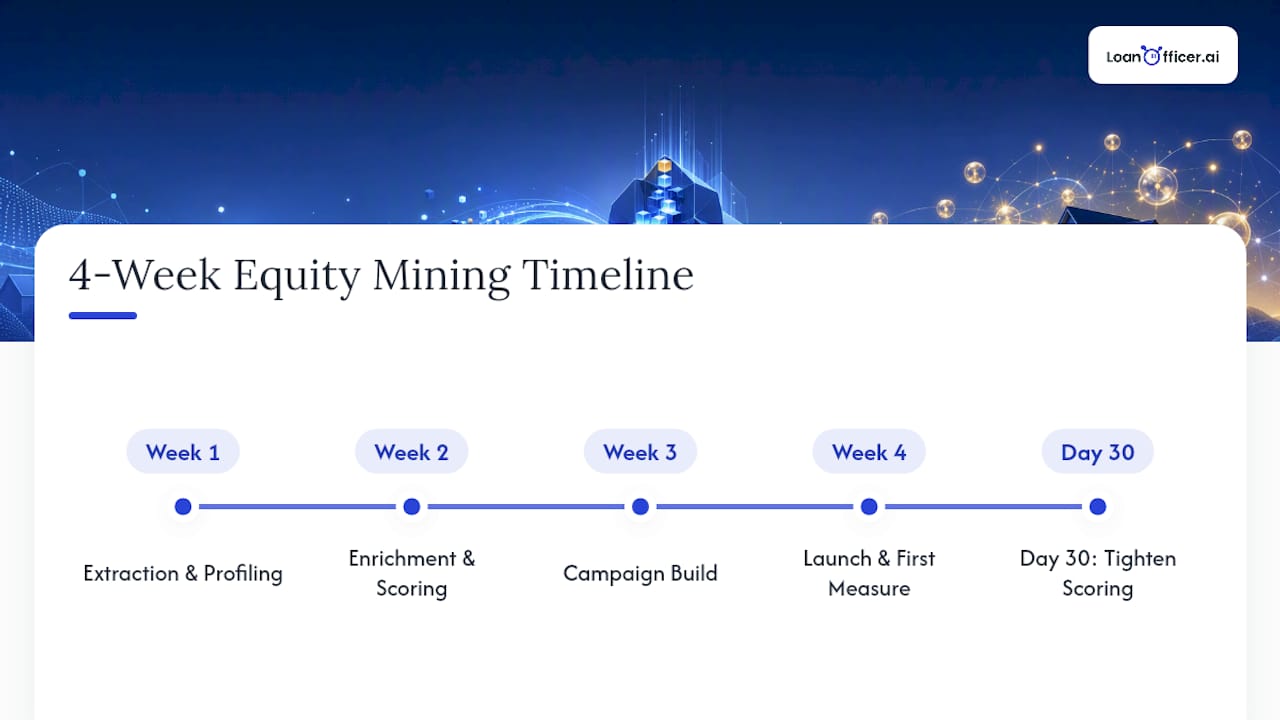
Week 1: Extraction and profiling. Pull every closed loan from your LOS along with current CRM contact data. Run your null-rate and duplicate checks immediately. Do not skip this step to save time. A dirty extraction poisons everything downstream.
Week 2: Enrichment and scoring. Match your loan file against an AVM feed for current property values. Layer in lien data and credit vintage where available. Run your weighted scoring model and sort results into hot, warm, and cold buckets.
Week 3: Campaign build. Write your three-touch and six-touch sequences. Pull the specific equity and savings figures for each hot-bucket borrower into your email and SMS templates. Load your dialer list for phone follow-up on anyone who engages.
Week 4: Launch and first measurement. Send touch one to your hot bucket. Track contact and response rates daily for the first week. Adjust messaging on anything underperforming before it reaches your warm bucket.
By day 30, you should have enough application data to know whether your scoring thresholds were too loose, too tight, or roughly right. Most teams find their first pass overestimates hot-bucket conversion by a wide margin, then tighten the LTV and vintage thresholds for round two. That correction is normal, not a sign the model failed.
What Software Actually Runs This Without a Full-Time Analyst?
You don’t need a data science team to run equity mining. You need three categories of tooling working together: a CRM that can score and segment your database, an AVM feed for property values, and a campaign automation layer that handles multi-channel outreach without you manually sending every text.
Spreadsheet-based mining works for a team of one broker with under 500 loans in their book. Past that volume, manual scoring becomes the bottleneck, not the data itself. A platform like Loan Officer AI’s mortgage CRM is built specifically to close that gap, combining opportunity detection, AVM-linked equity scoring, and automated campaign sequencing in one system instead of stitching together a spreadsheet, an email tool, and a separate dialer.
Whatever you choose, confirm it handles three things well: real-time property value updates so scores don’t go stale, LOS integration so new closings feed the pipeline automatically, and compliant multi-channel outreach that respects opt-outs and Telephone Consumer Protection Act requirements without you tracking it by hand. A tool that does equity scoring but requires manual campaign builds every time still leaves you doing the labor-intensive half of the job yourself.
How Often Should You Refresh Your Loan Database for Mining?
Stale data is the fastest way to burn goodwill with a past client. Calling someone about a refinance opportunity that expired six months ago makes your firm look sloppy, not helpful.
Refresh AVM values monthly at minimum, weekly if you’re running an active hot-bucket campaign, since property values and rate spreads shift fast enough to change a borrower’s status. Re-pull credit vintage quarterly for your warm and cold buckets, since a borrower’s credit profile can improve enough in six months to move them into a better rate tier. Run your duplicate and null-rate checks every time you do a bulk import, not just once a year, because a messy LOS export can quietly reintroduce the same duplicate-borrower problem you fixed months earlier.
Set up change-data-capture feeds wherever your LOS supports it, so new closings and updated fields flow into your scoring model without a manual export. This is the same governance discipline TCS recommends for mortgage data pipelines, and it’s the difference between a program that degrades over six months and one that keeps producing fresh leads on autopilot.
What Do You Say When a Borrower Pushes Back?
Objections during equity mining outreach follow predictable patterns, and most of them come from one root cause: the borrower doesn’t yet trust that your numbers are real.
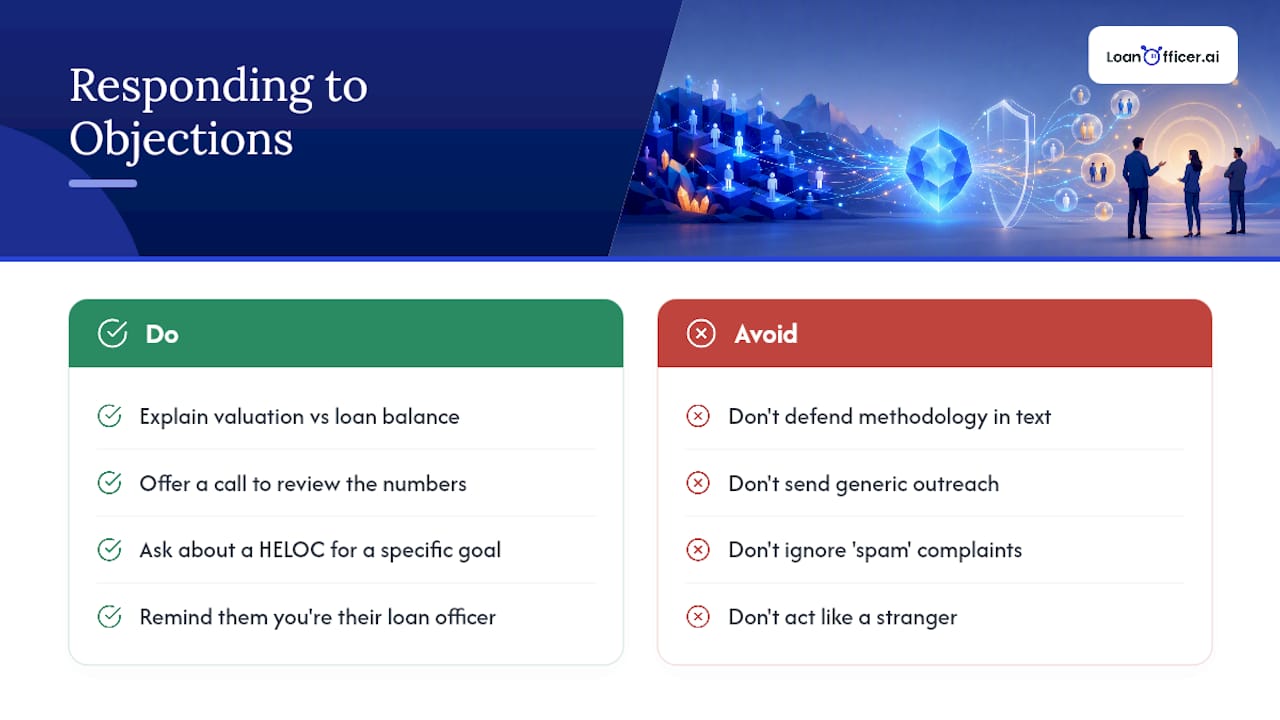
“How do you know how much equity I have?” Answer honestly. Explain you’re using current property value estimates compared against their existing loan balance, and offer to walk through the specific numbers on a call rather than defending the methodology in a text thread.
“I’m not interested in refinancing right now.” Acknowledge it and ask if a HELOC for a specific goal, home improvement, debt consolidation, a large purchase, would be worth a five-minute conversation instead. Refinance rejection doesn’t mean equity-access rejection.
“Why are you contacting me? I already have a mortgage.” Remind them you’re their original loan officer or that you’ve worked with people in their situation before. This is where a database-first program actually helps you, because you’re not a stranger, you’re following up on an existing relationship.
“This feels like spam.” Take this seriously. If you’re getting this response often, your messaging isn’t specific enough. Generic equity mining outreach reads as spam. Outreach with an actual dollar figure and a name attached reads as service.
Practitioner Quick Wins: What To Run This Week
Three moves produce results fast. First, run the LTV-plus-vintage query described earlier and get a hot-bucket list within a day. Second, set up an automated opportunity alert so new equity milestones surface without a manual monthly pull, something Optimal Blue’s continuous monitoring approach validates as an industry pattern. Third, launch a targeted three-touch HELOC campaign against your top 50 hot leads before doing anything more elaborate.
Loan Officer AI was built around exactly this workflow. Its opportunity detection and equity monitoring capabilities have already surfaced HELOC opportunities for teams running this playbook, and the platform reports 93% partner retention among the brokers and teams using it. That retention number matters here specifically because it reflects loan officers who kept using the tool after seeing what a properly mined database produces.
— Jared Hart
Put the Whole Workflow on Autopilot With Loan Officer AI
Everything in this playbook, the LTV-and-vintage scoring, the AVM integration, the multi-touch campaigns, the opportunity alerts, is exactly what Loan Officer AI’s mortgage CRM was built to run without you managing five disconnected tools. Instead of exporting spreadsheets, manually scoring leads, and copy-pasting messages into a dialer, you get one system that detects the opportunity, scores it, and launches the outreach sequence automatically.
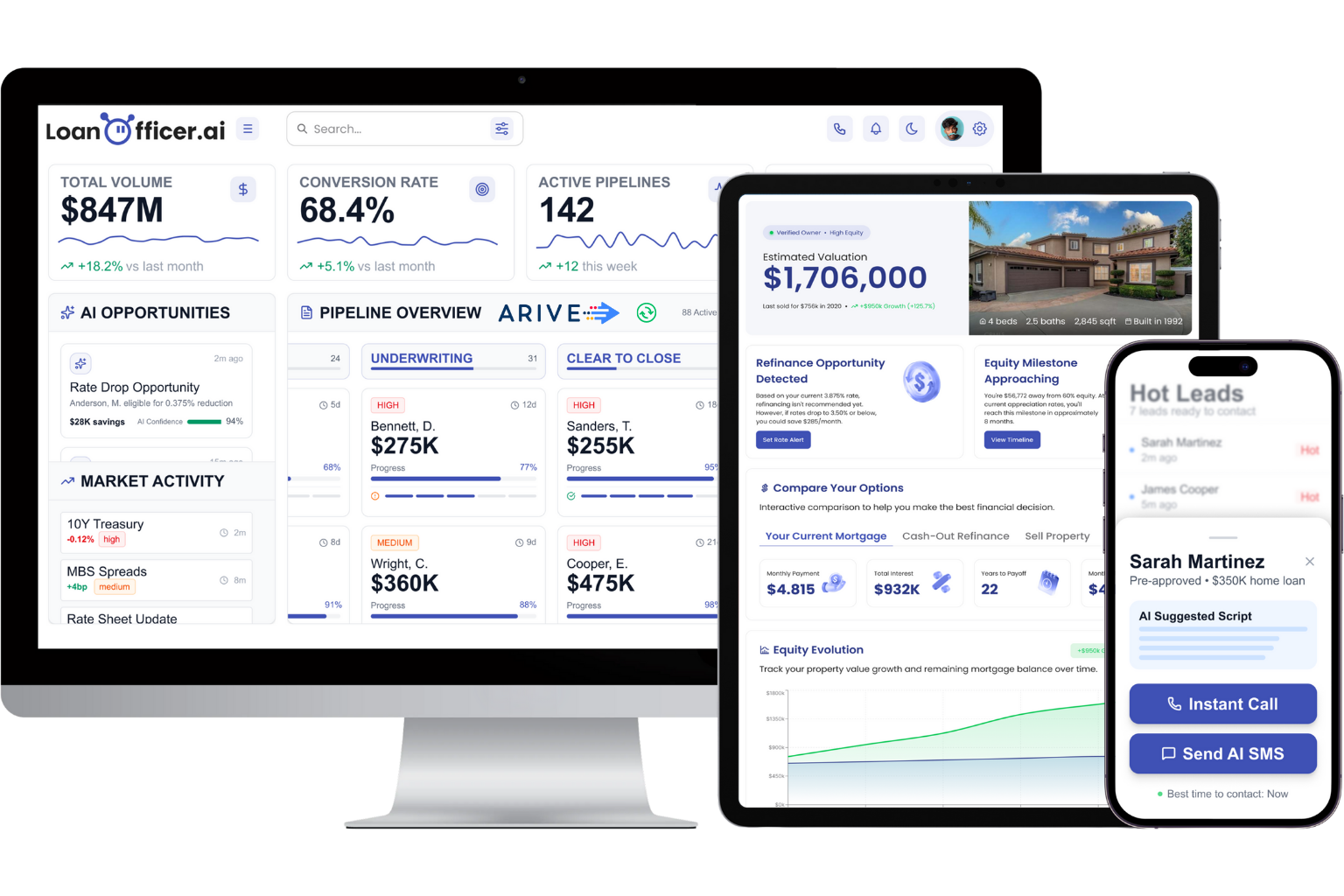
The platform connects to your LOS, pulls in AVM data for real-time equity scoring, and runs the automated campaigns this article walks through, all inside the same pipeline view where you already manage your active loans. Brokerages running multiple loan officers get team-wide visibility into which leads are hot right now, not which leads were hot last quarter. If you’re an independent loan officer working this alone, the platform built for solo producers handles the scoring and sequencing so you’re not the bottleneck in your own pipeline.
Start a trial and run your first LTV-plus-vintage query against your own database this week. You’ll know within days whether your book is sitting on refinance and HELOC opportunities you haven’t touched yet.
Sources
- Equity is the new battleground, and servicers are ready to steal your past clients | Mortgage Professional
- Data-driven decision-making in the mortgage business | TCS white paper
- CAPTURE℠ Lead Analytics Platform | Optimal Blue Leads | Optimal Blue
