Realtor Follow-Up Ideas for Loan Officers That Get Replies

The best way to follow up with a Realtor is to make their next deal easier: answer fast, keep their client informed, and send something they can use. Don’t send “just checking in.” This guide is for loan officers and brokers. It covers what to say after a first coffee, how often to reach out, which updates agents want, and how to keep it personal when you have 40 agents in your phone.
TL;DR
- Follow up within a day of meeting an agent, and put one useful thing in every message: a rate update, a program change, or an answer to a question they asked.
- Ask permission for the cadence. Agents who don’t answer should hear from you less, not more.
- Once a shared client is in motion, update everyone on a fixed day each week so nobody has to chase you.
- Pair agent outreach with your own database. Past clients and equity-rich borrowers are the leads you can hand back to agents.
- Automate the reminders and the first draft, never the relationship.
Table of Contents
- Why most Realtor follow-up fails
- What to say after you meet a Realtor
- How often to follow up with a Realtor
- Updates agents actually want to receive
- Follow-up after a Realtor sends you a borrower
- Use your database to give agents something back
- Keep it personal while you automate
- The follow-up routine for a week
- Where we come in
- Our perspective on follow-up
- FAQ
- Start following up without the busywork
- Sources
Why most Realtor follow-up fails
Agents get pitched constantly. A loan officer who sends a generic “let me know if you need anything” email joins a long line of people asking for business and offering nothing. Inman has written about the habits that frustrate agents, including a stream of unsolicited calls, emails, texts, market commentaries and social messages. Its advice is to ask permission and to stop the weekly or monthly solicitation when an agent doesn’t respond.
That gives you a simple filter for every idea below. Does it help the agent serve a client or win a listing? Does it respect their time? If yes, send it. If it only reminds them that you exist, skip it.
Follow-up with agents also splits into two jobs that need different rhythms:
- Relationship follow-up: before there is a deal. Slow, light, value-led.
- Transaction follow-up: once you share a borrower. Fast, predictable, specific.
Most loan officers are good at one and poor at the other. The sections below cover both.
What to say after you meet a Realtor
The first follow-up is where most relationships stall. You had a good conversation, then a week passed. Send the message the same day or the next morning, and make it about something you heard, not about you.
The same-day note
Keep it to three or four lines. Reference one detail from the conversation, promise one thing, and deliver it.
Hi Dana, good meeting you at the broker open today. You mentioned most of your buyers are first-timers who stall on down payment questions. I’ll send you a one-page rundown of low-down-payment options I walk those buyers through. You’ll have it by 5 today.
Then send it by 5. Keeping a small promise fast tells an agent more about how you’ll handle their client than any pitch.
The “how did you choose” question
If you met an agent cold and don’t know what they want, borrow a pressure-free approach. Embrace Home Loans’ listing agent playbook describes a “How Did You Choose?” challenge: instead of pitching, you ask how the agent met their current lender. It turns a sales call into a story, and you learn what they value (speed, communication, a friend’s referral) before you say anything about yourself.
A text version might read:
Quick question, no pitch: how did you end up working with your current lender? Trying to learn what agents actually value so I don’t waste anyone’s time.
Some agents will ignore it. The ones who answer have handed you your positioning.
The follow-up after an introduction
When a mutual contact introduces you, reply to the introducer first, then write to the agent. Mention the person who connected you in the first line, say what you do for their clients in one sentence, and propose one low-effort next step, such as a 15-minute call or a rate and program update for their buyers. Do not ask for referrals in the first message.

How often to follow up with a Realtor
There is no magic number, but there is a clear principle: frequency should follow the agent’s response, not your calendar.
A workable rhythm for a new agent contact looks like this:
| Touchpoint | Timing | Channel | Content |
|---|---|---|---|
| First follow-up | Same day or next morning | Text or email | The thing you promised |
| Second touch | 3 to 5 days later | One resource tied to their buyers or listings | |
| Third touch | About 2 weeks later | Call or voicemail | Short check-in, ask how they prefer to hear from you |
| Ongoing | Monthly or less | Email or text | Rate and program update, or a market snapshot |
The third touch matters most. Ask outright: “Would you rather I send a short update once a month, or only when something changes?” Agents appreciate being asked, and you now have permission, which is the thing Inman says lenders skip.
If an agent never responds to two or three touches, move them to a quarterly note. Chasing them harder makes you the lender they dread.
Updates agents actually want to receive
The easiest way to follow up without sounding needy is to send information an agent can forward to a client. Ideas that work:
- Rate alerts. A short note when rates move enough to change a buyer’s payment. Agents use them to nudge hesitant buyers.
- Monthly program updates. New or changed loan programs, down payment help, or guideline shifts, written as two or three lines an agent can repeat.
- Quarterly affordability snapshots. What a typical payment looks like at today’s rates for the price points in their farm area.
- First-time-buyer education. A one-page explainer agents can attach to a listing follow-up.
- Creative-financing talking points. Useful when a listing has been sitting or a buyer is stretched.
- A listing-day offer. “Send me your next listing and I’ll prepare a buyer payment sheet for it.” It gives the agent a marketing piece and gives you a reason to talk.
Write each one so it stands alone. If the agent has to open an attachment and decode a table, it won’t get forwarded.
Follow-up after a Realtor sends you a borrower
A referral is a test, and the agent is watching how you treat their client. Speed matters most in the first hours.
The Colorado Lending Team’s Realtor guide describes one lender’s standard: contact the referred client at least seven times by call, text and email in the first few days, then update all parties at least every Tuesday once the loan is under contract. You don’t need to copy the number, but the structure is worth stealing:
- Contact the borrower immediately, across channels. A call, then a text saying you called, then an email with next steps. People answer on the channel they prefer, not the one you chose.
- Tell the agent you’ve reached the borrower. One line is enough: “Spoke with Marcus, we’re collecting documents today.”
- Pick a fixed update day. A predictable weekly update beats ad hoc messages. Agents stop checking in because they know Tuesday (or whichever day) is coming.
- Flag problems early and bring a plan. “The appraisal came in low, here are three paths” earns more trust than silence followed by good news.
- Close the loop at funding. Send the agent a short thank-you and, with the client’s okay, a note they can use in their own follow-up.
One detail from a Zillow lender networking guide is worth building into your habits. Contact a client’s agent only after the client is comfortable with it, and make sure the buyer is pre-approved first. When you do reach out, share useful details such as the borrower’s preferred contact method and availability. That saves the agent from guessing how to reach their own client.
Use your database to give agents something back
Follow-up with agents works better when you also bring them business. Your past-client list is the obvious source, and most loan officers under-use it.
Two plays:
- Equity and refinance outreach to past borrowers. Borrowers who have built equity or who hold a rate well above today’s may be ready for a refinance or HELOC conversation. When one of them mentions selling, hand the lead to an agent you trust and tell the agent first.
- Tell agents what you’re doing. “I’m reaching out to my 2021 and 2022 clients about their options this month. If any of them need to buy or sell, I’ll introduce you.” That is a real reason to message an agent, and it positions you as a source, not a taker.
For tactics on reaching people who haven’t heard from you in a while, see our guide to mortgage cold outreach. For the agent side of the relationship, our post on getting more Realtor referrals goes deeper.
Keep it personal while you automate
The usual worry is that automation makes follow-up robotic. The reality is that most follow-up fails because it never happens. A busy loan officer forgets the agent from last Thursday’s open house. The fix is to automate the reminders and the first draft, then personalize the last sentence yourself.
What’s worth automating:
- Instant first response to new leads, so the borrower an agent sends you hears from you in minutes. Speed to lead is where referrals are won.
- Reminders for the second and third touch after you meet an agent.
- Rate-change triggers that tell you when a borrower or an agent’s client is worth a call.
- Post-close check-ins that keep past clients warm, so the agent’s client becomes your repeat client.
What to keep manual:
- The first note after meeting someone.
- Anything where an agent shared bad news or a client is stressed.
- The call when a deal hits trouble.
A useful rule: if a message would feel wrong coming from a template, you write it. If it is the fifth reminder of the day, a system sends it.
The follow-up routine for a week
A realistic weekly rhythm for a loan officer working with 15 to 30 agents:
- Monday: Review every agent you met or spoke with last week. Send the note you promised.
- Tuesday: Weekly status updates on every live file, to borrowers and agents.
- Wednesday: Ten minutes of calls to agents who have gone quiet for 30 days, with a short voicemail that offers something specific.
- Thursday: Send one resource (rate note, program update, or payment sheet) to the agents who asked for it.
- Friday: Log who replied, who didn’t, and who should move to a lighter cadence.
The routine is small enough to keep. The agents who see your name on Tuesday and Thursday week after week are the ones who think of you when a buyer asks, “Do you know a lender?”
Where we come in
If your follow-up lives in memory and sticky notes, it breaks the week you get busy. LoanOfficer.ai is built for loan officers who want follow-up to happen without the busywork. AI follow-up answers new leads quickly, keeps conversations moving, and nudges you when a person needs a real call. You also get a smart dialer, AI appointment scheduling and post-close retention.
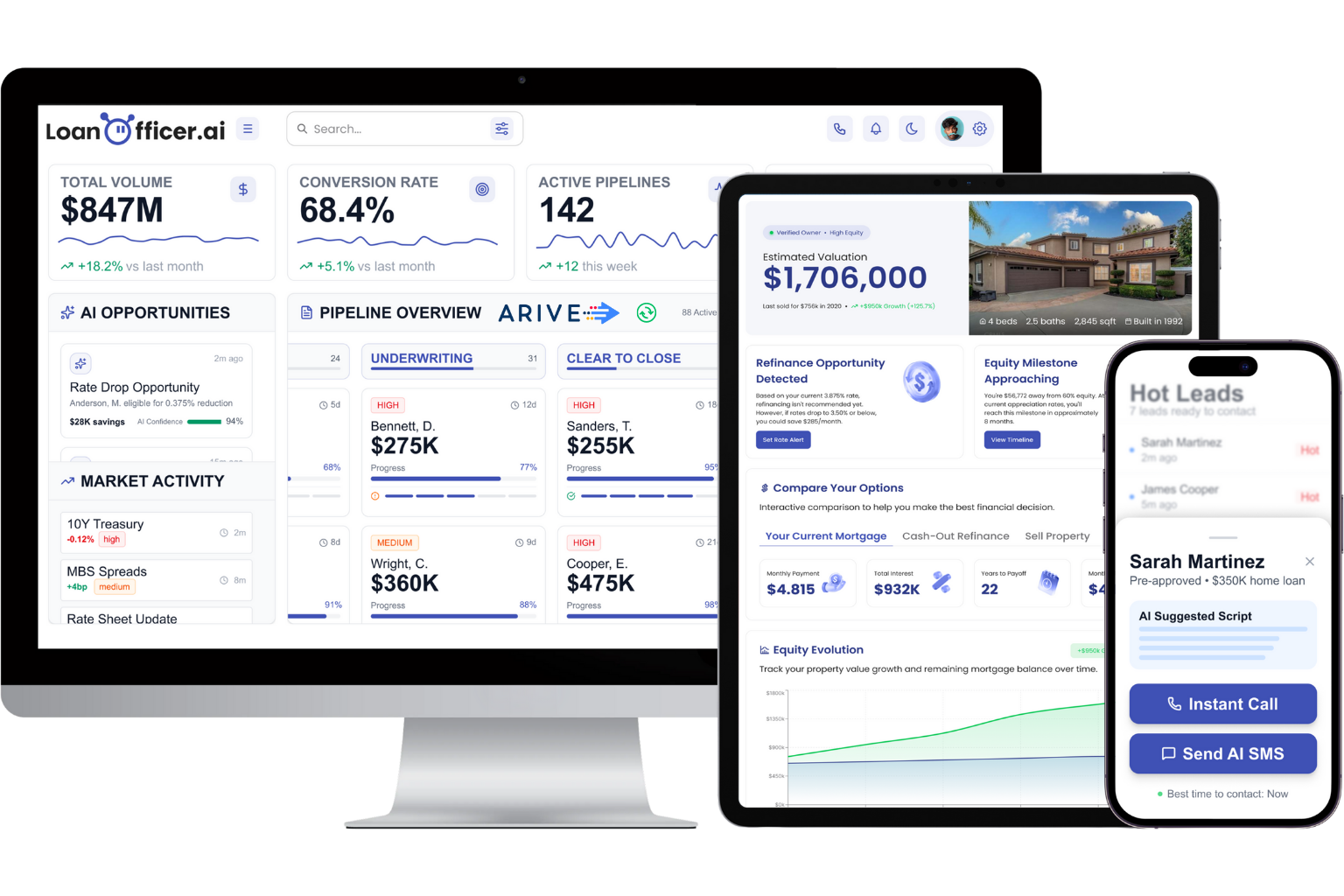
For database and equity outreach, Property Pulse monitors rates and flags refinance and HELOC opportunities among your past borrowers, giving you a real reason to call them and a reason to message agents. If you are just starting to build a pipeline, see how this works for new loan officers, or look at what we offer Realtor partners and the loan officers who serve them. You can see how the plans fit on our pricing page.
Our perspective on follow-up
We talk to loan officers every week, and the pattern is consistent: they don’t lose agents because they’re bad at the job, they lose them because the follow-up slipped. An agent sends a buyer, the loan officer is buried in a closing, the borrower waits a day, and the agent quietly stops sending referrals. Nobody complains. It just ends.
That is why we build around speed and consistency. The first reply to a lead, the second touch to an agent and the check-in after closing are the moments that decide who gets the next referral, and they are exactly the moments a busy person misses. We think software should catch those and leave you free to do the part only you can do: the call that sounds like a person who cares about the deal.
We also think restraint is a feature. More touches don’t make better relationships. The right touch to the right person at the right time does. Ask permission, send something useful, and let the agent set the pace.
— Jared Hart
FAQ
How soon should I follow up after meeting a Realtor?
Send a short note the same day or the next morning, and include whatever you promised in conversation. A fast, specific follow-up shows how you’ll handle their clients. If you wait a week, most of the goodwill from the meeting has faded.
How often should I contact a Realtor who sent me a referral?
During a live loan, update the agent on a fixed day each week, and contact them sooner if something changes, such as an appraisal issue or a delayed document. Between deals, ask the agent how often they want to hear from you. Monthly or less is a safe default.
What should I do if a Realtor doesn’t respond?
Move them to a lighter cadence instead of sending more messages. Inman warns that repeated unsolicited contact can overwhelm agents, so try a quarterly resource, then one direct call to ask how they’d prefer to stay in touch. If there’s still no reply, put your energy into agents who engage.
Should I text or email Realtors?
Ask them. Texts suit quick questions and status updates, and email suits resources an agent might forward to a client. Note each agent’s preference when you learn it and use that channel from then on.
Start following up without the busywork
If you want agents and borrowers to hear from you at the right moment every time, try LoanOfficer.ai for $1 for 14 days. Start your 14-day trial for $1 and see how automated follow-up fits your week.
Sources
- 8 Things Mortgage Lenders Do That Frustrate Real Estate Agents (Inman)
- Listing Agent Playbook (Embrace Home Loans)
- Realtor Guide 2024 (Colorado Lending Team)
- Lender networking tips (Zillow)
